Table of Contents
History of Buddhism
Buddhism’s starting point is genuinely unclear. Historians generally land somewhere in the 5th or 6th century BCE, somewhere in what we now call northeastern India, but nobody has a firm date that settles the argument.
The society Siddhartha Gautama was born into was heavily stratified. Brahmin priests sat at the top and controlled religious life entirely. The caste you came from decided your place in society and that place did not change. Siddhartha’s family had no such problems. His father led the Shakya clan in Lumbini, a settlement in what is now southern Nepal. The family was Kshatriya, the warrior ruling class. He was probably born around 563 BCE. At around 16 he married Yashodhara and later had a son named Rahula. His father deliberately kept suffering out of his sight for decades.
At 29 he went outside the palace walls a few times. He saw an old man, a sick man, a corpse, and a wandering monk who owned nothing but seemed completely at ease with that. These four encounters unsettled him enough that he left home that same night. He walked away from Yashodhara, from Rahula, from the clan, from everything his father had built around him.
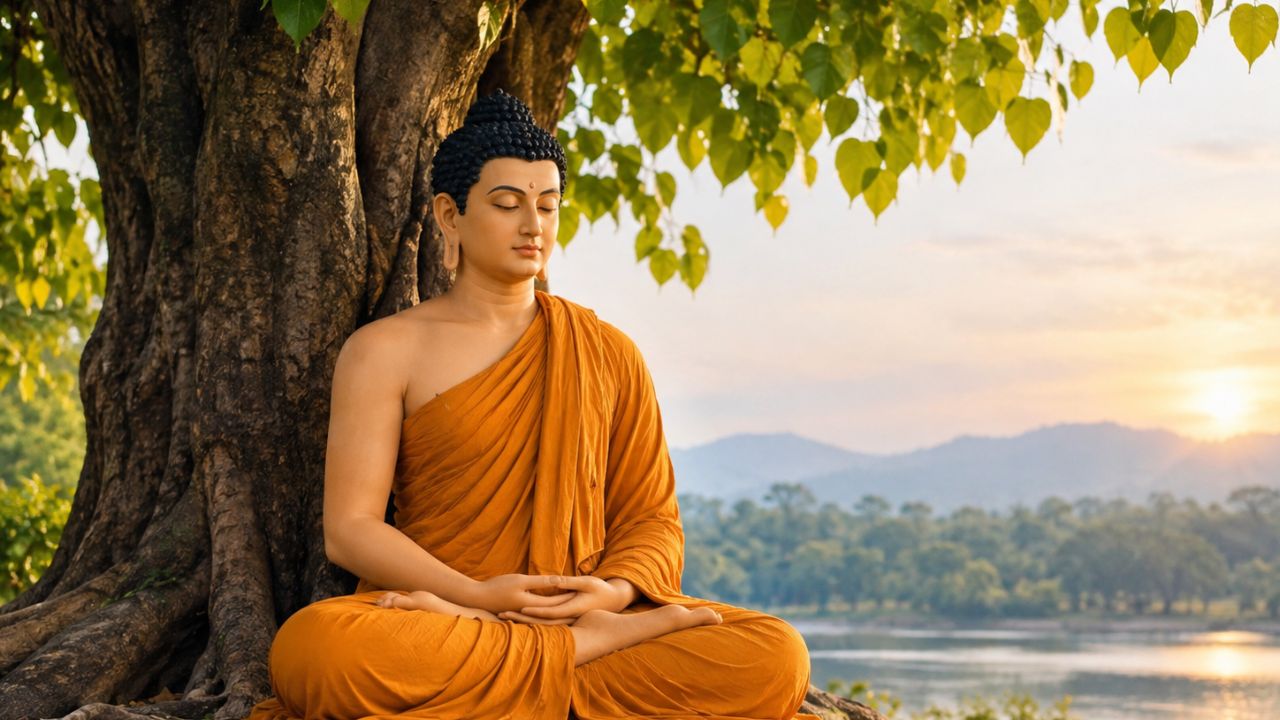
He spent six years with five monks in northeastern India practicing severe fasting and physical austerity. Nothing came of it. He quit, accepted a meal from a woman named Sujata near Bodh Gaya, sat under a fig tree and stayed there. That was around 528 BCE and he was 35 at the time.
He went to Sarnath afterward, just north of Varanasi, and taught those same five monks what he had figured out. Four things. Suffering is real. It has a source. The source can be eliminated. There is a path that does it. These four points became the base that every subsequent school of Buddhism, in every country it reached, worked from.
After Sarnath he kept going for another 45 years. Towns, villages, forests, riverbanks across northeastern India. He died somewhere near Kushinagar. The year was around 483 BCE and he was about 80 at that point.
The monks who had spent years traveling with him didn’t scatter after that. They pulled together, formed what became known as the Sangha, and made sure his teachings got written down and passed on.
Getting Buddhism out of India wasn’t quick. It took centuries and a lot of help from people in power. The most important early figure in that process was Emperor Ashoka. He built the Mauryan Empire into one of the largest in ancient history and ruled it from around 268 to 232 BCE. At some point he became personally committed to Buddhist principles and started sending monks outward as missionaries. His own son Mahinda made the trip to Sri Lanka, and that turned out to be one of the more consequential missionary journeys in religious history. Theravada Buddhism put down roots there that never came loose. Sri Lanka, Thailand, Myanmar, Cambodia and Laos all still practice it as their primary tradition.
The path into East Asia was different. Traders and merchants moving along the old Silk Road routes brought Buddhist ideas into China gradually, somewhere around the 1st century CE. It didn’t arrive as a formal mission. It came in pieces, through conversations and texts carried along trade routes, and then slowly became something the Chinese court took seriously. Tibet’s encounter with Buddhism came through political channels. King Srong-brtsan-sgam-po brought it in during his reign around the 7th century CE, backed by royal authority. Korea received it from China in the 4th century CE. Japan got it from Korea in the 6th century CE. Japanese rulers at first found it useful as a kind of state protection, a spiritual force that could guard the country. That framing didn’t last. Over time it moved well beyond the court and into everyday life across Japanese society.
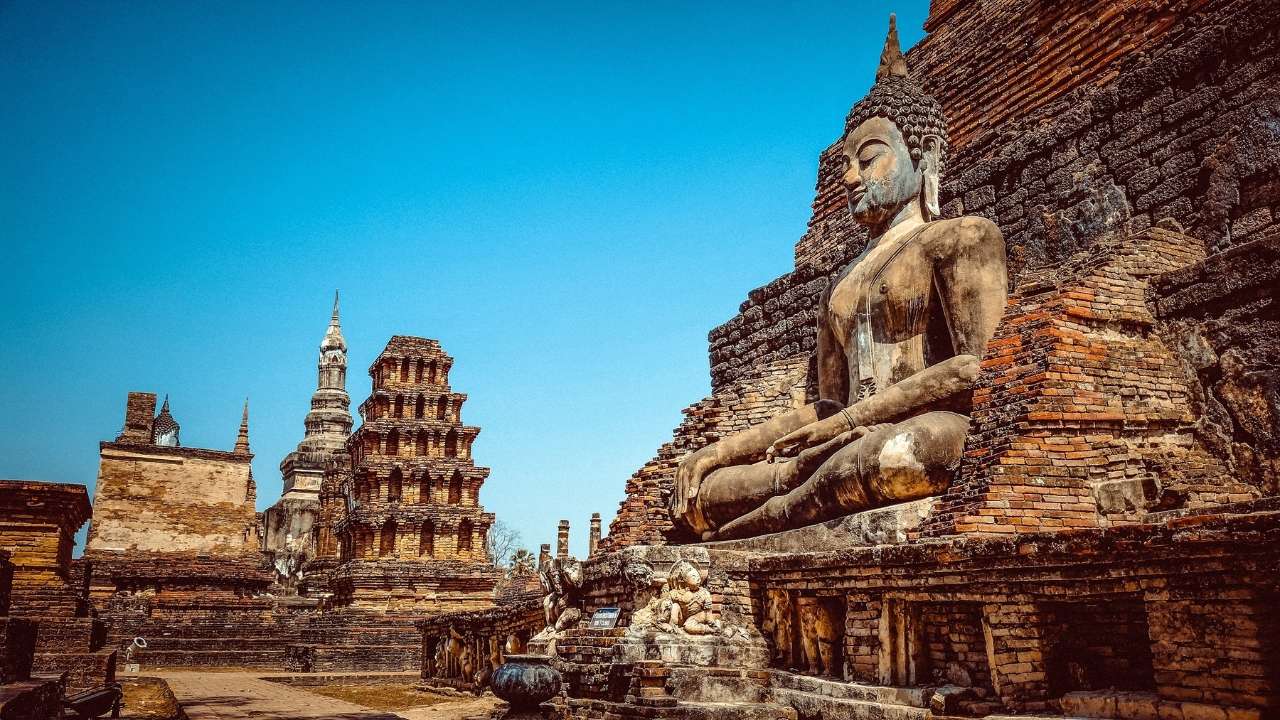
| Religion Name | Buddhism |
| Founder | Siddhartha Gautama (Gautama Buddha) |
| Founder Born | Approximately 563 BCE — Lumbini, present-day Nepal |
| Founder Died | Approximately 483 BCE (approx.) — Kushinagar, ancient India; age ~80 |
| Place of Origin | Northeastern India — Ganges River Valley region |
| Date Founded | Approximately 5th–6th century BCE (approx.) |
| First Sermon Location | Deer Park, Sarnath — north of Varanasi, India (~528 BCE) |
| Enlightenment Site | Bodh Gaya, Bihar, India — under the Bodhi tree (~528 BCE ) |
| Type | World Religion / Nontheistic Spiritual Philosophy |
| Sacred Languages | Pali (Theravada) and Sanskrit (Mahayana, Vajrayana) |
| Core Teachings | Four Noble Truths, Eightfold Path, Middle Way, Karma, Samsara, Nirvana |
| Three Main Branches | Theravada, Mahayana, Vajrayana |
| Sacred Texts | Pali Tipitaka, Mahayana Sutras, Tibetan Bka’-‘gyur |
| Total Followers | 343 to 506 million (est.) worldwide |
| Global Ranking | 4th largest religion in the world |
| Buddhist Majority Countries | Thailand, Cambodia, Myanmar, Bhutan, Sri Lanka, Japan |
| Current Leader (Tibetan) | 14th Dalai Lama — Tenzin Gyatso (born 1935); exiled in Dharamshala, India since 1959 |
| Key UNESCO Sites | Lumbini (1997), Bodh Gaya — Mahabodhi Temple (2002), Sanchi (1989) |
| Notable Emperor | Ashoka the Great (~268–232 BCE) — spread Buddhism across Asia |
What is the history of Buddhism?
Buddhism is a world religion founded by Siddhartha Gautama known as the Buddha — in northeastern India approximately in the 5th century BCE. Born a prince in present-day Nepal, he renounced wealth, attained enlightenment, and spent 45 years teaching the Four Noble Truths. Today Buddhism has an estimated 343 to 506 million followers worldwide.
China was already a deeply Daoist country when Buddhism arrived. The two didn’t stay separate for long. Buddhist teachers borrowed Daoist vocabulary to explain ideas that had no Chinese equivalent. Daoist thinkers picked up Buddhist concepts and worked them into their own framework. After a few centuries of this back and forth, the line between them in everyday Chinese religious life got genuinely blurry. What Buddhism looked like in China by the Tang dynasty had very little in common with what it looked like in Sri Lanka at the same time. Same thing happened everywhere else. The Buddhism that took root in each country grew out of local soil as much as Indian soil.
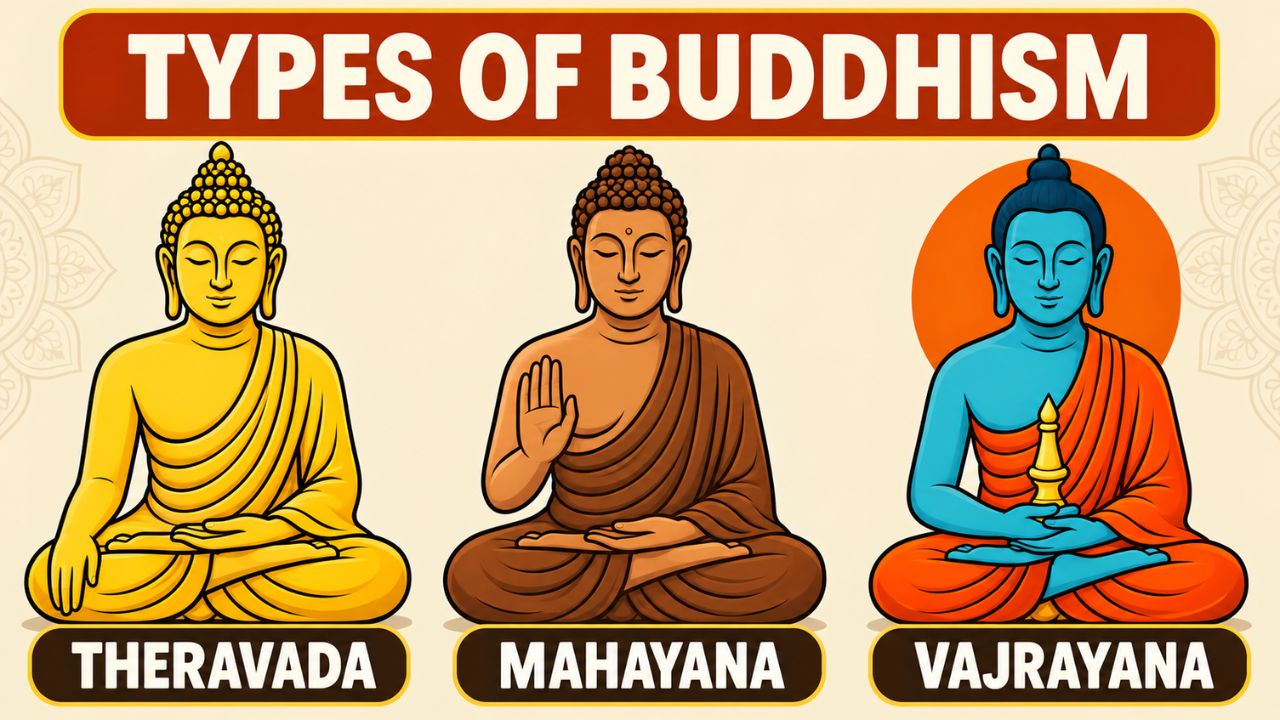
People broadly sort today’s Buddhist traditions into three groups. The first is Theravada. It’s the oldest continuous school, the one that stayed closest to the Pali canon, which are the earliest texts written down after the Buddha died. Theravada puts the monk at the center. Personal discipline, individual practice, working toward your own liberation through your own effort. That model dominated Sri Lanka, Thailand, Myanmar, Cambodia and Laos and still does.
Mahayana started pushing back against that model sometime around the 1st century CE. Its argument was that liberation shouldn’t be something only monks had access to. Lay people mattered too. That shift opened things up considerably and Mahayana spread fast, moving through China, Vietnam, Korea and Japan. As it traveled it kept producing new schools. Zen grew out of it, built almost entirely around meditation and direct experience, deliberately skeptical of too much reliance on scripture. Pure Land grew out of it too, took a completely different direction, centered practice on devotion to a figure called Amitabha Buddha and the goal of rebirth in a purified realm rather than liberation in this life.
Vajrayana came out of Mahayana but ended up looking quite distinct. It brought in tantric ritual, esoteric instruction passed directly from teacher to student, and a system of recognized reincarnated teachers called tulkus. Tibet took to it completely. So did Mongolia. The Dalai Lama institution, which has functioned as the central religious authority in Tibetan Buddhism since the 1600s, sits inside this tradition.
Between 343 and 506 million people practice Buddhism today. It ranks fourth among world religions by number of followers.
Origins of Buddhism — Where and When Did It Begin?
No one pinned down an exact date for when Buddhism started. Historians put it roughly in the 5th or 6th century BCE, in what is now northeastern India. That much is agreed on. Everything else gets argued about.
The geography is clearer. Buddhism grew out of the Ganges River Valley, in the stretch of land running along what is today the border between India and Nepal. This wasn’t a prosperous region. The river flooded annually and took the crops with it. When monsoons came they brought short relief and then hunger. Cholera moved through villages. Dysentery was common. For most people living there, life was physically difficult in ways that didn’t change much from one generation to the next.
The Geographic and Cultural Roots
Kapilavastu and Lumbini both sat in the foothills of the Himalayas, in territory that now belongs to Nepal. These weren’t major cities. They were part of a patchwork of small kingdoms and tribal republics that had started coming apart. Old clan structures that once held communities together were losing their grip as larger kingdoms expanded and absorbed smaller ones. The political ground was shifting under people’s feet at the same time that the physical conditions of life were already hard.
Religiously things were equally unsettled. The Brahmin tradition had the most authority across the region, built on Vedic texts, fire rituals and a priestly class that decided who had access to the sacred and who didn’t. But several other movements were already active and drawing followers. The Jains were teaching that the human soul was weighed down by matter and needed to be progressively freed from it. The Ajivikas held that fate determined everything and personal effort was essentially meaningless. Wandering skeptics and materialists passed through the same towns. Teachers with completely opposing ideas sometimes ended up in the same marketplace.
The concepts that Buddhism would later use weren’t new either. Samsara, the endless wheel of death and rebirth, was already part of how most people in the region understood existence. Karma, the idea that what you do in this life shapes what comes next, circulated widely. Nirvana as some form of release from the cycle had been discussed in various traditions before Siddhartha ever sat under a tree. Buddhism picked up this shared vocabulary and built something specific with it, a structured path centered on understanding suffering and moving through it.
The Social and Religious Climate That Gave Rise to Buddhism
The Brahmin class had sat at the top of Indian society for centuries and showed no signs of moving. Their position rested entirely on their function as ritual specialists. Fire sacrifices, Vedic recitations, ceremonies marking births and deaths and harvests, all of it required a Brahmin. They conducted these rituals in Sanskrit, which the vast majority of people in the region couldn’t follow. That wasn’t an accident. Keeping the sacred language inaccessible kept the priesthood necessary.
The caste structure underneath them was rigid. Brahmins at the top, then Kshatriya warriors and rulers, then the merchant class, then laborers. Outside these four groups were people the system didn’t formally recognize at all. Nobody moved between levels. The family you came from was the ceiling you lived under your entire life, and religious teaching generally supported that arrangement rather than questioning it.
For anyone outside the Brahmin and Kshatriya classes, the dominant religious tradition had almost nothing practical to offer. Rituals cost money and required specialists. The big spiritual questions, why do people suffer, what happens after death, is there any way to change your situation, didn’t have answers available to ordinary people in ordinary language. That gap was real and people felt it.
Northeastern India had less exposure to Vedic orthodoxy than the western and northwestern parts of the subcontinent. That made it more open to new ideas. Several teachers in this period built followings by addressing suffering directly, speaking plainly, and not requiring a priestly go-between. Buddhism fit that pattern. It came with a teacher who talked to farmers and merchants and outcasts in language they understood. It came with a community, the Sangha, that didn’t sort people by birth. And it came with a set of ideas that anyone could actually work with. That combination traveled fast.
Founder of Buddhism — Who Was the Buddha?
Siddhartha Gautama is the person Buddhism comes from. Born around 563 BCE in Lumbini, which today sits inside southern Nepal, he came from the Shakya clan, a Kshatriya ruling family. His life broke into three very unequal parts. Roughly 29 years of complete comfort. Six years of self-imposed suffering. Then 45 years of teaching.

Early Life of Siddhartha Gautama
His father ran the Shakya clan and had specific ideas about how his son’s life should go. The household Siddhartha grew up in kept anything difficult well out of reach. No sick people. No poverty visible from the windows. No funerals, no old men bent under their years. His father arranged this deliberately and maintained it for nearly three decades.
At around 16 he married a woman named Yashodhara. They had one son together, named Rahula. By his late twenties he had a family, a position, and no obvious reason to leave any of it behind.
Then he started taking rides outside the palace. On separate trips he encountered four things his father had spent decades keeping out of his sight. An old man, bent and struggling. A person visibly sick and in pain. A corpse being carried through the street. And finally a wandering monk who had nothing material but carried himself with a steadiness that none of the other three had. These four sights didn’t leave him. He left home that night, walked away from Yashodhara, from Rahula, from the Shakya clan and everything attached to it, and didn’t go back.
The Spiritual Quest and Path to Enlightenment
What followed was six years of searching. He joined five monks and practiced extreme asceticism in northeastern India. They fasted heavily. They pushed their bodies as far as they would go. Siddhartha’s physical condition deteriorated seriously. At the end of those six years he had no more answers than when he started.
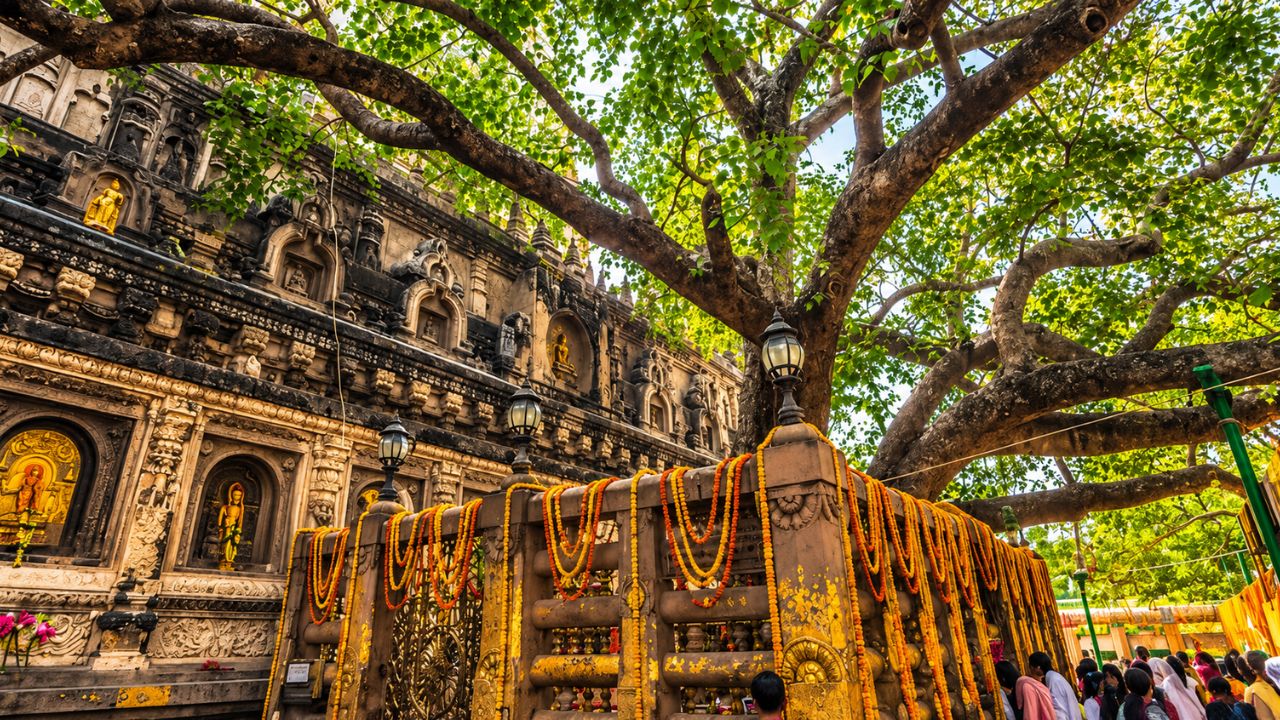
He concluded that the approach was wrong. Punishing the body wasn’t the path any more than indulging it had been. Near a town called Bodh Gaya, in what is now the state of Bihar, a woman named Sujata gave him food. He ate it. Then he walked to a large fig tree nearby, sat down beneath it, and decided he wasn’t leaving until he had an actual answer. Buddhists call that tree the Bodhi tree. The ground under it became one of the most significant locations in religious history.
What he encountered during that stretch of meditation, Buddhist tradition describes as Mara. Not a physical opponent. Something more like the full weight of temptation, fear and attachment bearing down on a mind that was trying to get free of all three. Mara came at him with desire, with threats, with visions of everything he had left behind. He sat through it.
That was around 528 BCE. He was 35. The man who got up from under that tree went by a different name from that point on. Buddha. In Sanskrit the word means the awakened one, or the enlightened one. It wasn’t a title he claimed for himself. It was a description that stuck because of what came next.
The Middle Way - Buddha’s Core Discovery
The principle he arrived at wasn’t dramatic on the surface. He called it the Middle Way. Don’t pursue sensory pleasure and worldly comfort. Don’t punish yourself with extreme physical austerity either. The path runs between those two extremes and requires neither wealth nor deprivation to walk.
This sounds simple. But it came from someone who had actually lived both extremes, the palace and the forest, and found that neither one led anywhere useful. The Middle Way wasn’t a philosophical position he reasoned his way toward. It was a conclusion drawn from direct experience of what didn’t work.
His first audience after Bodh Gaya was those same five monks he had walked away from when he gave up fasting. He found them at Deer Park in Sarnath, just north of Varanasi. What he taught them there became the structural foundation of everything Buddhism would eventually include. The Four Noble Truths. The Eightfold Path. The relationship between karma and rebirth. What nirvana actually meant and didn’t mean. Those five men became the first members of the Sangha, the monastic community that carried the teaching forward after he was gone.
He didn’t stop at Sarnath. He kept going for another 45 years, moving through towns and communities across northeastern India. He set up formal orders for monks and separately for nuns, the latter coming after some initial resistance and a request made by his aunt Mahapajapati. He built a community large enough and organized enough to outlast him.
He died near a place called Kushinagar around 483 BCE. He was somewhere around 80 years old. His body was cremated, which was the standard practice for someone of his standing, and his remains were divided up and sent to different locations. Stupas were built over these relics across the region and people began making journeys to visit them. Several of those sites still draw visitors today.
Buddhism Origin Story - The Narrative Behind the Faith
The story of Buddhism doesn’t start with a religion. It starts with a man who couldn’t sleep in his palace anymore.
Siddhartha Gautama had everything his father had arranged for him. A royal household in Lumbini. A wife named Yashodhara. A newborn son named Rahula. A clan that respected his family and a future that required nothing difficult from him. His father had spent nearly three decades making sure the world’s harder edges never reached his son. For a long time it worked.
Then it didn’t.
The Four Sights That Changed Everything
He was around 29 when he started going outside. Not far. Just beyond the palace walls, on chariot rides through the surrounding area. What he saw on those trips had been there his whole life. He just hadn’t been allowed to see it.
The first was an old man. Bent forward, struggling to walk, his body visibly worn down by decades of living. Siddhartha had never seen a person in that condition. He asked his charioteer what had happened to the man. The answer was that nothing had happened to him specifically. That’s just what age does. To everyone.
The second was a sick man. Feverish, weak, unable to care for himself. Again Siddhartha asked and again the answer was the same. Sickness comes for everyone. There’s no household it skips.
The third was a corpse. A dead body being carried through the street, surrounded by grieving people. His charioteer told him death was not an exception. It was the end of every life without exception.
The fourth sight was different. A wandering monk, moving through the same street as all that suffering, carrying nothing and looking somehow unbothered by everything around him. Not happy exactly. Just settled. Like someone who had made peace with something the rest of the world was still fighting.
These four encounters hit Siddhartha in a way that nothing in his palace had ever managed. The comfort his father had built around him suddenly had no weight. He had a wife, a son, a clan, a future. And none of it addressed what he had just seen. He left that same night. Walked out of the palace, left his family behind, and didn’t go back.
Buddhist tradition records a verse attributed to him from this period. He is said to have described the moment of leaving as a kind of breaking free, though what exactly he said varies across different textual traditions. What the texts agree on is that the decision was immediate and total.
The Night of Enlightenment - Bodhi Tree Story
Six years passed between leaving the palace and sitting under the Bodhi tree. Six years of extreme fasting with five other monks somewhere in northeastern India, pushing the body to see if suffering through it would produce answers. It didn’t. Siddhartha’s body suffered considerably but his understanding didn’t deepen in any way that felt meaningful.
He gave it up. Accepted a meal from a woman named Sujata. And walked to Bodh Gaya, a location in what is now the state of Bihar in northeastern India, sometimes described in older texts as west-central India. He found a large fig tree, which his tradition would later call the Bodhi tree, and sat down under it. He made a vow not to get up until something real had become clear to him.
What followed, Buddhist tradition describes through the figure of Mara. Mara is usually translated as a demon or an evil force, but the more useful way to understand it is as everything inside a human mind that resists clarity. Desire for the things left behind. Fear of what full understanding might require. Doubt about whether any of this was worth it. Mara came at Siddhartha with all of these, sometimes described as armies, sometimes as beautiful visions, sometimes as direct challenges to his right to be sitting there at all.
He didn’t move.
At some point during that night, around 528 BCE, something shifted. What he arrived at wasn’t a vision or a message from outside himself. It was an understanding. He saw clearly how suffering worked, where it came from, and what the path away from it actually looked like. This moment is what Buddhists call bodhi, which simply means awakening. The tree he sat under has carried that name ever since.
Bodh Gaya today is a functioning pilgrimage site. The Mahabodhi Temple complex there was designated a UNESCO World Heritage Site. The tree currently growing at the site is considered a descendant of the original. Monks, nuns and lay Buddhists from dozens of countries visit it every year.
This moment under the Bodhi tree is treated across Buddhist traditions as the actual origin point of Buddhism as a teaching. Not his birth. Not his renunciation. The night he understood something well enough to spend the rest of his life explaining it to other people.
Core Teachings Born From That Night
What Siddhartha worked out under the Bodhi tree came down to four connected observations. He called them the Four Noble Truths and they became the foundation every school of Buddhism has built from since.
The first is Dukkha. Life involves suffering. Not occasionally. Consistently. Even pleasant experiences carry an undertone of unsatisfactoriness because they don’t last and we know they won’t. Dukkha isn’t just pain. It’s the pervasive sense that something is off, that existence as most people experience it is not quite right.
The second is Samudaya. Suffering has a cause. That cause is craving. Specifically the craving for things to be permanent when they aren’t, for experiences to last when they won’t, for a fixed self to exist when that’s not actually how things work. Craving drives the cycle of rebirth that keeps beings moving through existence without resolution.
The third is Nirodha. The craving can stop. This is the part that makes Buddhism something other than just a description of how bad things are. Suffering isn’t inevitable in some absolute sense. Its cause can be removed. The cycle can end.
The fourth is Magga. There is a specific path for ending it. That path is the Eightfold Path, the practical framework Siddhartha laid out at his first teaching in Sarnath.
The Eightfold Path covers eight areas of practice. Right understanding, which means seeing things as they actually are rather than through the filter of craving and aversion. Right intention, which means orienting the mind toward letting go rather than grasping. Right speech, meaning honest and careful use of language. Right action, which covers the basic ethical precepts around not harming, not stealing, not lying. Right livelihood, meaning how you earn your living shouldn’t involve harming others. Right effort, which is the ongoing work of keeping the mind moving in a useful direction. Right mindfulness, meaning sustained attention to what is actually happening in the body and mind moment to moment. And right concentration, the development of meditative states that allow the mind to become genuinely still and clear.
These eight aren’t meant to be followed in sequence. They work together and reinforce each other.
Running underneath all of this is the concept of karma and samsara. Karma is the principle that intentional actions carry consequences, not as a cosmic punishment system but as a simple law of cause and effect. What you do shapes what comes next, in this life and across future lives. Samsara is the cycle itself, the wheel of rebirth that keeps beings moving through existence driven by craving and karma. The goal of Buddhist practice is to understand this cycle clearly enough to step outside it.
Nirvana is what stepping outside it looks like. The word in Pali means something like blowing out, like a flame going out when there’s nothing left to feed it. But nirvana isn’t annihilation or nothingness. It’s the end of craving. The end of the cycle. What remains after that, Buddhist teachers across traditions have generally said, can’t be described adequately in language built for describing ordinary experience. What can be said is that it’s not nothing, and it’s not more of the same.
The Three Jewels pull these ideas into a single framework that Buddhists across all traditions take refuge in. The Buddha, meaning the historical teacher and the principle of awakening itself. The Dharma, meaning the teaching, the body of understanding he worked out and spent 45 years communicating. And the Sangha, the community of practitioners, originally the monks and nuns, later extended to include all serious practitioners. Taking refuge in the Three Jewels is the basic act that marks someone as a Buddhist. It’s done at the beginning of most formal Buddhist ceremonies and it connects practitioners across centuries and traditions back to that night in Bodh Gaya when one person sat under a tree and didn’t move until something became clear.
History and Development of Buddhism - How It Grew and Spread
Buddhism didn’t come with a headquarters or an institution behind it. When Siddhartha Gautama died around 483 BCE near Kushinagar, what he left behind was a community of monks, a body of teaching that existed entirely in human memory, and no designated person to take over. What happened next is one of the more remarkable organizational stories in religious history.

Buddhism in Ancient India - From Teachings to Institution
The monks who had traveled with the Buddha during his 45 years of teaching had memorized his words carefully. That was the practice. You listened, you repeated, you committed it to memory, and you passed it on the same way. After his death they gathered to do this collectively, to agree on what had actually been said and make sure nothing got lost or altered in transmission. This gathering is remembered as the First Buddhist Council, held shortly after the Buddha’s death, where senior monks recited the teachings aloud and the assembled community confirmed them.
A second council followed roughly a century later, around 383 BCE, at Vaishali. By then disagreements had already started to develop about how certain rules should be interpreted. The Council of Vaishali tried to settle some of these disputes, with limited success. The community that came out of it was already beginning to divide into different schools with different positions on doctrine and monastic discipline.
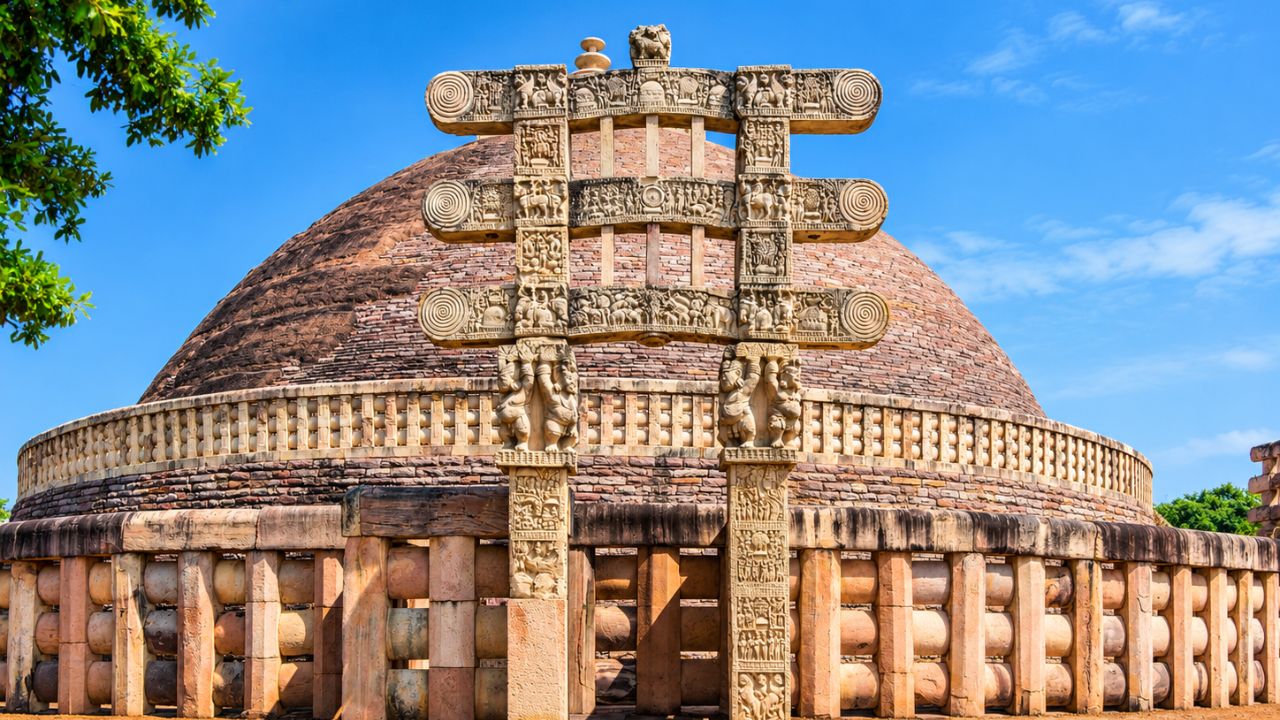
While these organizational developments were happening, physical structures were going up across northern India. Stupas, domed monuments built to house relics of the Buddha or other significant teachers, began appearing as early as the 3rd century BCE. The great stupas at Bharhut and Sanchi are among the oldest surviving examples of Buddhist architecture anywhere. Monasteries grew up around them. Pilgrimage routes connected the major sites.
The teachings themselves remained oral for several centuries. The Pali Tipitaka, the earliest complete written collection of Buddhist scripture, wasn’t committed to writing until around the 1st century BCE, in Sri Lanka. Before that the teaching lived in the memories of monks who had trained specifically to carry it.
Emperor Ashoka and Buddhism’s First Global Spread
The single most important political event in early Buddhist history happened in the 3rd century BCE when the Mauryan emperor Ashoka decided to make Buddhism central to how he governed. Ashoka ruled from roughly 268 to 232 BCE over one of the largest empires ancient India had seen, stretching from the Himalayas in the north down toward Sri Lanka in the south.
He hadn’t always been the ruler Buddhism remembers. Earlier in his reign he had fought a particularly brutal war against the kingdom of Kalinga. The scale of the killing affected him seriously. He turned toward Buddhist principles afterward and spent the rest of his rule trying to govern according to them.
He had pillars and rock edicts erected across his empire, carved with instructions about ethical conduct, religious tolerance and the welfare of his subjects. These are the oldest surviving Buddhist inscriptions. They’re still standing in several locations across India and Nepal. He sent missionaries outward in multiple directions, including to the border regions near Greece in the west and to Sri Lanka in the south. His son Mahinda made the journey to Sri Lanka personally. That mission planted Theravada Buddhism there so firmly it never left.
Ashoka became known in Buddhist memory as the Dharmaraja, the righteous king, the ruler who governed according to the Buddha’s teaching rather than just using it for political decoration. Later Buddhist kingdoms across Asia looked to his model when deciding how a Buddhist state should function.
The educational institution that grew to represent Indian Buddhism at its intellectual height came later. Nalanda Mahavihara, built in Bihar, became the most significant center of Buddhist learning in the ancient world. Scholars came to it from China, Southeast Asia and Central Asia. It held enormous libraries, taught subjects well beyond Buddhist doctrine, and produced some of the most important philosophical work in Buddhist history. It functioned for centuries before being destroyed during the Muslim invasions of the 12th century.
Buddhism’s Journey Across Asia
Getting out of India took time and moved along different routes in different directions. Sri Lanka received it earliest, during Ashoka’s reign in the 3rd century BCE, largely through Mahinda’s mission. The island became a Theravada stronghold and eventually the place where the Pali canon was first written down. That written canon became the authoritative text for Theravada communities across Southeast Asia for centuries afterward.
Central Asia came next, through the trade routes that connected northwestern India to China. Merchants, monks and texts moved along these roads from around the 1st century CE onward. The oasis towns of Central Asia became stopping points where Buddhist monasteries established themselves and where travelers from east and west exchanged ideas and manuscripts.
China received Buddhism gradually through those same routes, also around the 1st century CE. It didn’t arrive with an official mission or a royal invitation. It came in through traders and travelers, settled quietly in communities along the trade routes, and slowly attracted enough interest that the Chinese court began to take notice. Buddhism’s early growth in China was helped by the way its ideas about impermanence and detachment mapped onto concepts already present in Daoism. Chinese translators worked for centuries to render Buddhist texts into Chinese, a task that required not just linguistic skill but philosophical judgment about how to carry concepts across between very different systems of thought.
The Tang dynasty, which ran from 618 to 907 CE, is remembered as Chinese Buddhism’s high point. Imperial support funded monasteries, sponsored translation projects and elevated Buddhist institutions to a position of considerable influence. Then in 845 CE the emperor Wuzong turned against it. He ordered the destruction of Buddhist institutions across the empire. Around 4,600 temples were destroyed. Roughly 40,000 smaller shrines were torn down. More than 260,000 monks and nuns were forced back into lay life. Buddhism in China never fully recovered to its Tang dynasty scale, though it continued and still exists there today.
Korea received Buddhism from China in the 4th century CE, when it was divided into three separate kingdoms. Each kingdom encountered it at a slightly different time and the religion spread differently through each one. After the peninsula unified under the Silla kingdom in the 660s, Buddhism became more uniformly established.
Japan got it from Korea in the 6th century CE. Prince Shotoku, who became regent in 593 CE, was its most important early champion. He promoted Buddhist principles alongside Confucian ideas in his administrative reforms, wrote a constitution that drew on both, and built temples that are still standing. Japanese rulers initially valued Buddhism partly for its perceived protective power over the state.
Tibet received it in the 7th century CE during the reign of King Srong-brtsan-sgam-po. The king had two Buddhist queens, one Nepalese and one Chinese, and both are credited in Tibetan tradition with bringing Buddhist images and texts into the country. A second major wave of Buddhist influence came in the 11th century when the Indian master Atisa arrived and helped consolidate the tradition.
Southeast Asia developed its own relationship with Buddhism across several centuries. Thailand, Myanmar, Cambodia and Laos all became predominantly Theravada over time, drawing from both Indian and Sri Lankan sources. The tradition in these countries stayed closely connected to the Pali canon and maintained strong monastic institutions that are still central to public life in those countries today.
The Three Main Branches of Buddhism
Three broad schools cover most of what exists today, though within each school there are further divisions that sometimes look quite different from each other.
Theravada, whose name means Way of the Elders, is the oldest surviving school. It works from the Pali canon and stays closest to what can be reconstructed of the Buddha’s earliest teaching. Its central figure is the arhat, the individual who achieves liberation through their own disciplined practice. Monastic life is the center of Theravada communities. Monks maintain a strict code of conduct, rely on lay people for material support, and in return offer teaching, ritual services and a model of practice. Theravada dominates Sri Lanka, Thailand, Myanmar, Cambodia and Laos.
Mahayana, the Greater Vehicle, began taking shape around the 1st century CE and argued that the arhat ideal was too narrow. The goal it put forward was the bodhisattva, a being who works toward full Buddhahood not just for their own liberation but in order to help all sentient beings find their way out of suffering. This shift opened Buddhism considerably. Salvation wasn’t just for monks working through a lifetime of disciplined practice. It was available to everyone and the bodhisattvas were actively working to make it so. Mahayana spread through China, Japan, Korea, Vietnam and Taiwan and kept producing new schools as it went. Zen developed out of it, centering practice on meditation and direct experience. Pure Land developed out of it too, centering practice on devotion to Amitabha Buddha. Tiantai developed a comprehensive philosophical system that tried to organize all of Buddhist teaching into a single coherent framework.
Vajrayana grew from Mahayana but developed its own distinctive character. It brought in tantric methods, ritual practices and a system of esoteric transmission that required a qualified teacher to pass on directly. The tradition holds that these methods can accelerate the path to enlightenment considerably, which is why they require careful guidance rather than independent study. Vajrayana took deepest root in Tibet, Nepal, Mongolia and Bhutan. The Dalai Lama lineage, which has served as the central institution of Tibetan Buddhism since the 17th century, belongs to the Gelug school within the Vajrayana tradition. The current Dalai Lama, Tenzin Gyatso, was born in 1935 and has lived in exile in Dharamshala, India since China’s takeover of Tibet in 1959.
Buddhism’s Decline in India and Modern Revival
The country where Buddhism started is also the country where it came closest to disappearing entirely.
The first serious damage came in the 6th century CE when Hunnic invasions swept through northern India. Monasteries were targeted and destroyed. The institutional structures that had supported Buddhist learning and practice for centuries were badly disrupted. Buddhism recovered partially under the Pala dynasty, which ruled in northeastern India from the 8th to the 12th century and actively patronized Buddhist institutions including Nalanda.
Then the Pala dynasty collapsed and the Muslim invasions of the 12th and 13th centuries finished what the Huns had started. Monasteries were sacked. Libraries burned. Monks fled or were killed. Nalanda, the greatest center of Buddhist learning in the ancient world, was destroyed around 1193 CE. Without the monasteries, Buddhism in India lost its institutional base. The lay community that might have preserved it had, over centuries of Buddhist success, become so connected to the monastic system that when the monasteries went, the broader community went with them.
By the 19th century Buddhism was effectively gone from India as a living tradition. A small number of communities in Bengal and Assam preserved fragments of the older tradition, but they were marginal. The religion had survived and flourished across the rest of Asia while nearly vanishing from the country that produced it.
Revival came from an unexpected direction. B.R. Ambedkar was one of the most significant political figures in 20th century India. He came from the Mahar community, one of the groups classified as Scheduled Castes, formerly called untouchables, at the bottom of the Hindu caste hierarchy. He had spent decades fighting caste discrimination through legal and political channels. In 1956 he concluded that Buddhism offered what Hinduism structurally could not, a religious framework that didn’t recognize caste distinctions at all.
In October 1956, at a ceremony in Nagpur, Ambedkar converted to Buddhism along with several hundred thousand people. The ceremony was followed by similar conversions across Maharashtra in the days and weeks that followed. Ambedkar died just weeks after the Nagpur ceremony, but the movement he started continued. Several million people in India today identify as Buddhist through this lineage, which is sometimes called Navayana or Ambedkarite Buddhism.
Nalanda University was re-established in 2014 in Bihar, near the site of the original institution. It operates as a modern international university with a focus on Asian studies and Buddhist scholarship.
Beyond India, the 20th and 21st centuries brought Buddhism steadily into the Western world. Japanese scholars including D.T. Suzuki introduced Zen to Western audiences in the early 20th century. Tibetan teachers who fled after 1959 established centers across Europe and North America. The mindfulness movement, which draws heavily from Buddhist meditation practice, became mainstream in Western healthcare and psychology during the late 20th and early 21st centuries. Between 343 and 506 million people identify as Buddhist today, across every continent, in traditions that range from Theravada monasteries in rural Thailand to Zen centers in American cities to Tibetan Buddhist communities in European capitals.
Personal Life of Siddhartha Gautama
Most of what is known about Siddhartha Gautama’s personal life comes from texts written centuries after he died. The broad outlines are consistent across traditions. The finer details vary. What follows reflects what the major textual traditions broadly agree on.
Family and Relationships
His mother was Maha Maya. She died shortly after his birth, within days according to most accounts. His father then married her sister, Mahapajapati, who raised Siddhartha from infancy. This made Mahapajapati both his aunt and his stepmother. She was the person who actually brought him up and the household he grew into was hers as much as his father’s.
He married Yashodhara when he was around 16. She came from a noble family and the match was appropriate to his clan’s standing. They had one child together, a son named Rahula. The name Rahula means fetter or bond in Pali, and some accounts suggest Siddhartha chose or noted that name deliberately, aware that his attachment to his son was one of the things binding him to the life he was already thinking about leaving.
When he left at 29 he left all three of them. Yashodhara, Rahula and Mahapajapati. He didn’t say goodbye. The accounts describe him looking at his sleeping wife and son one last time before walking out. He didn’t wake them.
Yashodhara’s life after that departure is recorded in several Buddhist texts. She is described as having understood, after some time, what her husband had gone to do. She and Rahula eventually both joined the Buddhist community. Rahula became a monk under his father’s teaching. Yashodhara became a nun. Buddhist tradition remembers her as one of the senior nuns of the early Sangha and credits her with significant spiritual attainment in her own right.
Mahapajapati’s story is separately significant. Years after Siddhartha had become the Buddha and established the monastic order for monks, she approached him and asked that women be allowed to ordain as nuns. He refused three times. His closest disciple Ananda then intervened on her behalf, arguing that women were equally capable of achieving liberation. The Buddha accepted this and established the order of nuns with Mahapajapati as its first member. The conditions he attached to women’s ordination placed the nuns’ community in a subordinate relationship to the monks’ community, a decision that has been debated within Buddhism ever since.
Ananda himself deserves a mention separately. He served as the Buddha’s personal attendant for the last 25 years of the Buddha’s life. He accompanied him everywhere, remembered everything he said, and was present for most of the major teaching occasions. At the First Buddhist Council, held after the Buddha’s death, it was Ananda who recited the discourses from memory. The sutras that begin with the phrase “thus have I heard” are attributed to his recollection. Without Ananda’s memory the teaching tradition would have looked considerably different.
Later Years and Legacy
After the first sermon at Sarnath the Buddha walked. For 45 years he moved through towns, villages and forest retreats across northeastern India. He taught farmers, merchants, kings and outcasts. He debated with priests and philosophers from other traditions. He established protocols for how the monastic community should function, settling disputes and laying down rules that governed everything from how monks should eat to how the community should handle a member who broke the code of conduct.
His final journey took him northward through a series of towns. He was around 80 and his health had been declining. At a place called Pava he ate a meal offered by a blacksmith named Cunda. Shortly afterward he became seriously ill. Most accounts identify the meal as the cause, though they disagree on exactly what was in it. He continued traveling despite the illness, walking toward Kushinagar.
He died in Kushinagar around 483 BCE, lying on his side between two sal trees. His last words, according to the Pali accounts, addressed his monks directly. He told them that all conditioned things are impermanent and urged them to work out their liberation with diligence. Then he passed through a sequence of meditative states and died.
His body was cremated with the honors due to a great king, according to the texts. The relics from the cremation were divided among eight clans and groups who had come to claim them. Stupas were built over these relics in different locations. These became the earliest Buddhist pilgrimage sites. The four places most associated with the key events of his life, Lumbini where he was born, Bodh Gaya where he attained enlightenment, Sarnath where he gave his first sermon, and Kushinagar where he died, became known as the Four Great Places and drew pilgrims from across the Buddhist world.
His personal philosophy, as it comes through in the texts, centered on a few consistent positions. He taught compassion toward all beings without exception. He taught non-violence as a basic principle of how to live. He taught mindfulness, meaning sustained careful attention to what is actually happening in experience, as a practical method rather than an abstract ideal. He was consistently skeptical of metaphysical speculation, of questions about the origin of the universe or what happens after death, on the grounds that answering them wouldn’t help anyone get free of suffering. He pointed back to the practical path every time those questions came up.
What he left behind wasn’t a church or a hierarchy or a fixed set of rules for all situations. It was a body of teaching, a community of practitioners, and a method. The community argued about the teaching for centuries. It still does. But the basic orientation he established, that suffering can be understood and that understanding it is the beginning of getting free of it, has held across every school, every country and every century that Buddhism has passed through.
Net Worth and Global Influence of Buddhism
Siddhartha Gautama was born into one of the wealthier households in his region. His father led the Shakya clan, controlled considerable land and resources, and raised his son inside a compound designed to keep discomfort out. Whatever that wealth amounted to in material terms, Siddhartha walked away from all of it at 29 and never went back.
For the remaining 50 or so years of his life he owned nothing. He ate what people gave him. He slept in forests, public parks and monastery grounds. He wore robes made from discarded cloth. The monks around him lived the same way. The principle wasn’t poverty for its own sake. It was the deliberate removal of material attachment as a condition for the kind of clarity he was trying to develop and teach. At his death around 483 BCE he left no property, no estate and no financial legacy of any kind. What he left was a body of teaching and a community trained to carry it.

Buddhism’s Global Reach
The institution that grew from that teaching is a different matter entirely.
Between 343 and 506 million people practice Buddhism today, making it the fourth largest religion in the world by follower count. That range reflects genuine uncertainty in how different countries count religious affiliation, not a small margin of error. The actual number sits somewhere in that band.
Six countries have Buddhist majorities. Thailand, Cambodia, Myanmar and Bhutan are predominantly Buddhist by wide margins. Sri Lanka and Japan have large Buddhist populations that have shaped national culture and law for centuries, though Japan’s religious picture is more complicated given the overlap between Buddhist and Shinto practice in daily life.
The physical footprint is substantial. Hundreds of thousands of Buddhist temples and monasteries operate across Asia alone. Some are small village structures maintained by a handful of monks. Others are major institutions with large landholdings, schools, hospitals and publishing operations attached to them. Several of the largest Buddhist temples in the world, including Borobudur in Indonesia and the Shwedagon Pagoda in Myanmar, are national landmarks that draw millions of visitors annually.
Several sites connected to the Buddha’s life and to early Buddhist history carry UNESCO World Heritage designation. Lumbini in Nepal, the site of the Buddha’s birth, received the designation in 1997. The Mahabodhi Temple Complex at Bodh Gaya in India, built at the site of the enlightenment, was designated in 2002. The Buddhist Monuments at Sanchi in India, which include the oldest surviving stone structures in the country, were designated in 1989. The site at Sarnath, where the Buddha gave his first sermon, falls within a broader protected archaeological zone.
The influence of Buddhist practice has moved well beyond traditionally Buddhist countries over the past several decades. Mindfulness, which derives directly from the Buddhist concept of sati and the vipassana meditation tradition, became a significant part of mainstream Western psychology and healthcare from the 1970s onward. Jon Kabat-Zinn’s Mindfulness-Based Stress Reduction program, developed at the University of Massachusetts in 1979, brought vipassana-derived techniques into clinical settings and opened the door to a much wider adoption. The global wellness industry built around mindfulness and meditation is today worth several billion dollars annually. Most of the people using these techniques have no formal connection to Buddhism as a religion.
Tibetan Buddhism gained a particular international profile after the Chinese takeover of Tibet in 1959 and the subsequent exile of the Dalai Lama and large numbers of Tibetan monks and teachers. Tibetan Buddhist centers established across Europe and North America from the 1960s onward introduced Vajrayana teaching to Western students. The 14th Dalai Lama, Tenzin Gyatso, born in 1935, became one of the most recognized religious figures in the world and received the Nobel Peace Prize in 1989.
Siddhartha Gautama - Personal Wealth in Context
There is no documented figure for the wealth of the Shakya clan or the household Siddhartha grew up in. The texts describe a life of considerable comfort, multiple palaces according to some accounts, and a father who could afford to manage his son’s environment comprehensively for nearly three decades. The clan was Kshatriya, the ruling warrior class, and controlled territory in what is now southern Nepal. Beyond that the specifics aren’t recorded in any form that allows a meaningful estimate.
What is documented is the renunciation. At 29 he gave up whatever claim he had to that inheritance and spent the rest of his life depending on what people chose to give him. The alms round, in which monks walk through a community with a bowl and receive food from lay people, was the basic economic arrangement of the early Sangha. The monks gave teaching, ritual services and a model of practice. The lay community gave food, robes and shelter. Neither side in that exchange dealt in money.
The irony the numbers now present is not small. The man who voluntarily reduced his personal holdings to a robe, a bowl and a few small items is now the founding figure of an institution with a global presence measured in hundreds of millions of followers, thousands of major monasteries, and a wellness industry derivatives market worth billions. Buddhism as Siddhartha practiced it and Buddhism as a global economic and cultural presence are connected by an unbroken historical line and separated by everything that line passed through on the way.
The Four Noble Truths of Buddhism
| Truth 1 | Dukkha — Suffering Exists | Life involves suffering, dissatisfaction and impermanence. Even pleasant experiences carry an undertone of unease because they don't last. |
| Truth 2 | Samudaya — Suffering Has a Cause | Suffering is caused by craving and attachment — the desire for things to be permanent when they aren't. |
| Truth 3 | Nirodha — Suffering Can End | The craving that causes suffering can be removed. Suffering is not inevitable in an absolute sense. |
| Truth 4 | Magga — There Is a Path | The Eightfold Path is the practical framework for ending suffering, laid out by the Buddha at his first sermon in Sarnath. |
Historical Timeline
| ~528 BCE | First sermon at Sarnath, India — Buddhism formally begins as a teaching tradition |
| ~483 BCE | Buddha's death near Kushinagar — Sangha formed; teachings preserved orally |
| ~383 BCE | Council of Vaishali — early organizational milestone; first doctrinal disputes |
| ~268–232 BCE | Emperor Ashoka promotes Buddhism across Mauryan Empire; sends missionaries to Sri Lanka, Central Asia and Greek border regions |
| ~250 BCE | Buddhism reaches Sri Lanka via Ashoka's son Mahinda — Theravada takes root |
| ~1st century BCE | Pali Tipitaka committed to writing in Sri Lanka — earliest complete Buddhist scripture |
| ~1st century CE | Buddhism enters China via Silk Road trade routes; Mahayana Buddhism takes shape |
| 4th century CE | Buddhism introduced to Korea from China |
| 6th century CE | Buddhism reaches Japan from Korea; Prince Shotoku becomes its major early champion |
| 7th century CE | Buddhism enters Tibet under King Srong-brtsan-sgam-po; Vajrayana tradition develops |
| 618–907 CE | Tang dynasty China — golden age of Chinese Buddhism |
| 845 CE | Emperor Wuzong persecution — 4,600 temples and 40,000 shrines destroyed in China; 260,000+ monks forced into lay life |
| 8th–12th century CE | Pala dynasty India — Vajrayana peak; Nalanda Mahavihara at its height |
| ~1193 CE | Nalanda destroyed during Muslim invasions — Buddhism effectively ends in India as institutional tradition |
| 1956 CE | B.R. Ambedkar leads mass conversion of hundreds of thousands to Buddhism in Nagpur, India — modern revival |
| 1959 CE | China takes over Tibet — 14th Dalai Lama exiled to Dharamshala; Tibetan Buddhism spreads globally |
| 2014 CE | Nalanda University re-established in Bihar, India |
Three Main Branches of Buddhism
| Branch | Theravada | Mahayana | Vajrayana |
| Name Meaning | Way of the Elders | Greater Vehicle | Diamond Vehicle / Tantric Buddhism |
| Sacred Text | Pali Tipitaka | Mahayana Sutras (Sanskrit) | Tantras, Tibetan Bka'-'gyur |
| Central Ideal | Arhat — individual liberation through monastic practice | Bodhisattva — liberation for all beings | Rapid enlightenment through tantric methods |
| Main Regions | Sri Lanka, Thailand, Myanmar, Cambodia, Laos | China, Japan, Korea, Vietnam, Taiwan | Tibet, Nepal, Mongolia, Bhutan |
| Sub-Schools | Vipassana, Forest Tradition | Zen, Pure Land, Tiantai, Huayan | Gelug, Kagyu, Nyingma, Sakya |
| Key Practice | Meditation, monastic discipline, Pali recitation | Meditation, devotion, philosophical study | Tantric ritual, mantra, esoteric transmission from teacher |
| Current Leader | No single central leader | No single central leader | 14th Dalai Lama — Tenzin Gyatso (born 1935) |
| Approx. Followers | ~150 million (est.) | ~185 million (est.) | ~20 million (est.) |
FAQ: Everything You Need to Know About the History of Buddhism
Key questions answered about Buddhism's origins, founder, teachings and global spread
Siddhartha Gautama was born around 563 BCE in Lumbini, present-day Nepal. He renounced his royal life at 29, attained enlightenment at Bodh Gaya around 528 BCE, and spent 45 years teaching the Four Noble Truths and Eightfold Path. After his death around 483 BCE, his followers organized the Sangha and spread his teachings across Asia. Buddhism today exists in three main forms — Theravada, Mahayana and Vajrayana — practiced across dozens of countries.
The founder, Siddhartha Gautama, was born in Lumbini — a location in what is now southern Nepal — and attained enlightenment in Bodh Gaya in present-day Bihar, India. His first public teaching took place in Sarnath, near Varanasi. These three locations — Lumbini, Bodh Gaya and Sarnath — are considered the geographical heart of Buddhism's origin. The region was part of the broader Ganges River Valley world, shaped by Brahmin religious authority, the caste system and several competing spiritual movements that were active at the time.
He was born into the ruling Shakya clan, a Kshatriya warrior-class family. His father was the clan chief. After a sheltered upbringing, he encountered suffering for the first time at age 29, left his family and spent six years as an ascetic. He attained enlightenment under the Bodhi tree in Bodh Gaya around 528 BCE at age 35. He then taught for 45 years across northeastern India before dying near Kushinagar around 483 BCE at approximately 80 years old.
Siddhartha grew up shielded from suffering by his father. At 29 he saw four things outside the palace walls — an old man, a sick man, a corpse and a wandering monk. These four sights, known in Buddhist tradition as the Four Sights, broke his attachment to his privileged life. He left his wife Yashodhara and son Rahula that same night. After six years of failed extreme asceticism with five other monks, he accepted food from a woman named Sujata, sat under the Bodhi tree, and stayed until understanding came. He faced Mara — representing temptation, fear and doubt — and sat through it. What he arrived at became the Four Noble Truths and the Eightfold Path. His first public teaching of these ideas at Deer Park in Sarnath is considered the formal beginning of Buddhism as a teaching tradition.
The biggest early push came from Emperor Ashoka, who ruled the Mauryan Empire from roughly 268 to 232 BCE and sent missionaries across the subcontinent and beyond, including his son Mahinda to Sri Lanka. Merchants and travelers carried it into Central Asia and China along the Silk Road. Buddhist teachers adapted the teaching to local cultures as it traveled, which is why Theravada Buddhism in Thailand looks very different from Zen Buddhism in Japan or Vajrayana Buddhism in Tibet. Each country kept some things and changed others.
The first is Dukkha — life involves suffering and dissatisfaction. The second is Samudaya — suffering is caused by craving and attachment. The third is Nirodha — suffering can be ended by removing that craving. The fourth is Magga — there is a specific path for doing so, which is the Eightfold Path. These four points form the structural core that every school of Buddhism, across every country it has reached, has built from. They were the content of the Buddha's very first teaching and remain central to Buddhist practice today.
Theravada, meaning Way of the Elders, is the oldest surviving school. It follows the Pali canon and centers on monastic practice and individual liberation. It dominates Sri Lanka, Thailand, Myanmar, Cambodia and Laos. Mahayana, or Greater Vehicle, argues that liberation should be available to everyone, not just monks, and spread through China, Japan, Korea and Vietnam. It produced sub-schools including Zen and Pure Land Buddhism. Vajrayana grew from Mahayana and added tantric ritual and esoteric transmission. It took deepest root in Tibet, Nepal, Mongolia and Bhutan and is the tradition the Dalai Lama lineage belongs to.
The exact founding date is debated because ancient Indian historical records don't use fixed calendar systems. Scholars broadly agree the Buddha lived sometime between the 6th and 4th centuries BCE. Many place his birth around 563 BCE and his death around 483 BCE. His first public teaching at Sarnath, where he laid out the Four Noble Truths, is generally treated as the point where Buddhism began as an organized tradition rather than a private understanding.
By the 19th century Buddhism was effectively gone from India as a living tradition. Revival came in 1956 when B.R. Ambedkar, a leader of the Scheduled Castes, led a mass conversion ceremony in Nagpur where hundreds of thousands of people converted to Buddhism. Ambedkar died weeks after the ceremony but the movement continued. Several million people in India today practice Buddhism through this lineage. Nalanda University, the ancient center of Buddhist learning destroyed in the 12th century, was re-established as a modern institution in Bihar in 2014.
Unlike most major religions, Buddhism doesn't center on belief in a creator god or divine authority. The Buddha himself was a human being who attained enlightenment through practice, not a god or prophet sent from above. The tradition focuses on understanding suffering and following a practical path to end it. Some practitioners engage with it as a complete religious system with rituals, ceremonies and a monastic community. Others engage with it purely as a meditative or philosophical practice. Both approaches exist within Buddhism's broad tradition and neither is considered incorrect.
Gallery