Table of Contents
Journalist (Media Profession)
A journalist — more commonly called a reporter — is one of the most essential professionals in any functioning society. Journalists gather facts, verify information, conduct interviews, and deliver news to the public through newspapers, television, radio, and online media. The word itself comes from the Latin journal, meaning a daily record, and the profession has existed in formal practice since the rise of mass print media in the seventeenth century. Whether working as a newspaper reporter covering local government, a broadcast journalist delivering breaking news on television, or a TV reporter filing live dispatches from a conflict zone, journalists serve a single defining purpose: keeping the public informed.
The role takes many forms. A news anchor presents stories from the studio. A news editor shapes what gets published and what gets cut. A newsman or newsreporter chases leads in the field. In Spanish, the profession is called periodista — and periodismo is the word for journalism itself, reflecting how universal this work truly is.
Some of the most well-known journalists in history — from Walter Cronkite, trusted by millions as the voice of American television news, to Ida B. Wells, whose investigative reporting helped expose racial injustice in the nineteenth century — have used the craft to hold power accountable and shape public understanding of the world.
This article covers everything about the journalist profession: what journalists do, the different types of journalists, salary data, how to become a journalist, and the famous journalists who defined the field.

| Topic Name | Journalist |
| Also Known As | Reporter, Newsreporter, Newsman, TV Reporter, Broadcast Journalist, Correspondent, News Anchor |
| Journalist Synonym | Reporter, Correspondent, Newsperson, Columnist, Commentator, Anchor, Newswriter |
| Profession Type | Media and Communication Occupation |
| Industry | Journalism, Mass Media, Broadcasting, Print, Digital News |
| Periodista in English | Journalist / Reporter (Source: Cambridge Dictionary) |
| Periodismo in English | Journalism (Source: Larousse Spanish–English Dictionary) |
| Education Required | Bachelor’s Degree in Journalism, Communications, or related field (typically) |
| Types of Journalists | Newspaper Reporter, TV Reporter, Broadcast Journalist, News Anchor, News Editor, Investigative Reporter, Foreign Correspondent, Photojournalist, Data Journalist |
| Core Duties | Research, Interviewing, Writing, Fact-Checking, Live Reporting, Source Development |
| Median U.S. Salary | $60,280 per year (U.S. Bureau of Labor Statistics, May 2024) |
| Salary Range | $35,000 – $100,000+ depending on experience, market, and outlet |
| Hourly Rate | $25 – $36 per hour (Salary.com) |
| Job Openings Per Year | Approximately 4,100 (U.S. Bureau of Labor Statistics projection) |
| Job Outlook | Projected 4% decline in traditional roles (2024–2034); growth in digital, podcast, and data journalism |
| Top Award | Pulitzer Prize (administered by Columbia University; first awarded 1917) |
| Other Awards | Edward R. Murrow Award, Emmy Award, Sigma Delta Chi Award (SPJ) |
| Professional Body | Society of Professional Journalists (SPJ) — spj.org |
| BLS SOC Code | 27-3020 (News Analysts, Reporters, and Journalists) |
| Famous Journalists | Walter Cronkite, Edward R. Murrow, Bob Woodward, Carl Bernstein, Ida B. Wells, Nellie Bly, Joseph Pulitzer, Barbara Walters, Anderson Cooper, Helen Thomas |
Who is a journalist?
A journalist — also called a reporter — is a media professional who gathers, verifies, and shares news with the public through newspapers, television, radio, or online platforms. Journalists conduct interviews, research stories, and report on local, national, and international events to keep the public informed.
Origin and Meaning of "Journalist"
The word journalist traces directly to the Latin diurnalis, meaning “daily,” which gave rise to the Old French journal — a daily register of events. The profession itself grew from that same idea: recording what happens, day by day, so that others may know.
Formal journalism as a recognized occupation emerged in seventeenth-century Europe, when the first printed newspapers began circulating in cities such as Amsterdam, London, and Paris. Those early publications employed writers whose sole task was to observe public affairs and report them accurately to a reading public. The role of the journalist — or reporter, as the field’s practitioners became widely known — was established from the start as one of public service rather than personal opinion.
By the nineteenth century, mass-produced newspapers transformed the profession. Figures such as Joseph Pulitzer shaped what rigorous, investigative reporting could look like at scale. His legacy endures through the Pulitzer Prize, awarded annually by Columbia University and widely recognized as the highest honor in American journalism.
Where Does the Word "Journalist" Come From?
The clearest answer: journalist comes from journal, itself derived from the Latin word for “day.” A journal was originally a daily record — and a journalist was the person who kept it. According to standard etymological references, the English word entered common professional use during the seventeenth and eighteenth centuries as print media expanded across Europe and its colonies.
Journalist Synonym — Other Names for a Reporter
The profession carries many names, depending on the medium and role. According to Cambridge Dictionary and Collins Dictionary, recognized synonyms for journalist include: reporter, correspondent, newswriter, columnist, commentator, anchor, and newsreporter. In everyday speech, newsman remains a widely understood informal term, particularly in broadcast contexts. Each word carries a slightly different shade of meaning, but all describe professionals engaged in the same core work — gathering and sharing verified information with the public.
Periodista and Periodismo — The Spanish Terms Explained
In Spanish, the word for journalist is periodista and the word for journalism is periodismo. According to Cambridge Dictionary’s Spanish–English reference and the Collins Spanish–English Dictionary, periodista translates directly to “journalist” or “reporter” in English. A simple example: “Mi tío es periodista” means “My uncle is a journalist.” For Spanish-speaking audiences searching periodista in English or periodismo in English, both terms map cleanly onto their English equivalents — the profession and the practice that defines it.
Types of Journalists — Every Role in the Newsroom Explained
Journalism is not a single job. It is a profession with dozens of distinct roles, each shaped by the medium, the beat, and the level of responsibility involved. Understanding the different types of journalists helps clarify what the profession actually looks like in practice — from the reporter chasing a story on a city street to the editor deciding which stories reach the public at all.
Newspaper Reporter
A newspaper reporter is a journalist who researches, writes, and publishes news stories for a print or digital newspaper. The role is one of the oldest in journalism and remains one of the most common entry points into the profession.
Newspaper reporters cover a wide range of subjects. On any given day, the same reporter may attend a city council meeting in the morning, interview a crime victim’s family by afternoon, and file a finished story before the evening deadline. General assignment reporters handle whatever story their editor assigns. Beat reporters develop deep expertise in a single subject area — politics, courts, education, business, or health — and build trusted source networks within that field.
Investigative pieces represent the highest form of newspaper reporting. These are long-term projects, sometimes spanning months, that expose wrongdoing, systemic failure, or hidden information the public has a right to know. The Pulitzer Prize — administered by Columbia University and widely considered the most prestigious award in American journalism — was built largely around recognizing this kind of work.
Whether working in print or digital, the newspaper reporter’s core obligation has not changed: get the facts right, attribute them properly, and publish them clearly.
TV Reporter and Broadcast Journalist
A TV reporter is a journalist who investigates stories, appears on location, and files packaged reports for television broadcast. The work shares much with print reporting — source development, interviewing, fact-checking — but adds a layer of visual and technical demands that print does not require.
TV reporters must tell a story through images as much as words. They work alongside camera operators to capture footage at the scene, record interviews on location, and deliver live reports in front of the camera — sometimes with little preparation time and unpredictable conditions around them. Deadline pressure in television is immediate and public.
Broadcast journalist is the broader term that covers both television and radio. A broadcast journalist may appear on screen as a TV reporter, or may work entirely in audio — hosting a radio news program, filing recorded packages, or conducting interviews for a radio audience. According to the U.S. Bureau of Labor Statistics, broadcast journalists may set up and conduct interviews that are aired live or recorded for later broadcast, depending on the format and outlet.
The key distinction from print: in broadcast journalism, the journalist is often part of the story’s presentation. Their voice, face, and presence on screen are part of how the audience receives the news.
News Anchor — What Is a News Anchor?
A news anchor is a broadcast journalist who presents the news from a studio desk rather than reporting from the field. The anchor is typically the most visible face of a television news program — the person viewers see at the opening and closing of every broadcast, and throughout the program as it moves between segments.
The anchor’s role is to guide the flow of the program. They introduce stories, throw to field reporters for live updates, moderate in-studio interviews, and provide on-air context when breaking news develops unexpectedly. According to Indeed.com, anchors are often the most recognizable figures on television stations and must be able to synthesize new information quickly and respond to live developments without preparation.
What anchors generally do not do is gather stories themselves. That work belongs to the reporter in the field. The anchor and the reporter have a complementary relationship: the reporter uncovers and files the story; the anchor presents it to the audience.
The table below summarizes the key differences, based on verified role descriptions:
| Feature | News Anchor | Reporter / TV Reporter |
|---|---|---|
| Location | Studio | Field / On location |
| Primary duty | Presents and narrates news | Investigates and gathers stories |
| Interviews | In-studio guests | On-location sources and witnesses |
| Live role | Guides broadcast flow | Delivers live field reports |
| Audience relationship | Direct — faces camera throughout | Indirect — appears for specific reports |
Some senior broadcast journalists hold both roles — reporting in the field earlier in their careers before moving into an anchor chair. Others specialize in anchoring from the beginning.
News Editor — and a Note on "News Editer"
A news editor is a senior journalist who oversees the selection, writing standards, and production of news content within a media organization. Where reporters gather and write stories, the news editor decides which stories get told, how prominently they are featured, and whether the reporting meets the publication’s standards before it reaches the public.
The news editor’s responsibilities include managing teams of reporters, setting the editorial agenda, reviewing copy for accuracy and clarity, making judgment calls on sensitive or legally complex stories, and coordinating between reporters, photographers, and production staff to meet publication deadlines.
In larger newsrooms, the role may be divided further — into managing editors, section editors, digital editors, and copy editors — each responsible for a different part of the editorial process. In smaller outlets, a single news editor may handle all of these functions.
One practical note: news editer is a common misspelling of news editor. Both refer to the same role. The correct spelling is editor.
Other Types of Journalists
The newsroom contains many more roles beyond the ones above. Each serves a distinct function within the broader journalism profession:
Investigative reporter — Focuses exclusively on long-term, in-depth investigations. These journalists spend weeks or months on a single story, often working to expose corruption, policy failure, or institutional wrongdoing. Their work requires tenacity, legal awareness, and a high tolerance for uncertainty before a story is ready to publish.
Foreign correspondent — Reports from overseas locations, providing firsthand coverage of international events, conflicts, elections, and humanitarian crises. Foreign correspondents often operate with significant independence and face logistical and sometimes physical risks that domestic reporters do not.
Photojournalist — Documents news events through photographs rather than written text. Photojournalism is a distinct discipline within journalism, requiring both technical photography skills and the same ethical commitments to accuracy and fairness that written journalism demands.
Feature writer — Produces longer, narrative-driven pieces that go beyond breaking news. Feature writing explores the human side of events, profiles individuals, and examines issues in depth over more time than a daily news cycle allows.
Data journalist — Uses statistical analysis, databases, and digital tools to find and tell stories embedded in numbers. Data journalism has grown significantly as government datasets and digital records have become more accessible.
Podcast journalist — Reports and presents journalism through audio podcast formats, a growing area of the profession as audiences shift toward on-demand listening.
Newsman — What Is a Newsman?
Newsman is an informal term — and an older one — for a journalist or news broadcaster, historically used to refer specifically to male journalists. The term emerged alongside broadcast media in the mid-twentieth century, when television news was dominated by male anchors and reporters, and phrases like “veteran newsman” became standard in industry descriptions.
Today the word is less common in formal usage, having been largely replaced by the gender-neutral journalist or reporter. It still appears in everyday speech and in historical references to the profession. Hearing someone described as “a seasoned newsman with decades in the field” carries a specific connotation — experience, credibility, and a long career in the business of reporting.
What Do Journalists Do? — Duties, Responsibilities, and Job Description
Ask most people what a journalist does and they will say: “writes the news.” That answer is not wrong, but it misses most of the job. Reporting is the visible end product. Everything that makes it possible — the research, the source calls, the verification, the editing, the ethical judgment calls — happens before a single word is published or broadcast. Understanding the full journalist job description means understanding that journalism is as much a process as it is a product.

Core Duties of a Reporter
The day-to-day work of a reporter is built around one obligation: finding out what is true and telling the public clearly. According to CareerExplorer and the U.S. Bureau of Labor Statistics, the core duties of a journalist across most roles and media types include the following.
Researching news stories. Before a journalist writes anything, they must understand it. Research draws on public records, government databases, press releases, court documents, academic studies, and prior reporting. A reporter covering a municipal corruption story, for example, may spend days reviewing financial disclosures and meeting minutes before making a single phone call.
Conducting and recording interviews. Interviews are the primary tool through which journalists gather firsthand information. Reporters speak with eyewitnesses, subject matter experts, elected officials, corporate spokespeople, and ordinary members of the public — depending on the story. A good interview surfaces facts that no document can provide: context, motive, human experience. Every interview must be attributed accurately and, where relevant, recorded.
Writing and editing articles. Once the reporting is done, the journalist writes. News writing follows specific conventions — clarity over elegance, the most important information first, attribution on every factual claim. Reporters also self-edit before submitting to a news editor, checking for accuracy, fairness, and compliance with the outlet’s style guide.
Fact-checking and verifying information. Verification is not optional. Before anything is published or broadcast, every claim must be confirmed against a reliable source. This is especially critical in the age of misinformation, where false information travels quickly and corrections damage credibility. According to Media Helping Media, verification is paramount and involves rigorous cross-referencing, document analysis, and source vetting.
Delivering live reports under deadline pressure. Broadcast reporters and digital journalists routinely work under conditions that allow little time for revision. A TV reporter on location may need to deliver a coherent, accurate live report within minutes of arriving at the scene. This requires composure, preparation, and the ability to organize information quickly under pressure.
Building and maintaining source relationships. Sources are the lifeblood of sustained journalism. Reporters develop relationships over time — with officials, community members, whistleblowers, and industry insiders — that give them access to information others do not have. These relationships are built on trust and, where necessary, protected by confidentiality.
Skills Required — Journalist Job Description Breakdown
The journalist job description has two distinct dimensions: the technical skills that make reporting possible, and the personal qualities that make a journalist effective over a career.
Hard skills are the practical tools of the trade. Journalists are expected to write clearly and quickly to deadline, edit their own work and sometimes the work of others, and conduct structured research using both digital and physical sources. Familiarity with AP Style — the standard for most English-language newsrooms — is generally expected. Many modern journalists also work with content management systems, audio and video editing software, and data analysis tools as newsrooms have expanded into digital and multimedia formats.
Soft skills matter equally. Communication is foundational — not just the ability to write, but the ability to ask the right question of the right person at the right moment. Resilience is necessary because journalism involves rejection, hostile sources, missed stories, and public criticism. Adaptability has become essential as the media landscape has shifted; journalists who began in print have had to develop broadcast and digital skills, often simultaneously. Critical thinking underlies everything — the ability to assess whether a source is credible, whether a document is authentic, whether a story holds together under scrutiny.
Ethical requirements are not soft skills — they are professional standards. Accuracy means getting the facts right. Fairness means representing all relevant perspectives. Independence means reporting without influence from advertisers, employers, or political interests. Transparency means being honest with audiences about how information was obtained and where it comes from. These principles are formalized in the Code of Ethics published by the Society of Professional Journalists, which has guided the profession for decades.
Daily Life of a Reporter — What Journalism Actually Looks Like
The public sees the finished article or the polished broadcast. What they rarely see is the structure of the working day that produced it. A reporter’s morning typically begins not with writing, but with listening. Editorial meetings — sometimes called pitch meetings or news conferences — bring reporters and editors together to assess what stories are developing, what is worth pursuing, and who will cover what. In a daily newsroom, these meetings set the agenda for the next twelve hours. A reporter may arrive with three story ideas and leave assigned to something entirely different because overnight events changed the news landscape.
Midday belongs to the field. This is when reporters make calls, sit in courtrooms, attend press conferences, knock on doors, and conduct the interviews that form the backbone of their reporting. A newspaper reporter covering a local election may spend the better part of a morning at polling locations, gathering observations and quotes that will anchor the day’s story. A TV reporter may be managing a camera operator, a live truck, and a producer simultaneously while trying to secure one more interview before the evening broadcast.
The afternoon shifts toward production. Notes are organized, recordings are reviewed, and writing begins in earnest. The clock becomes the dominant pressure. A daily reporter filing for a print outlet or news website typically has a hard deadline in the late afternoon. A broadcast journalist may have an even tighter window — filing a finished package for an early evening news program while simultaneously preparing a live update for the broadcast itself.
By evening, the cycle closes and immediately begins again. Tomorrow’s stories are already taking shape: a tip that came in during the afternoon, a follow-up on a story that ran today, a source who called back too late to be included in tonight’s broadcast. The journalist’s day does not end so much as it transitions into the next one.
That rhythm — observe, verify, write, publish, repeat — is what journalism actually looks like from the inside. It is demanding, deadline-driven, and frequently unpredictable. It is also, for those who practice it seriously, one of the most consequential jobs in public life.
How to Become a Journalist — Step-by-Step Career Path
Journalism is one of the few professions where there is no single prescribed route in. Some of the most respected reporters in the industry hold advanced degrees from prestigious journalism schools. Others walked into their first newsroom with nothing more than a collection of published clips and a willingness to work. What the profession consistently rewards is not credentials alone, but demonstrated ability — the capacity to find a story, report it accurately, and write it clearly under pressure.
That said, most people who pursue journalism follow a recognizable path. Here is what that path looks like in practice.
Step 1 — Education Requirements
Most working journalists begin with a bachelor’s degree in Journalism, Communications, English, or a closely related field. A journalism degree provides foundational training in news writing, interviewing technique, media law, ethics, and increasingly, digital and broadcast production. According to Forbes Advisor and CareerExplorer, this educational background remains the most common starting point for entering the profession.
Relevant coursework typically includes news reporting and writing, investigative methods, media ethics, First Amendment law, data journalism, and — for those pursuing broadcast careers — television and radio production. These courses do more than teach skills; they introduce students to the standards and obligations that define professional journalism.
A master’s degree is not required to become a journalist, but it can be valuable in specific circumstances. Graduate programs in journalism are particularly useful for those who want to specialize in investigative reporting, data journalism, or international correspondence — areas where deeper technical training or subject matter expertise provides a meaningful advantage. Some journalists also pursue graduate degrees in fields adjacent to their beat, such as public health, economics, or law, which strengthens their reporting in those areas.
There is, however, no absolute educational requirement for entering journalism. According to LearnHowToBecome.org, practical skills and a strong published portfolio can substitute for formal qualifications in many cases, particularly at smaller outlets, digital publications, and freelance markets. Editors, more often than not, care most about what a candidate has written and whether they can write more of it on deadline.
Step 2 — Gain Practical Experience
Education opens the door. Experience is what gets a journalist hired. The most direct way to build experience while still in school is through campus media. Most colleges and universities offer student-run newspapers, radio stations, television programs, and digital news outlets. These are not practice environments in the abstract — they are real newsrooms with real deadlines, real editors, and in many cases, real audiences. A student who has spent two years reporting for a campus newspaper, filing stories under deadline and having them edited by someone who holds them to a professional standard, arrives at their first job with genuine skills.
Internships are equally important. Local newspapers, regional television stations, radio programs, and digital news outlets regularly offer internships to journalism students, providing exposure to professional newsroom culture and, critically, the opportunity to build relationships with working editors and reporters. A strong internship can lead directly to a first job offer — or at minimum, to a reference from someone inside the industry.
For those who did not study journalism formally, freelancing offers another path into the profession. Writing independently for local publications, contributing to online outlets, or maintaining a substantive writing presence through self-published work builds the portfolio of published clips that editors look for. The quality and range of those clips matter more than where they were published.
Step 3 — Build a Portfolio and Apply
A journalism portfolio is a collection of published work — articles, video packages, audio reports, photo essays, or data projects — that demonstrates a candidate’s reporting and storytelling ability across real assignments. It is the single most important document a journalist presents when applying for a position.
Strong portfolios show range and consistency. They include stories that required genuine reporting — sourced, verified, attributed work — rather than opinion pieces or commentary. They demonstrate that the journalist can write in different formats, meet different editorial standards, and cover different types of stories.
Entry-level roles in journalism include positions such as Editorial Assistant, Staff Reporter, Digital Writer, and Junior Producer. These roles are competitive, but the market is not closed. According to the U.S. Bureau of Labor Statistics, as reported by Research.com, approximately 4,100 journalism job openings are projected each year on average — driven primarily by retirements and career transitions rather than growth in overall employment. That number represents real opportunity for candidates who are prepared.
Career Progression Timeline
The journalism career path is not linear, and progression varies significantly depending on the outlet, the market, and the individual journalist’s beat and reputation. The following timeline reflects general patterns based on verified salary and employment data from the U.S. Bureau of Labor Statistics and JournalismJobs.com:
Entry Level — Years 0 to 3
Roles: Reporter, Editorial Assistant, Digital Writer, Junior Producer
Typical salary range: $35,000 – $45,000 per year
At this stage, the primary goal is volume and range — covering as many different story types as possible, building source networks, and developing speed and accuracy under deadline pressure.
Mid-Career — Years 4 to 9
Roles: Staff Writer, Senior Reporter, Beat Reporter, Producer
Typical salary range: $58,000 – $70,000 per year
Mid-career journalists have established a beat or specialty and are trusted to handle complex stories with greater independence. Many begin mentoring junior reporters or taking on editorial responsibilities alongside their own reporting.
Senior Level — 10 or more years
Roles: News Editor, Bureau Chief, Anchor, Investigative Lead, Managing Editor
Typical salary range: $70,000 and above
Senior journalists either move into editorial leadership — shaping what gets covered and how — or deepen their reporting expertise to the point where their byline or broadcast presence carries significant audience trust.
Top Earners
Journalists working in major media markets, national television networks, or long-form investigative units at flagship publications can earn well above $100,000. These positions are competitive and typically require both a substantial track record and a recognizable body of work.
The median annual wage for news analysts, reporters, and journalists across the United States was $60,280 as of May 2024, according to the U.S. Bureau of Labor Statistics — a figure that sits solidly in the mid-career range and reflects the broad middle of a profession with wide variation at both ends.
Journalist Salary and Career Outlook
Salary in journalism varies more than in almost any other profession. The gap between an entry-level reporter at a small regional paper and a senior anchor at a national television network can be enormous. Geography, medium, experience, and the type of outlet all play significant roles in determining what a journalist earns. What follows is a clear picture of where the profession sits financially, based entirely on verified public data.
Note: Salary figures below are drawn from publicly available sources including the U.S. Bureau of Labor Statistics and industry salary surveys. Individual earnings will vary based on location, outlet size, experience, and specialization.
How Much Do Journalists Make?
The most authoritative benchmark comes from the U.S. Bureau of Labor Statistics, which places the median annual wage for news analysts, reporters, and journalists at $60,280 as of May 2024. The median figure means that half of all working journalists in this category earned more than that amount and half earned less — making it the most reliable single number for understanding where the profession sits as a whole.
Salary.com, as reported by Career.com, places the average annual salary slightly higher at $61,816, with an hourly equivalent of $25 to $36 per hour depending on role and experience level. The modest difference between these two figures reflects normal variation across data collection methodologies and the range of roles included in each dataset.
At the entry level — typically the first three years in the profession — journalists can expect to earn between $35,000 and $45,000 annually, according to JournalismJobs.com, which compiles data from BLS figures, Glassdoor, and PayScale. This range is most common at smaller regional outlets, local television stations, and digital-only publications. Mid-career journalists, those with four to nine years of experience, typically earn between $58,000 and $70,000 — a range that reflects growing specialization, editorial responsibility, and market value.
For broader context, the U.S. Bureau of Labor Statistics reports that the median annual wage across all media and communications occupations — a category that includes public relations specialists, writers, and broadcast technicians alongside journalists — was $70,300 as of May 2024. This figure is notably higher than the median for journalists specifically, reflecting the stronger earning potential in adjacent communications roles such as advertising management and public relations.
The full verified salary picture looks like this:
| Salary Category | Amount | Source |
|---|---|---|
| Median Annual Wage | $60,280 | U.S. Bureau of Labor Statistics, May 2024 |
| Average Annual Salary | $61,816 | Salary.com via Career.com |
| Hourly Rate | $25–$36/hour | Salary.com |
| Entry-Level (under 3 years) | $35,000–$45,000 | JournalismJobs.com |
| Mid-Career (4–9 years) | $58,000–$70,000 | JournalismJobs.com |
| Median — All Media & Communications | $70,300 | BLS, May 2024 |
Geography adds another layer of variation. According to the University of Iowa School of Journalism, citing BLS data, the best-paid journalists in the United States tend to work in major coastal media markets — cities where larger outlets, higher audience reach, and greater advertiser revenue translate into stronger compensation. A staff reporter at a major metropolitan daily or a network television affiliate in New York, Los Angeles, or Washington, D.C. will typically earn significantly more than a reporter at an outlet of equivalent seniority in a smaller market.
At the top of the earnings range, journalists working in national television, flagship investigative units, or senior editorial roles at major publications can earn well above $100,000. These positions are competitive and represent a small fraction of the total journalism workforce, but they establish the ceiling of what the profession can pay for those who reach the highest levels.
Job Outlook for Reporters
The employment picture for journalists is one of transition rather than collapse. Overall numbers in traditional media are contracting, but the underlying demand for verified, professionally reported information has not disappeared — it has shifted platforms.
According to the U.S. Bureau of Labor Statistics Occupational Outlook Handbook, employment of news analysts, reporters, and journalists is projected to decline by 4 percent between 2024 and 2034. The primary driver of this decline is the sustained fall in advertising revenue across traditional media — newspapers, local television, and radio — which has forced many outlets to reduce staff, consolidate operations, or close entirely. Print newspaper circulation has fallen sharply over the past two decades, and the advertising model that once sustained large local newsrooms has not fully transferred to digital formats.
Despite the projected decline in total employment, the BLS estimates that approximately 4,100 journalism job openings will still become available each year throughout the decade. These openings will arise primarily from retirements and career transitions rather than the creation of new positions — meaning that entry points into the profession will continue to exist, even as the overall number of jobs contracts.
The growth areas within journalism are clear. Digital journalism — reporting produced for online outlets, news websites, and newsletter-based publications — has expanded as audiences have moved away from print and broadcast. Podcasting has created new formats for long-form audio journalism, with several major news organizations building dedicated podcast teams. Data journalism, which uses statistical and computational tools to find stories within large datasets, has become an increasingly valued specialization as newsrooms invest in accountability and investigative work. Independent journalism, including individual newsletters and subscription-based reporting, has also grown as a viable professional path for experienced journalists who build direct relationships with their audiences.
The profession is not shrinking in terms of its social function. It is restructuring in terms of where and how that function is performed. Journalists who develop skills across multiple formats — writing, audio, video, data — and who can work effectively in digital environments are better positioned to navigate this shift than those whose skills are tied exclusively to a single medium.
Famous Journalists — Well-Known Reporters Who Shaped the Industry
The history of journalism is inseparable from the individuals who practiced it with exceptional skill, courage, or consequence. Some reporters changed the course of public events through their investigations. Others built the formats and standards that the entire profession still follows. A few did both. The famous journalists listed here are not simply well-known names — they are figures whose work left a permanent mark on what journalism is, what it can do, and what it is expected to stand for.
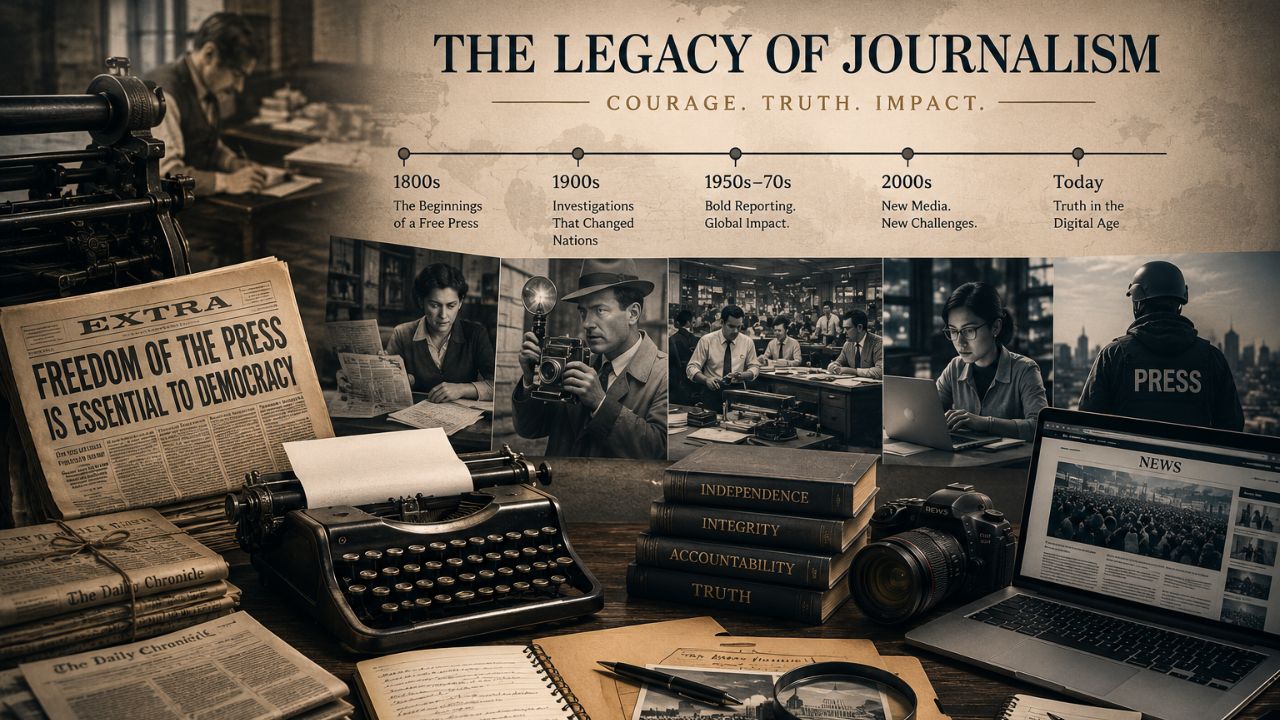
Most Famous Journalists in History
Edward R. Murrow is widely regarded as the father of broadcast journalism. Born in North Carolina and educated at Washington State College, Murrow joined CBS Radio in the 1930s and built his reputation reporting from London during the Second World War. His dispatches — delivered live from rooftops and bomb shelters as the city came under attack — brought the reality of war into American living rooms in a way that print could not match. Later, his televised investigation of Senator Joseph McCarthy is credited with helping to turn public opinion against McCarthyism. Murrow established the standard that broadcast journalism could be as rigorous and consequential as any other form of reporting. According to Rolli.ai’s compilation of the most influential journalists of the modern era, Murrow ranks among the five most consequential figures the profession has produced.
Walter Cronkite anchored the CBS Evening News from the early 1960s until 1981, a tenure during which he covered some of the most significant events in twentieth-century American history — including the assassination of President John F. Kennedy, the Apollo 11 moon landing, and the Vietnam War. According to NYU Journalism’s list of the 100 Outstanding Journalists in the United States in the Last 100 Years, Cronkite became the best-known and perhaps most respected American television journalist of his era. Polls conducted during his active years regularly identified him as the most trusted person in America — a distinction that reflected not just his skill but his consistent adherence to the standards of fairness and accuracy that define credible journalism.
Bob Woodward and Carl Bernstein are the most celebrated investigative reporting duo in American journalism history. Working for The Washington Post in the early 1970s, they pursued the story of a break-in at the Democratic National Committee headquarters in Washington’s Watergate complex — a story that ultimately led to the resignation of President Richard Nixon. Their reporting demonstrated that investigative journalism, pursued rigorously and protected by editorial independence, could hold the most powerful office in the world accountable. According to the New York Film Academy’s profile of influential journalists, Woodward remains one of the most celebrated journalists of the modern era.
Ida B. Wells was a pioneering investigative journalist working at the end of the nineteenth century and into the twentieth. Her reporting focused on the systematic practice of lynching in the American South — a subject that most mainstream publications of the time refused to address. Wells documented individual cases, challenged official narratives, and published her findings at significant personal risk. She was a co-founder of the NAACP and, according to NewswireJet’s verified history of famous journalists, her work laid the foundation for what is now understood as advocacy journalism — reporting that pursues truth in the service of justice.
Nellie Bly is credited as one of the earliest practitioners of undercover journalism. In 1887, she feigned mental illness to gain admission to a women’s asylum on Blackwell’s Island in New York, where she documented the conditions patients were forced to endure. Her resulting piece, “Ten Days in a Mad-House,” published in the New York World, prompted a public inquiry and institutional reform. Bly’s immersive, first-person method of reporting influenced investigative journalists for generations.
Joseph Pulitzer was a Hungarian-American journalist and newspaper publisher who transformed American print media in the late nineteenth century. He championed investigative reporting, expanded newspaper readership through accessible writing and visual storytelling, and upon his death left a bequest to Columbia University that established both its School of Journalism and the prize that now bears his name. The Pulitzer Prize, first awarded in 1917, remains the highest honor in American journalism.
Barbara Walters was a pioneering figure in broadcast journalism, among the first women to co-anchor a major American television evening news program and one of the most recognized interviewers in the history of the medium. Over a career spanning several decades, she conducted landmark interviews with heads of state, cultural figures, and newsmakers across the full range of public life.
Anderson Cooper is an Emmy Award-winning anchor and correspondent at CNN who has covered major international and domestic news events including the war in Iraq and Hurricane Katrina. Before joining CNN, Cooper worked as a correspondent for ABC News. His career reflects the contemporary broadcast journalist’s role — combining field reporting, studio anchoring, and long-form documentary work within a single professional identity.
Helen Thomas spent 57 years working for United Press International and later Hearst Newspapers, covering every U.S. presidency from Eisenhower to Obama. She was the first female officer of the National Press Club, the first female member and president of the White House Correspondents’ Association, and the first female member of the Gridiron Club — a set of firsts that collectively reshaped the gendered landscape of American political journalism.
The full record at a glance:
| Name | Known For | Active Era |
|---|---|---|
| Edward R. Murrow | Father of broadcast journalism; WWII London reports; McCarthy investigation | 1930s–1960s |
| Walter Cronkite | Most trusted anchor in U.S. TV history; CBS Evening News | 1950s–1981 |
| Bob Woodward & Carl Bernstein | Broke the Watergate scandal for The Washington Post | 1970s |
| Ida B. Wells | Investigative reporting on lynching; co-founder of the NAACP | 1880s–1930s |
| Nellie Bly | Pioneer of undercover journalism; “Ten Days in a Mad-House” (1887) | 1880s–1920s |
| Joseph Pulitzer | Established the Pulitzer Prize; defined investigative newspaper reporting | 1870s–1911 |
| Barbara Walters | Pioneer female broadcast journalist and interviewer | 1960s–2000s |
| Anderson Cooper | CNN anchor; Emmy Award winner; covered Iraq War and Hurricane Katrina | 2000s–present |
| Helen Thomas | 57 years with UPI; first female WHCA president | 1940s–2010 |
Well-Known Journalists Today
Contemporary journalism is practiced across a wider range of platforms and formats than at any previous point in the profession’s history. Major wire services — the Associated Press and Reuters — continue to supply verified news reporting to outlets worldwide, employing thousands of reporters and correspondents across every region. The New York Times, The Washington Post, CNN, BBC, and The Guardian maintain large international reporting operations, with staff journalists covering everything from geopolitics to science to culture.
The benchmark against which serious journalism continues to be measured is the Pulitzer Prize, administered annually by Columbia University. The prize covers categories including Public Service, Investigative Reporting, Breaking News, Feature Writing, and International Reporting, among others. Winning or being named a finalist for a Pulitzer is widely recognized across the industry as the clearest signal that a journalist’s work has met the highest professional standard.
What defines well-known journalists in the current era is less a single defining story than a sustained body of work — years of accurate, consequential reporting across difficult beats, conducted ethically and attributed honestly. The names that endure in journalism tend to be those attached not to celebrity but to credibility.
FAQ: Everything You Need to Know About Journalists and Reporters
Key questions answered about the journalism profession, reporter roles, salary, and career path
Journalists conduct interviews, research stories, fact-check information, and report on local, national, and international events to keep the public informed. The profession includes many roles: newspaper reporters, TV reporters, broadcast journalists, news anchors, news editors, and investigative correspondents. In Spanish, a journalist is called a periodista, and the practice of journalism is called periodismo.
All reporters are journalists, but not all journalists are reporters. News editors, anchors, photojournalists, and columnists are also journalists — but they perform different functions within the profession. The word reporter specifically describes a journalist who goes out, gathers information firsthand, and brings it back to the newsroom or delivers it live.
According to Cambridge Dictionary and Collins Spanish–English Dictionary, periodista directly maps to the English word journalist. Example: "Mi tío es periodista" means "My uncle is a journalist." The word periodismo covers the broader practice — equivalent to the English word journalism in all professional and academic contexts.
News editors manage teams of reporters, set the editorial agenda, review copy for accuracy and clarity, and make final decisions on what gets published or broadcast. The role is sometimes misspelled as news editer — both refer to the same position. In larger newsrooms, the role may be divided into managing editors, section editors, digital editors, and copy editors.
Unlike reporters who gather stories in the field, anchors present and narrate stories from the studio. They are typically the most recognizable face of a television news program. Anchors conduct in-studio interviews, manage live breaking news situations on air, and work closely with producers and field reporters to deliver a cohesive broadcast. According to Indeed.com, anchors must be able to synthesize information quickly and respond to live developments without prior preparation.
According to Forbes Advisor and CareerExplorer, a bachelor's degree in Journalism, Communications, or English is the most common starting point. Practical experience — through student newspapers, radio or TV stations, internships, and freelance writing — is equally important. About 4,100 journalism job openings are projected each year in the United States, according to the U.S. Bureau of Labor Statistics, primarily from retirements and career transitions.
Salary varies significantly based on experience, location, and outlet type. Entry-level reporters typically earn between $35,000 and $45,000 per year. Mid-career journalists earn between $58,000 and $70,000. Senior journalists, news editors, and national television anchors can earn $100,000 or more. Journalists in major media markets — New York, Los Angeles, Washington D.C. — generally earn higher salaries than those in smaller regional markets. These figures are based on publicly available salary data and may vary by individual.
Edward R. Murrow is widely regarded as the father of broadcast journalism for his WWII reporting and his investigation of Senator McCarthy. Walter Cronkite anchored CBS Evening News for nearly two decades and was regularly identified as the most trusted person in America. Bob Woodward and Carl Bernstein broke the Watergate scandal for The Washington Post. Ida B. Wells pioneered investigative reporting on racial injustice, and Nellie Bly created undercover journalism with her 1887 asylum investigation. The Pulitzer Prize — established by Joseph Pulitzer and first awarded in 1917 — remains the highest honor in American journalism. Sources: NYU Journalism; NewswireJet, March 2026.
Gallery