Table of Contents
Jean Taynton (American Educator)
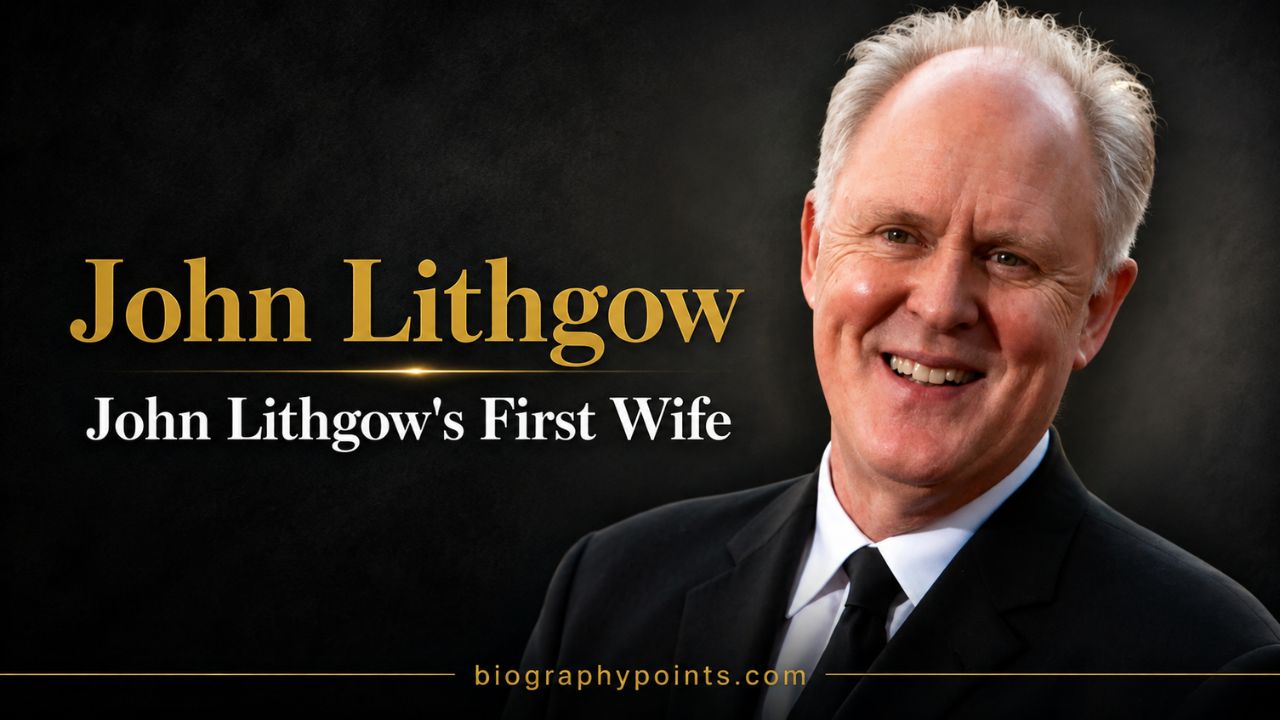
The jean taynton biography tells the story of a woman who chose a meaningful life over a famous one. Jean Taynton is an American educator best known as the first wife of Emmy Award-winning actor John Lithgow. Long before Lithgow became a household name in film and television, Jean was the one holding everything together — working as a teacher, raising a family, and quietly supporting a young actor who had not yet found his footing.
Jean attended Oberlin College in Ohio, where she developed a genuine passion for both education and performance. She spent summers performing at Highfield Theater in Falmouth, Massachusetts — a decision that changed her life. It was there, during a production of Gilbert and Sullivan’s Patience, that she first met John Lithgow. The two married in 1966.
What makes her story compelling is not the marriage itself, but what she built around it. Jean specialized in teaching children with dyslexia to read, working at The World Blind Center, where she developed methods that helped students others had given up on. While her husband rehearsed lines, she was changing young lives in a classroom.
The marriage lasted fourteen years, ending in divorce in 1980. Through it all — including the heartbreaking loss of a premature child — Jean Taynton remained private, dignified, and focused. She and Lithgow share one son, Ian David Lithgow, who went on to become both an actor and a licensed therapist.

| Full Name | Jean Taynton |
| Date of Birth | Not publicly available (born 1930s, United States) |
| Place of Birth | United States (exact location not publicly available) |
| Nationality | American |
| Profession | Educator, Teacher, Dyslexia Specialist |
| Employer | The World Blind Center |
| Education | Oberlin College, Ohio (field of study not publicly specified) |
| Career Start | Teaching career began after graduating from Oberlin College |
| Current Role | Not publicly available; lives privately |
| Notable Work | Developed innovative literacy methods for children with dyslexia at The World Blind Center; primary financial provider during John Lithgow’s early acting career |
| Marital Status | Divorced; was married to actor John Lithgow (1966–1980) |
| Children | Ian David Lithgow (born February 3, 1972) — actor and licensed therapist |
| Awards | Not publicly available |
| Estimated Net Worth | Not publicly available (not officially confirmed) |
| Salary | Not publicly available (not officially confirmed) |
| Siblings | Not publicly available |
| Residence | Not publicly available; lives a private life |
Who is Jean Taynton?
Jean Taynton is an American educator and former teacher best known as the first wife of award-winning actor John Lithgow. She attended Oberlin College, specialized in teaching children with dyslexia, and performed community theater in Massachusetts. The couple married in 1966 and divorced in 1980. They have one son, actor and therapist Ian Lithgow.
Early Life and Education
Jean Taynton’s formative years laid the foundation for everything she would later become — a dedicated educator, a skilled performer, and a woman defined by quiet discipline. Growing up in the United States during a period of significant social and cultural change, she developed values that would stay with her throughout her life: a love of learning, a commitment to others, and a deep respect for privacy. Those qualities did not appear overnight. They were shaped early, in childhood, and refined through years of serious academic and artistic pursuit.
Childhood and Family Background
Jean Taynton was born in the United States, and according to available biographical sources, her birth is placed in the decade of the 1930s. Beyond that, specific details about her birthplace, parents, and siblings are not publicly available. She has never shared those details in interviews or public statements, and no verified records have surfaced to fill those gaps. That choice of privacy feels consistent with the woman she would become.
What is clear, even without a documented childhood record, is the character that emerged from it. Jean grew up at a time when education was considered a serious and respectable vocation — particularly for women who wanted professional independence. The postwar era in America placed enormous value on community, stability, and service. Those cultural currents appear to have shaped her outlook. Her early interests leaned toward academics and the performing arts, two worlds that might seem separate but, in her case, fed each other naturally.
Educational Journey
Jean Taynton attended Oberlin College in Ohio, a institution long recognized for its progressive academic tradition and strong commitment to the arts. Oberlin was not a conventional choice. It was a college that attracted independent thinkers, and it offered Jean the intellectual environment she needed to grow in multiple directions at once.
At Oberlin, she developed a genuine passion for both literature and education — the kind of deep interest that eventually becomes a career. But she did not limit herself to the classroom. During her college summers, Jean performed at Highfield Theater in Falmouth, Massachusetts, a respected community theater where serious students came to sharpen their craft. She took on comedic roles, demonstrating a sharp wit and a natural ease onstage that surprised those who only knew her academic side.
It was this combination — rigorous academic training paired with real performance experience — that shaped the teacher she would become. Her ability to connect with an audience, to communicate clearly and hold attention, translated directly into her later work with children who struggled to read. According to multiple biographical accounts, Jean went on to specialize in teaching children with dyslexia, a field that demands both patience and creativity. Oberlin gave her both the knowledge and the confidence to pursue that work with genuine conviction.
Career
Jean Taynton built her professional life not on visibility, but on impact. While her former husband John Lithgow pursued the spotlight, Jean chose a path grounded in service — teaching children who struggled to learn, in classrooms that offered no applause and no awards. Her career was unglamorous by public standards and extraordinary by any human measure. It also, for many years, kept the family financially stable while Lithgow’s acting career was still finding its footing. To understand Jean Taynton fully, her professional life must be placed at the center of her story — not as a footnote to someone else’s fame.
Early Career as an Educator
Jean Taynton began her teaching career after completing her studies at Oberlin College. She entered the profession at a time when the field of education was undergoing quiet but meaningful change. Literacy was increasingly recognized as a foundation for everything else a child might achieve, and teachers who specialized in reading difficulties were rare and genuinely needed.
Jean gravitated toward the children most teachers found difficult to reach — those who struggled with reading and comprehension despite effort and intelligence. Her specialty became dyslexia, a learning difference that, during the early decades of her career, was poorly understood by the medical and educational communities alike. Many children with dyslexia were dismissed as slow or disinterested. Jean understood otherwise. She approached their difficulties not as failures of the child but as challenges that demanded a more creative, patient, and methodical teaching response.
During the early years of her marriage to John Lithgow, Jean’s teaching salary was the household’s primary income. Lithgow was a young actor in training, moving between the United States and London as he developed his craft. That takes financial backing. Jean provided it. She went to work every day while he rehearsed, auditioned, and studied — a contribution that rarely appears in accounts of his rise, but one that made that rise possible.
Work at The World Blind Center
The most documented chapter of Jean Taynton’s professional life is her work at The World Blind Center, where she focused specifically on teaching children with dyslexia to read. According to multiple biographical sources, she did not simply deliver a standard curriculum. She developed innovative methods tailored to students whose reading difficulties had not responded to conventional instruction.
This was not easy work, and it was not celebrated work — at least not publicly. The field of learning disabilities was still emerging during the decades Jean was most professionally active. Dyslexia had no widespread awareness campaigns, no broadly accepted diagnostic framework, and no universally agreed-upon teaching strategies. Educators who worked in this space were largely figuring it out themselves, combining instinct, observation, and whatever research existed at the time.
Jean Taynton was one of those educators. Her work at The World Blind Center placed her in direct contact with students who had often exhausted other options. The methods she developed were practical responses to real children who needed real results. That kind of work does not generate headlines.
It generates literacy. And for the children who passed through her classroom, the impact would have been lasting. Her career stands as a quiet but significant professional record — one defined by commitment to others rather than recognition for herself.
Theater Involvement and Connection to John Lithgow
Before Jean Taynton became a full-time educator, she spent her college summers doing something altogether different — performing on stage. During her time at Oberlin College, she participated in productions at Highfield Theater in Falmouth, Massachusetts, a respected community theater that attracted serious young performers from across the region.
Jean took on comedic roles during her seasons there. Those who worked alongside her during that period remembered her for a sharp wit and a natural comedic timing that balanced her otherwise disciplined and academically focused personality. She was not simply dabbling in theater. She was genuinely talented in it — comfortable onstage in a way that few people are without formal training.
It was at Highfield Theater, in the mid-1960s, that Jean Taynton first crossed paths with John Lithgow. The two were cast together in Gilbert and Sullivan’s comic opera Patience. Jean played Lady Jane. Lithgow played Bunthorne — her stage love interest. The chemistry between them during rehearsals and performances, according to biographical accounts, was not confined to the script. A genuine connection developed offstage, rooted in a shared love of theater, performance, and the particular intensity that comes with collaborative creative work.
That summer production changed the course of both their lives. What began as a stage romance became a real one. The two married not long after, in 1966. Jean’s theater background never left her — it informed her teaching, her communication, and her understanding of how performance and learning are, at their core, deeply connected disciplines.
Jean Taynton Net Worth and Salary
Jean Taynton has never been a public figure in the financial sense. She did not build a celebrity career, launch a business, or accumulate wealth in any way that entered the public record. What is known about her professional life points to a woman who worked steadily, lived privately, and measured success by standards that had nothing to do with money. That said, people searching for Jean Taynton naturally ask about her financial standing — and those questions deserve honest, carefully framed answers. What follows is based entirely on publicly available information, and where figures cannot be verified, that is stated plainly.
The figures and estimates in this section are based on publicly available information only. No verified financial records for Jean Taynton exist in the public domain.

Salary Details
Jean Taynton’s specific salary has never been publicly disclosed. She worked as a teacher and educator throughout her professional life — a vocation that, by its nature, does not generate public financial records or media coverage of compensation. There are no interviews, court documents, or verified sources that reveal what she earned at any point in her career.
What can be said with reasonable confidence is that Jean worked as a full-time educator during the early decades of her marriage to John Lithgow. During that period, she served as the household’s primary financial provider. Lithgow was a young actor in the early stages of a career that had not yet produced significant or stable income. Jean’s teaching salary — modest by any standard — was what kept the family financially grounded while he trained and auditioned.
For context, teaching salaries during the period when Jean was most professionally active were not substantial. Educators in the United States working in specialized fields, including literacy and reading support for children with learning differences, were typically paid within the general public school salary structure of their time. Those figures varied by state and institution, but they were rarely enough to constitute wealth. Jean was not teaching for financial gain. She was teaching because it was the work she believed in.
Her role as the family’s financial anchor during those formative years represents a contribution that is rarely acknowledged in accounts of John Lithgow’s career — but it was a real and significant one. Without her steady income, the early chapter of his professional life would have looked very different.
Net Worth Estimate
Jean Taynton’s net worth is not publicly available. No verified figure exists, and any specific number found on entertainment or celebrity net worth websites should be treated with caution, as such figures are typically unverified estimates with no documented basis.
Jean has lived a private, non-celebrity life throughout her adult years. She has not appeared in public financial disclosures, has no known business ventures or investments on public record, and has never participated in the kind of media presence that generates financial reporting. Her wealth, whatever it may be, is entirely her own private matter — and she has kept it that way with consistency and deliberateness.
For those seeking a point of reference, her former husband John Lithgow has an estimated net worth of approximately $45 million, according to widely cited entertainment industry sources. That figure reflects a decades-long career in film, television, and theater, including major roles in productions such as 3rd Rock from the Sun, The Crown, and numerous Broadway productions. Jean’s financial profile bears no relationship to that figure. The two divorced in 1980, and their financial lives have been entirely separate since.
What Jean Taynton’s financial story actually reflects is something more straightforward than a net worth figure could capture. She was a working educator who lived within the means of that profession, raised a child, and built a private life on her own terms after her marriage ended. That is the accurate and honest picture available from public information.
Personal Life — Siblings & Family
Jean Taynton’s personal life has been defined by four things: resilience, love, loss, and an unwavering commitment to privacy. She did not live a simple life behind closed doors — she lived a full one, marked by genuine joy and genuine grief in equal measure. A marriage that lasted fourteen years. A child lost too soon. A son who grew into a remarkable man. And a divorce handled with a dignity that never once became public spectacle. To understand Jean Taynton as a person, this is where the story lives — not in classrooms or on stages, but in the private corners of a life quietly and purposefully built.
Marriage to John Lithgow
Jean Taynton met John Lithgow at Highfield Theater in Falmouth, Massachusetts, during the mid-1960s. They were performing together in Gilbert and Sullivan’s Patience — he as Bunthorne, she as Lady Jane, his stage love interest. What began as theatrical chemistry became something real. The connection that developed between them during rehearsals and performances carried over into their lives off stage, and it did not take long for a genuine relationship to take root.
The two married in 1966. Lithgow was just nineteen years old at the time — young by any measure, and still years away from becoming the celebrated actor the world would eventually know. Jean was older, more professionally established, and in many ways the steadier of the two. That dynamic would come to define much of their marriage.
Their life together took them across the Atlantic. During the period when Lithgow was training at the London Academy of Music and Dramatic Art, Jean accompanied him to England. Living abroad as a young married couple, far from familiar support systems, was not easy. Jean adapted. She continued working, continued building her professional identity as an educator, and continued providing the financial and emotional foundation that allowed Lithgow the freedom to focus on his craft.
Throughout the years that followed, Jean remained the stabilizing force in their household. As Lithgow moved between theater productions, auditions, and early career opportunities, she kept the household grounded. Her teaching salary supported the family during a period when acting offered more uncertainty than income.
The marriage lasted fourteen years, ending in divorce in 1980. The specific circumstances were not something Jean ever discussed publicly. John Lithgow, however, later publicly acknowledged that he had engaged in an affair during the course of their marriage — a disclosure that came from him, not from her. Jean offered no public response then, and has offered none since. That silence was not passive. It was chosen, deliberate, and entirely consistent with the woman she had always been.
Lithgow remarried the following year, in 1981, wedding historian Mary Yeager. Jean’s life after the divorce remained entirely private. She made no public statements, gave no interviews, and sought no platform to tell her side of the story. She simply moved forward — quietly, on her own terms.
The Loss of Their First Child
Among the most painful chapters of Jean Taynton’s life is one that is rarely discussed in detail, because Jean herself has never discussed it publicly. During the period when she and John Lithgow were living in London, their first child was born nine weeks premature. The baby lived only a few hours before passing away.
There are no extensive public records around this loss. Jean has never spoken about it in any documented interview or public forum. What is known comes from biographical accounts of John Lithgow’s life, where the loss is referenced as one of the most devastating experiences the couple shared during their time together.
Premature birth at that stage carries an almost certain prognosis, and the grief that follows such a loss is of a particular and profound kind — the grief not just of a death, but of an entire imagined future. For a young couple living far from home, in a foreign country, without the immediate support of family and close friends, the weight of that experience would have been immense.
Jean bore that grief privately. She has never sought sympathy for it, never used it to generate public attention, and never allowed it to define her public narrative — in large part because she has no public narrative. It belongs to her alone. What it tells us, in the context of her broader story, is that Jean Taynton faced the hardest kind of loss early in her marriage and continued forward with a strength that was never announced and never performed.
Son Ian David Lithgow
Jean Taynton’s son, Ian David Lithgow, was born on February 3, 1972, in Cambridge, Massachusetts. He is the only surviving child from Jean and John Lithgow’s marriage, and by any measure, he has built a life that reflects the values of both his parents in equal and distinct ways.
Ian attended Harvard University, graduating in 1994 with a degree in English — following in the academic footsteps of his father, who had also studied there. He did not stop at an undergraduate degree. He went on to earn a Master of Arts in Clinical Psychology, specializing in marriage and family therapy, from Antioch University Los Angeles, graduating in 2005. He currently runs a therapy practice in Lower Manhattan, where he works with individuals and couples navigating the challenges of relationships and family life.
That Ian chose psychology and therapy as a professional vocation is, in its own quiet way, a reflection of Jean’s influence. She spent her career helping people — children, specifically — develop skills they had been told they might never acquire. Ian’s work operates in a different register but from the same essential impulse: the belief that people deserve support, patience, and a professional who genuinely believes in their capacity to grow.
Ian is also an actor. He has performed extensively in regional theater across the United States, including productions at the Goodman Theatre, the American Repertory Theatre, the Williamstown Theatre Festival, the Ahmanson Theatre, and the Pasadena Playhouse. On screen, he is perhaps best known for his recurring role as Leon in the NBC sitcom 3rd Rock from the Sun, where he appeared alongside his father, John Lithgow. His additional screen credits include Perry Mason, The Blacklist, Bull, and Girls, among others.
Ian has two half-siblings — Phoebe, born in 1982, and Nathan, born in 1983 — both children of John Lithgow and his second wife, Mary Yeager. Jean Taynton’s relationship with her son remains private, as does every other aspect of her personal life. But Ian’s accomplishments speak, in part, to the environment in which he was raised — one shaped significantly by a mother who valued education, discipline, creative expression, and quiet dedication to others.
FAQ: Everything You Need to Know About Jean Taynton
Key questions answered about the American educator and first wife of actor John Lithgow
She attended Oberlin College in Ohio and later specialized in teaching children with dyslexia, working at The World Blind Center where she developed innovative literacy methods. She and Lithgow married in 1966 and divorced in 1980. They have one son together, Ian David Lithgow, who is both an actor and a licensed therapist based in New York City.
They met at Highfield Theater in Falmouth, Massachusetts, during a production of Gilbert and Sullivan's Patience, where Jean played Lady Jane and Lithgow played Bunthorne. After their divorce, Jean maintained complete privacy and made no public statements. Lithgow went on to remarry historian Mary Yeager in 1981. Jean Taynton's current relationship status is not publicly available.
John Lithgow later publicly acknowledged that he had engaged in an affair during the course of their marriage. Jean offered no public response to this disclosure and has maintained complete privacy regarding the end of their relationship. She has never given interviews or made public statements about the divorce.
Ian is the only surviving child from Jean and John Lithgow's marriage. Their first child was born nine weeks premature and sadly passed away shortly after birth. Ian went on to graduate from Harvard University in 1994 and earned a Master of Arts in Clinical Psychology from Antioch University Los Angeles. He works as both an actor and a licensed therapist in New York City.
She worked as a teacher and educator throughout her professional life — a private vocation that generates no public financial records. No verified net worth figure exists for Jean Taynton. Any figures found on third-party celebrity net worth websites are unverified estimates and should not be treated as confirmed data.
She began her teaching career after completing her studies at Oberlin College in Ohio. Her specialty lay in literacy and reading difficulties, particularly working with children who struggled with dyslexia at a time when the condition was poorly understood. She also served as the primary financial provider for her household during John Lithgow's early, unstable years as a working actor.
At Oberlin, she developed a passion for both education and theater performance. During her college summers, she performed at Highfield Theater in Falmouth, Massachusetts, where she took on comedic roles and was remembered for her sharp wit and natural stage presence. Her specific degree and graduation date are not publicly available.
Since her divorce from John Lithgow in 1980, Jean has consistently chosen privacy over publicity. She has not given any interviews, maintained any known public profiles, or entered the public domain in any documented way. Her current location, activities, and personal circumstances remain entirely private and are not publicly available.
Gallery