Table of Contents
United States of America (USA)
The United States of America stands as one of the most influential and studied nations in modern history — a vast federal republic stretching across North America, built on a foundation of democratic ideals, constitutional law, and extraordinary geographic diversity. Founded on July 4, 1776, when thirteen British colonies declared their independence from Great Britain, the United States has grown from a fragile new nation into the world’s largest economy and a permanent member of the United Nations Security Council.
Spanning over 3.7 million square miles, the country is home to 50 states, a federal capital in Washington, D.C., and a population of more than 330 million people — making it the third most populous nation on Earth. From the towering skyline of New York City to the sun-baked plains of Texas, from the Pacific coastline of California to the historic streets of Philadelphia, no two states are quite alike in landscape, culture, or character.
The United States is recognized globally for its contributions to science, technology, literature, music, and film. Its universities — including Harvard, MIT, and Stanford — consistently rank among the finest institutions of higher learning in the world. Its military is one of the most capable on the planet, and its currency, the U.S. Dollar, serves as the world’s primary reserve currency.
This article covers the complete profile of the United States of America — its history and founding, all 50 states and their capitals, major cities, system of government, economy, population, education, military strength, and essential facts every reader should know.


| Full Name | United States of America |
| Common Name | USA / America / United States |
| Demonym | American |
| Capital City | Washington, D.C. (Coordinates: 38°53′N 77°1′W) |
| Largest City | New York City, New York (Coordinates: 40°43′N 74°0′W) |
| Government Type | Federal Constitutional Presidential Republic |
| Legislature | Congress (Upper House: Senate | Lower House: House of Representatives) |
| Key Leadership |
President: Joe Biden Vice President: Kamala Harris House Speaker: Mike Johnson Chief Justice: John Roberts |
| Independence & Milestones |
Revolution: March 22, 1765 Declaration: July 4, 1776 Confederation: March 1, 1781 Treaty Recognition: September 3, 1783 Constitution Ratified: June 21, 1788 Last Amendment: May 5, 1992 |
| UN Member Since | 1945 (Founding Member — Permanent Security Council Seat) |
| NATO Member Since | 1949 (Founding Member) |
What is the United States of America?
The United States of America is a federal republic in North America made up of 50 states and a capital city of Washington, D.C. With a population of over 330 million people, it holds the world’s largest economy and stands as one of the most geographically and culturally diverse nations on Earth.
History and Foundation
The United States of America was founded on July 4, 1776 — the date thirteen British colonies formally declared their independence from Great Britain and set in motion one of the most consequential political transformations in world history. What began as a collection of colonial settlements along the eastern coast of North America eventually became the most powerful democratic republic on Earth.
Before the United States existed, thirteen British colonies occupied a narrow stretch of land along North America’s eastern seaboard. These colonies — from Massachusetts in the north to Georgia in the south — operated under British rule for over a century. Tensions steadily grew. Disputes over taxation, representation, and political autonomy pushed colonial leaders toward an irreversible decision.
On July 4, 1776, colonial representatives formally adopted the Declaration of Independence, a document primarily drafted by Thomas Jefferson. It proclaimed that all men are created equal and that governments derive their power from the consent of the governed — radical ideas for their time.
The American Revolutionary War, fought against British forces, gave these words teeth. Figures such as George Washington, who commanded the Continental Army, and Benjamin Franklin, who secured French military support through skilled diplomacy, proved essential to the colonial victory. By 1783, Great Britain recognized American sovereignty through the Treaty of Paris.
Thirteen colonies had become a sovereign nation. The transition was neither smooth nor guaranteed — but it held.
According to the National Archives, the Declaration of Independence remains one of the most reprinted political documents in recorded history.
| Total Area | 3,796,742 sq mi (9,833,520 km²) | Land: 3,531,905 sq mi | Water: 7.0% |
| Highest Point | Denali, Alaska — 20,310 ft (6,190 m) |
| Total States | 50 States + 1 Federal District (Washington, D.C.) |
| Overseas Territories | Puerto Rico, Guam, U.S. Virgin Islands, American Samoa, Northern Mariana Islands |
| Population | 334,914,895 (2023 Est.) | 331,449,281 (2020 Census) — 3rd most populous |
| Population Density | 87/sq mi (33.6/km²) |
| Ethnic Diversity (By Race) | White (61.6%), Black (12.4%), Asian (6.0%), Native American (1.1%), Pacific Islander (0.2%), Two or more races (10.2%), Other (8.4%) |
| Ethnic Origin | Non-Hispanic or Latino (81.3%), Hispanic or Latino (18.7%) |
| Religion (2022) | 70% Christianity (34% Protestant, 23% Catholic, 2% Mormon, 11% Other Christian), 21% Unaffiliated, 2% Judaism, 6% Other, 1% Unanswered |
| Official Language | English (de facto national language; no federally declared official language) |
| Second Most Spoken Language | Spanish |
Formation of the Federal Government
Winning independence was one challenge. Building a functioning government was another entirely. The original governing document — the Articles of Confederation — proved too weak to unite the young states effectively. Leaders recognized that a stronger framework was needed.
In 1787, delegates gathered in Philadelphia for the Constitutional Convention. What emerged was the United States Constitution — a document that established three co-equal branches of government: the Legislative (Congress), the Executive (the President), and the Judicial (the Supreme Court). Each branch was designed to check the power of the others.
The Constitution was ratified in 1788. One year later, George Washington was inaugurated as the first President of the United States, setting precedents that shaped the office permanently.
To protect individual freedoms, the Bill of Rights — comprising the first ten amendments to the Constitution — was ratified shortly after. It guaranteed freedom of speech, religion, press, and protection against unlawful government action.
From those original thirteen states, the nation grew steadily westward through territorial acquisition, treaties, and statehood agreements — eventually reaching its current total of 50 states, with Hawaii and Alaska becoming the final additions.
As documented by the National Constitution Center, the U.S. Constitution is the oldest written national constitution still in active use anywhere in the world.
Geography of the United States
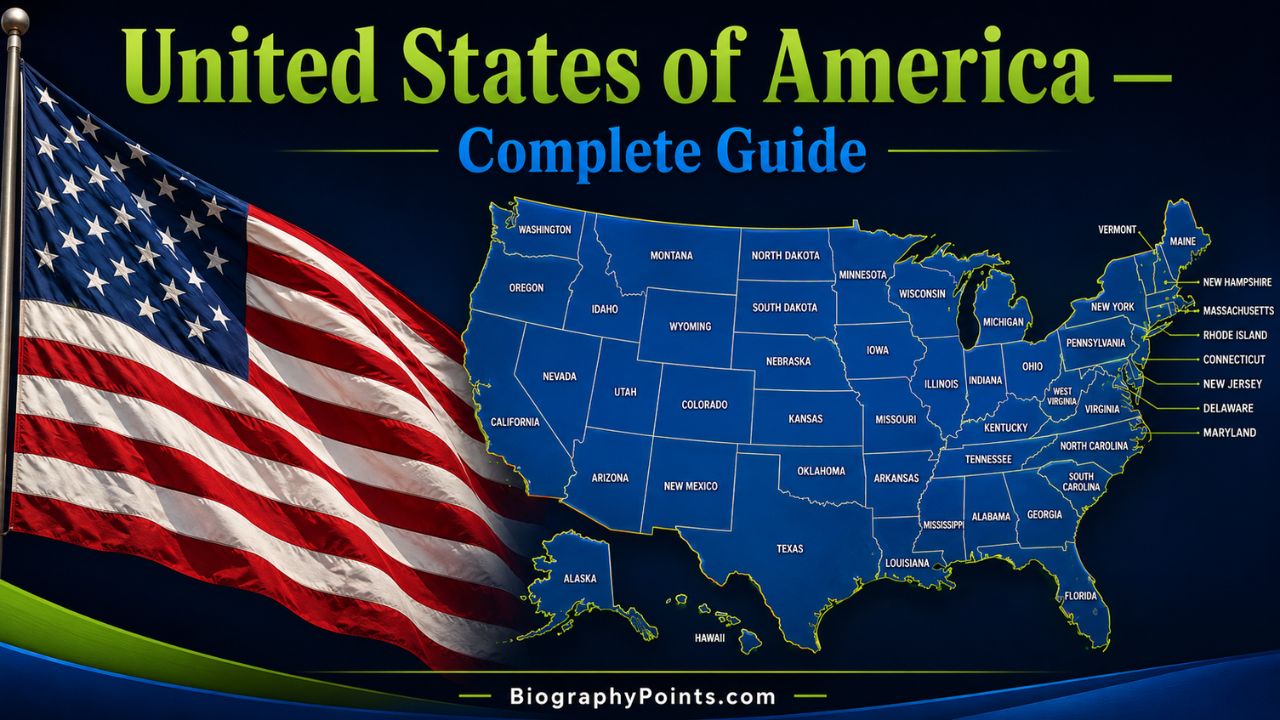
The United States is made up of 50 states, one federal capital district, and five overseas territories — spanning two continents, six time zones, and nearly every climate type found on Earth. Few nations on the planet match the sheer geographic range that defines American territory, from the frozen tundra of Alaska to the volcanic islands of Hawaii.
The United States comprises exactly 50 states, each functioning as a semi-autonomous governing unit within the federal system. In addition, Washington, D.C. — the District of Columbia — serves as the nation’s capital and federal seat of government. It is not a state, though it operates with its own local government and congressional representation remains a debated political matter.
Beyond the 50 states, the U.S. administers five permanently inhabited territories: Puerto Rico, Guam, the U.S. Virgin Islands, the Northern Mariana Islands, and American Samoa. Residents of these territories hold U.S. nationality but operate under different federal rules than state citizens.
Geographically, the 50 states divide into four broad regions:
- Northeast — dense, historically significant, home to cities like New York, Boston, and Philadelphia
- South — culturally distinct, includes Texas, Florida, Georgia, and the Deep South states
- Midwest — agricultural heartland, includes Illinois, Ohio, Michigan, and Minnesota
- West — expansive and diverse, from California’s coast to the Rocky Mountain states
Among the 50 states, Alaska is the largest by total area — more than twice the size of Texas. Rhode Island is the smallest. California holds the largest population of any state, while Wyoming is the least populous.
| Currency | United States Dollar ($) (USD) — World’s Primary Reserve Currency |
| Central Bank | Federal Reserve (The Fed) |
| GDP (Nominal & PPP) | $26.950 Trillion (2023) | Per Capita: $80,412 |
| Economic Indicators | Gini Index: 39.4 (Medium) | Human Development Index (HDI): 0.921 (Very High) |
| Stock Exchanges | NYSE (New York Stock Exchange) and NASDAQ — world’s two largest |
| National Anthem | The Star-Spangled Banner |
| National Motto |
Official: In God We Trust (since 1956) Traditional: “E pluribus unum” (Out of many, one), “Annuit cœptis” (Providence favors our undertakings), “Novus ordo seclorum” (New order of the ages) |
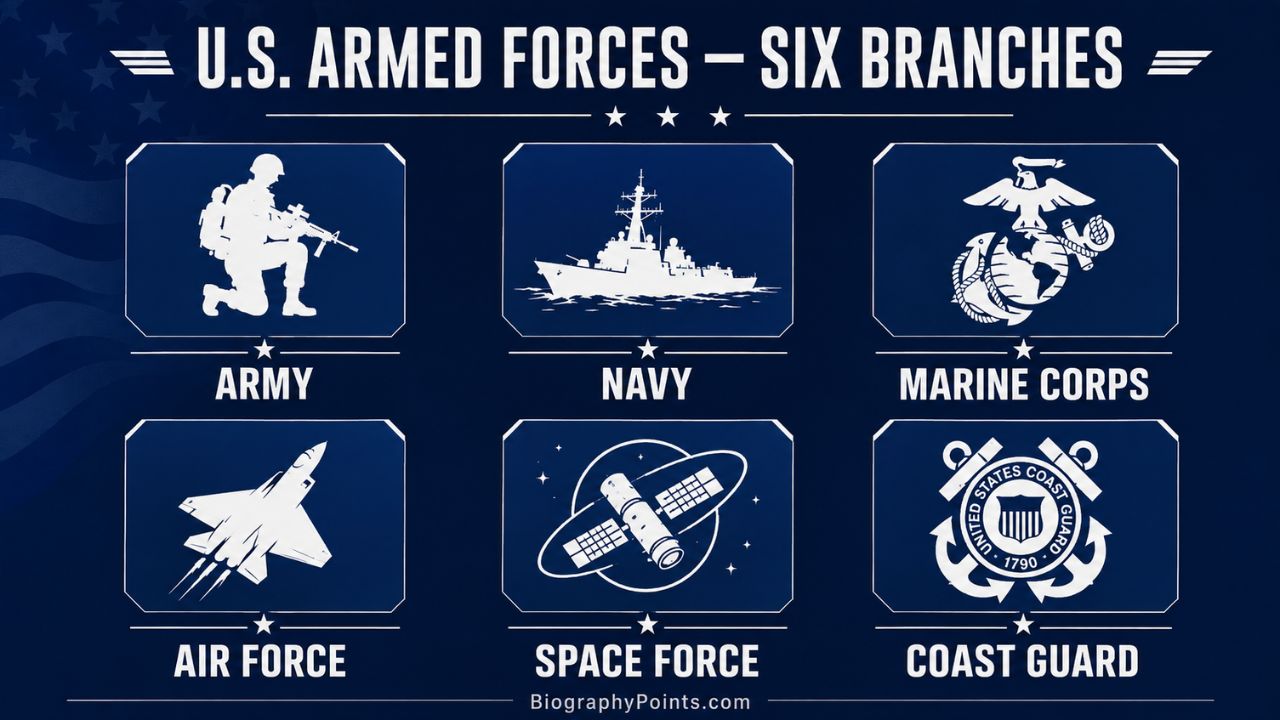
| Military Branches | Army, Navy, Marine Corps, Air Force, Space Force, Coast Guard |
| Commander-in-Chief | President of the United States |
| Time Zones | UTC−4 to −12, +10, +11 (Mainland: UTC−4 to −10 across 6 primary time zones) |
| Driving Side | Right |
| Date Format | mm/dd/yyyy |
| Calling Code | +1 |
| ISO 3166 Code | US |
| Internet Domain | .us / .gov / .edu / .mil |
All 50 U.S. States
| # | State | Capital | Region | Year of Statehood |
|---|---|---|---|---|
| 1 | Alabama | Montgomery | South | 1819 |
| 2 | Alaska | Juneau | West | 1959 |
| 3 | Arizona | Phoenix | West | 1912 |
| 4 | Arkansas | Little Rock | South | 1836 |
| 5 | California | Sacramento | West | 1850 |
| 6 | Colorado | Denver | West | 1876 |
| 7 | Connecticut | Hartford | Northeast | 1788 |
| 8 | Delaware | Dover | Northeast | 1787 |
| 9 | Florida | Tallahassee | South | 1845 |
| 10 | Georgia | Atlanta | South | 1788 |
| 11 | Hawaii | Honolulu | West | 1959 |
| 12 | Idaho | Boise | West | 1890 |
| 13 | Illinois | Springfield | Midwest | 1818 |
| 14 | Indiana | Indianapolis | Midwest | 1816 |
| 15 | Iowa | Des Moines | Midwest | 1846 |
| 16 | Kansas | Topeka | Midwest | 1861 |
| 17 | Kentucky | Frankfort | South | 1792 |
| 18 | Louisiana | Baton Rouge | South | 1812 |
| 19 | Maine | Augusta | Northeast | 1820 |
| 20 | Maryland | Annapolis | Northeast | 1788 |
| 21 | Massachusetts | Boston | Northeast | 1788 |
| 22 | Michigan | Lansing | Midwest | 1837 |
| 23 | Minnesota | Saint Paul | Midwest | 1858 |
| 24 | Mississippi | Jackson | South | 1817 |
| 25 | Missouri | Jefferson City | Midwest | 1821 |
| 26 | Montana | Helena | West | 1889 |
| 27 | Nebraska | Lincoln | Midwest | 1867 |
| 28 | Nevada | Carson City | West | 1864 |
| 29 | New Hampshire | Concord | Northeast | 1788 |
| 30 | New Jersey | Trenton | Northeast | 1787 |
| 31 | New Mexico | Santa Fe | West | 1912 |
| 32 | New York | Albany | Northeast | 1788 |
| 33 | North Carolina | Raleigh | South | 1789 |
| 34 | North Dakota | Bismarck | Midwest | 1889 |
| 35 | Ohio | Columbus | Midwest | 1803 |
| 36 | Oklahoma | Oklahoma City | South | 1907 |
| 37 | Oregon | Salem | West | 1859 |
| 38 | Pennsylvania | Harrisburg | Northeast | 1787 |
| 39 | Rhode Island | Providence | Northeast | 1790 |
| 40 | South Carolina | Columbia | South | 1788 |
| 41 | South Dakota | Pierre | Midwest | 1889 |
| 42 | Tennessee | Nashville | South | 1796 |
| 43 | Texas | Austin | South | 1845 |
| 44 | Utah | Salt Lake City | West | 1896 |
| 45 | Vermont | Montpelier | Northeast | 1791 |
| 46 | Virginia | Richmond | South | 1788 |
| 47 | Washington | Olympia | West | 1889 |
| 48 | West Virginia | Charleston | South | 1863 |
| 49 | Wisconsin | Madison | Midwest | 1848 |
| 50 | Wyoming | Cheyenne | West | 1890 |
Major Cities in the United States of America
The largest cities in the United States serve as economic, cultural, and political engines that drive the country’s identity on a global stage. Each major city carries a distinct character shaped by geography, industry, and the communities that built it.
New York City, located in the state of New York, is the largest city in the United States by population. It functions as the nation’s financial capital, home to Wall Street, the New York Stock Exchange, and the global headquarters of major banks and corporations. It is also one of the world’s foremost centers of art, media, fashion, and culture.
Los Angeles, California, is the entertainment capital of the world — home to Hollywood, the American film industry, and the headquarters of major streaming and technology companies. It ranks as the second most populous city in the country.
Chicago, Illinois, anchors the Midwest as its largest city. Known for its architectural heritage, deep-dish pizza, blues music tradition, and robust financial sector, Chicago is a major hub for commerce and transportation.
Houston, Texas, is the center of the American energy industry, home to NASA’s Johnson Space Center, and one of the most ethnically diverse cities in the nation.
Other major cities of significant size and influence include Phoenix (Arizona), Philadelphia (Pennsylvania), San Antonio (Texas), San Diego (California), Dallas (Texas), and San Jose (California).
Population figures are sourced from U.S. Census Bureau estimates and are subject to change with each official census cycle.
| Rank | City | State | Estimated Population |
|---|---|---|---|
| 1 | New York City | New York | ~8.3 million |
| 2 | Los Angeles | California | ~3.9 million |
| 3 | Chicago | Illinois | ~2.7 million |
| 4 | Houston | Texas | ~2.3 million |
| 5 | Phoenix | Arizona | ~1.6 million |
| 6 | Philadelphia | Pennsylvania | ~1.6 million |
| 7 | San Antonio | Texas | ~1.4 million |
| 8 | San Diego | California | ~1.4 million |
| 9 | Dallas | Texas | ~1.3 million |
| 10 | San Jose | California | ~1.0 million |
Geographic Features and Climate Zones
The physical landscape of the United States is among the most varied of any country in the world. Three major mountain systems shape the terrain: the Appalachian Mountains run along the eastern interior, among the oldest mountain ranges on Earth; the Rocky Mountains rise dramatically through the western half of the country; and the Sierra Nevada forms a rugged spine along California’s eastern edge.
Major river systems define transportation and agriculture across the interior. The Missouri River is the longest river in the country, flowing through the Great Plains before joining the Mississippi River — itself one of the most commercially significant waterways on Earth. The Colorado River carves through the Southwest, feeding the Grand Canyon, while the Rio Grande marks the southern border with Mexico.
Three notable desert regions occupy the American Southwest: the Mojave, the Sonoran, and the Great Basin Desert. To the east of the Rockies, the Great Plains stretch across the continent’s midsection — the agricultural foundation of the nation. The Great Lakes region in the north holds nearly 20 percent of the world’s surface freshwater.
Climate ranges from tropical conditions in southern Florida and Hawaii to arctic environments in interior Alaska. The country spans six primary time zones: Eastern, Central, Mountain, Pacific, Alaska, and Hawaii-Aleutian.
Government and Political Structure of the USA
The United States government operates as a federal constitutional republic — a system in which power is divided between a central national government and fifty individual state governments, with authority ultimately derived from the people through free and regular elections. This structure, established by the U.S. Constitution in 1788, remains the oldest written national constitution in continuous active use anywhere in the world.

The Three Branches of Government
The U.S. Constitution divides federal power into three distinct and co-equal branches, each designed to prevent any single institution — or individual — from accumulating unchecked authority.
The Legislative Branch — known as Congress — holds the power to make federal law. Congress is bicameral, meaning it consists of two chambers. The Senate is composed of 100 senators, two from each state, each serving a six-year term. The House of Representatives consists of 435 members, with seats apportioned by state population, each serving a two-year term. All federal legislation must pass both chambers before becoming law.
The Executive Branch is headed by the President of the United States, who serves a four-year term and is constitutionally limited to two terms in office. The President is supported by the Vice President and a Cabinet of appointed department secretaries who oversee federal agencies covering everything from defense to education. The President holds the power to sign legislation into law, veto congressional bills, command the armed forces, and conduct foreign policy.
The Judicial Branch is anchored by the Supreme Court of the United States — the highest court in the country — composed of nine justices who serve lifetime appointments. The Supreme Court holds the authority to interpret the Constitution and strike down laws that violate it. This power, known as judicial review, acts as a fundamental check on both Congress and the President.
These three branches operate under a deliberate system of checks and balances — each branch holds specific powers to limit the others. The Tenth Amendment to the Constitution further reserves all powers not granted to the federal government to the individual states, ensuring that state governments retain meaningful authority over local affairs.
Political Parties and Electoral System
The American political landscape is dominated by two major parties: the Democratic Party and the Republican Party. While third parties exist and occasionally influence elections, the two-party system has shaped U.S. politics for over a century and a half. The Democratic Party generally aligns with progressive and liberal policy positions, while the Republican Party typically represents conservative and traditional values — though both parties contain significant internal diversity.
Presidential elections in the United States operate through the Electoral College — a system in which voters in each state cast ballots that determine a slate of electors. There are 538 total electoral votes, distributed among states based on their congressional representation. A candidate must secure 270 electoral votes to win the presidency. This means a candidate can win the popular vote nationally but lose the election — a distinction that has determined several presidential outcomes throughout American history.
Presidential elections are held every four years. Between presidential cycles, midterm elections occur every two years, during which all 435 seats in the House of Representatives and approximately one-third of Senate seats are contested. Senate seats carry six-year staggered terms, meaning the full Senate is never up for election simultaneously.
The minimum voting age in the United States is 18 years, a right guaranteed by the Twenty-Sixth Amendment to the Constitution.
Economy of the United States of America
The United States operates the largest economy in the world by nominal gross domestic product — a position it has held for well over a century. Built on a foundation of free-market capitalism, private enterprise, and global trade, the American economic system produces more measurable output than any other single nation on Earth. Its influence reaches into virtually every corner of global commerce, finance, and industry.

GDP and Global Economic Position
The United States holds the largest nominal GDP of any country in the world, consistently outpacing other major economies including China, Germany, and Japan. It functions as a mixed-market capitalist economy — one in which private businesses operate freely within a framework of government regulation, public services, and social programs.
The U.S. Dollar (USD) is the world’s dominant reserve currency, meaning that central banks across the globe hold it as a primary store of value and that most international commodities — including oil — are priced and traded in dollars. This status grants the United States extraordinary economic leverage on the world stage.
Monetary policy is managed by the Federal Reserve — commonly called the Fed — an independent central banking system responsible for regulating interest rates, controlling inflation, and maintaining financial system stability.
The two largest stock exchanges in the world both operate on American soil. The New York Stock Exchange (NYSE), located on Wall Street in Lower Manhattan, and the NASDAQ, headquartered in New York City, together represent trillions of dollars in publicly traded company value.
The United States conducts its largest volumes of international trade with China, Canada, Mexico, and the European Union — relationships that reflect both deep economic interdependence and, at times, significant political tension.
According to the World Bank and International Monetary Fund, the United States has consistently ranked first in nominal GDP among all member nations.
Major Industries and Sectors
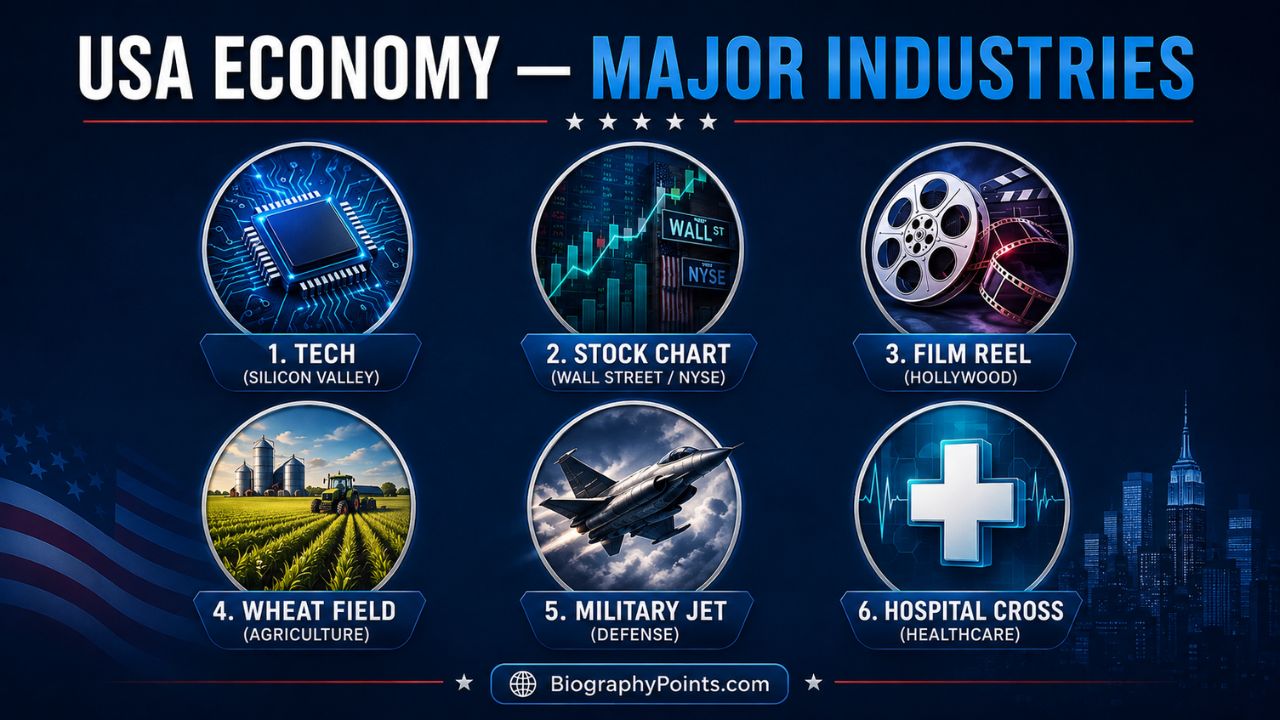
The American economy is not built on any single industry — its strength lies in extraordinary diversification across multiple high-output sectors.
Technology is among the most globally influential. Silicon Valley, located in the San Francisco Bay Area of California, is home to some of the world’s most valuable companies, including Apple, Google, Meta, and Amazon. Microsoft, headquartered in Redmond, Washington, remains one of the largest corporations on Earth by market capitalization.
Finance and banking represent another cornerstone. Wall Street — the financial district of New York City — is the symbolic and operational center of American and global capital markets, housing major investment banks, hedge funds, and financial institutions that move markets worldwide.
Healthcare and pharmaceuticals constitute one of the largest sectors of the domestic economy, driven by a network of private hospitals, insurance companies, research institutions, and drug manufacturers that collectively serve a population of over 330 million.
Defense and aerospace represent a uniquely American industrial strength. The United States maintains the largest defense budget of any nation, supporting a vast network of contractors, manufacturers, and research facilities.
Agriculture remains a powerful export sector. The U.S. is one of the world’s leading producers and exporters of wheat, corn, and soybeans, feeding both domestic demand and global markets across dozens of countries.
Entertainment is led by Hollywood — the Los Angeles-based film and television industry that shapes global popular culture and generates billions in annual export revenue through cinema, streaming, and music.
The energy sector spans conventional oil and natural gas production — particularly concentrated in Texas and the Gulf Coast — alongside a rapidly expanding renewable energy industry in solar, wind, and battery technology.
Manufacturing and automotive industries, while restructured significantly over recent decades, remain significant contributors, with major production centers in Michigan, Ohio, and the broader Midwest.
Population and Demographics of the United States
The United States is home to more than 330 million people — making it the third most populous country in the world, behind only China and India. Its population is not only large in scale but extraordinarily diverse in origin, language, ethnicity, and cultural identity. No single demographic group, language, or regional tradition fully defines what it means to be American.
Population Size and Distribution
The United States currently holds a total population of over 330 million people, ranking third globally by population size. The country is predominantly urban — approximately 82 percent of the population lives in cities, suburbs, or metropolitan areas, with rural communities making up the remaining share.
Population is distributed unevenly across the 50 states. The four most populous states — California, Texas, Florida, and New York — together account for a substantial portion of the national total. At the opposite end of the scale, Wyoming, Vermont, and Alaska remain the least populated states, each holding relatively small populations despite significant geographic size.
The median age of the American population sits at approximately 38 to 39 years, reflecting an aging population trend consistent with other developed nations. Birth rates, immigration levels, and life expectancy all contribute to ongoing shifts in this figure over time.
Population data referenced from the U.S. Census Bureau, which conducts an official national census every ten years, supplemented by annual population estimates.
Ethnic and Cultural Diversity
The United States has no federally declared official language. English functions as the de facto national language — used in government, law, education, and commerce — but it holds no constitutionally mandated status. Spanish is the second most widely spoken language, reflecting both historical roots in the Southwest and ongoing immigration patterns from Latin America.
Ethnically, the United States is one of the most diverse nations in the world. Major population groups include White (non-Hispanic), Hispanic or Latino, Black or African American, Asian, Native American, Pacific Islander, and individuals identifying as multiracial. Each group carries its own cultural heritage, history, and contribution to the national identity.
The country is frequently described as a “nation of immigrants” — a phrase that reflects centuries of migration from Europe, Africa, Asia, Latin America, and beyond. Long before European contact, Indigenous peoples inhabited North America for thousands of years, and their cultures, languages, and histories form an essential part of the American story.
Culturally, American contributions to the world are immense. Music genres born on American soil — including jazz, blues, rock and roll, and hip-hop — have shaped global popular culture for generations. American cinema, literature, and sports — particularly baseball, basketball, and American football — carry influence that extends far beyond national borders.
Education System in the United States of America
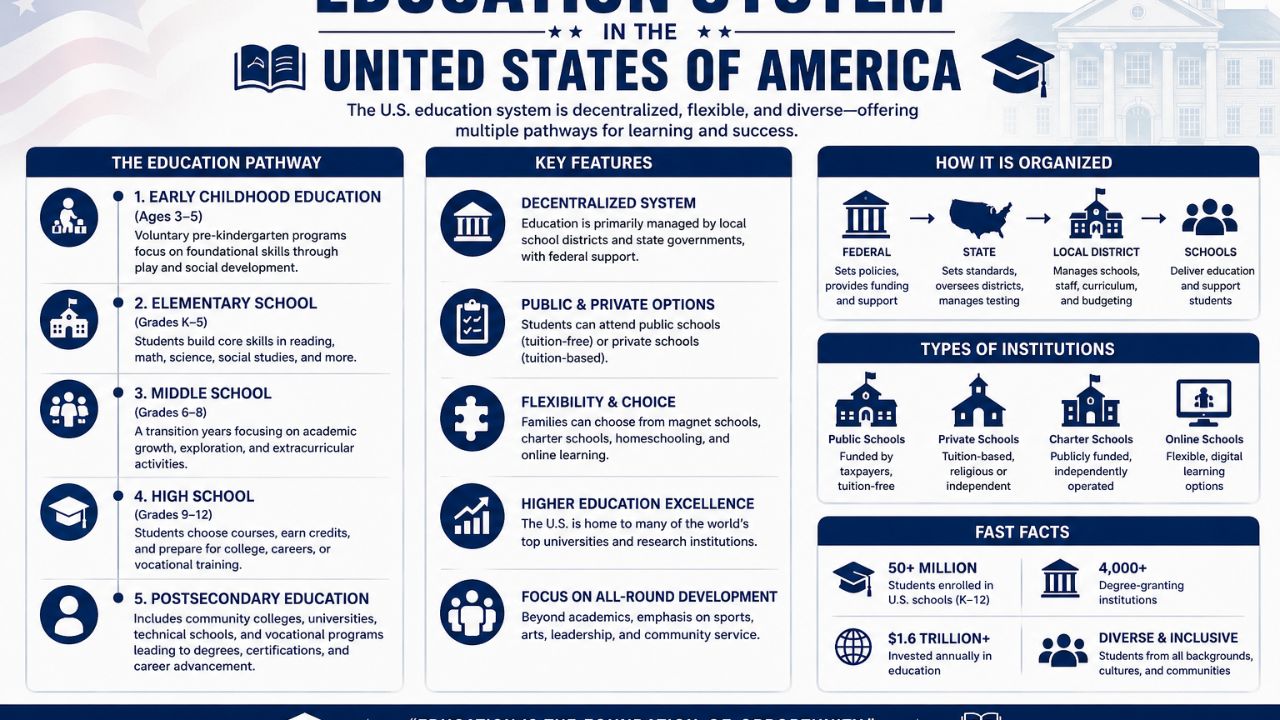
The United States education system serves over 330 million people through a layered structure of public schools, private institutions, and universities that together form one of the most expansive educational networks in the world. Governed largely at the state level — with federal oversight provided by the U.S. Department of Education — the system offers multiple pathways from early childhood through advanced postgraduate study.

K–12 Public and Private Education
The American school system follows a K–12 structure — beginning with Kindergarten and continuing through Grade 12, typically ending when students are 17 or 18 years old. Education is compulsory in all 50 states, though the exact age requirements vary by state. Most states require children to attend school between the ages of 6 and 16.
Three primary types of schools serve American students at the K–12 level. Public schools are state-funded and tuition-free, operating under local school district governance and serving the majority of American students. Private schools operate independently, often with religious affiliations, and charge tuition. Charter schools function as publicly funded but independently managed institutions, offering alternative teaching models within the public system.
Homeschooling is legal in all 50 states, subject to varying degrees of state regulation, and is chosen by a meaningful segment of American families.
The U.S. Department of Education sets federal education policy, administers financial aid programs, and collects national education data — though curriculum decisions remain primarily the responsibility of individual states and local districts. The national adult literacy rate stands at approximately 99 percent, among the highest in the world.
Universities and Higher Education
The United States is home to more than 4,000 degree-granting colleges and universities — a higher education ecosystem unmatched in scale and global reputation. Institutions range from small liberal arts colleges to vast public research universities serving tens of thousands of students.
The Ivy League — a group of eight elite private universities — carries particular prestige worldwide. Its members are Harvard, Yale, Princeton, Columbia, the University of Pennsylvania, Brown, Dartmouth, and Cornell. Beyond the Ivy League, institutions such as MIT, Stanford, Caltech, and the University of Chicago consistently rank among the finest research universities on Earth, producing Nobel laureates, heads of state, and industry-defining scientists and entrepreneurs.
The community college system provides an accessible and affordable gateway into higher education, allowing students to earn two-year associate degrees or transfer credits toward four-year university programs. This pathway is particularly important for first-generation college students and working adults.
Federal financial support — through grants, subsidized loans, and work-study programs administered under the Free Application for Federal Student Aid (FAFSA) — makes higher education accessible to students across income levels, though student debt remains a significant national policy issue.
American universities attract hundreds of thousands of international students annually, drawn by academic reputation, research opportunities, and the global value of a U.S. degree.
Military and International Role of the United States
The United States maintains one of the most powerful and globally deployed militaries in the world — a force built not only for national defense but for projecting influence, honoring treaty commitments, and responding to international crises across every continent. Combined with its economic reach and diplomatic network, American military power shapes global affairs in ways no other single nation currently matches.

The United States Armed Forces
The United States Armed Forces are organized into six distinct branches, each with a defined mission and area of responsibility.
The Army is the oldest and largest branch, responsible for land-based military operations. The Navy projects power across the world’s oceans, operating a fleet of aircraft carriers, submarines, and destroyers that give the United States unmatched maritime reach. The Marine Corps functions as a rapid-response amphibious force, capable of deploying quickly to crisis zones anywhere in the world. The Air Force maintains air superiority and strategic bombing capability, operating the most technologically advanced fleet of military aircraft on Earth. The Space Force, established most recently, is responsible for protecting American interests and assets in orbital and outer space environments. The Coast Guard operates domestically and internationally, conducting maritime law enforcement, search and rescue, and port security operations.
The President of the United States serves as Commander-in-Chief of all six branches — a constitutional role that places ultimate military authority in the hands of a civilian elected official. Day-to-day oversight of defense operations is managed by the Secretary of Defense, a civilian cabinet position confirmed by the Senate.
The United States is one of nine nuclear-armed states in the world and holds a permanent seat on the United Nations Security Council — a position that gives it veto power over binding international resolutions and places it at the center of global security decision-making.
According to the U.S. Department of Defense, the United States Armed Forces maintain hundreds of military installations across dozens of countries worldwide, making it the most globally distributed military force in history.
International Alliances and Global Role
The United States does not project power through military strength alone. Its global influence is equally shaped by a dense network of international alliances, multilateral organizations, and economic relationships that have been built and maintained since the mid-twentieth century.
The U.S. was a founding member of the United Nations in 1945, helping to establish the post-World War II international order. Its permanent seat on the UN Security Council — alongside the United Kingdom, France, Russia, and China — grants it direct authority over the world’s most consequential collective security decisions.
In 1949, the United States became a founding member of the North Atlantic Treaty Organization (NATO) — a military alliance that now spans 30-plus member nations across North America and Europe. Under NATO’s Article 5 collective defense principle, an attack on one member is treated as an attack on all — a guarantee that has anchored European security for decades.
The United States is also a core member of the G7 — the group of the world’s seven largest advanced economies — and the G20, the broader forum addressing global economic coordination. Its membership in the World Trade Organization (WTO), World Bank, and International Monetary Fund (IMF) further embeds American influence into the architecture of global finance and trade.
The U.S. Dollar’s status as the world’s primary reserve currency amplifies this influence significantly. Because global commodities, debt instruments, and trade agreements are predominantly denominated in dollars, American monetary policy decisions carry consequences far beyond U.S. borders.
The United States maintains diplomatic relations with nearly every country on Earth, operating one of the largest embassy and consulate networks in the world — a presence that supports trade, intelligence, humanitarian assistance, and political engagement across virtually every region.
FAQ: Everything You Need to Know About the United States of America
Key questions answered about the USA — its states, cities, history, government, and population
In addition to the 50 states, the U.S. administers Washington, D.C., as its federal capital district — a territory that is not a state and has no voting representation in the U.S. Senate. The country also governs five permanently inhabited overseas territories: Puerto Rico, Guam, the U.S. Virgin Islands, American Samoa, and the Northern Mariana Islands.
Located on the eastern seaboard between the states of Maryland and Virginia, Washington, D.C., is home to all three branches of the federal government — including the White House (Executive), the U.S. Capitol Building (Legislative), and the Supreme Court (Judicial). It is not a state and was established as a dedicated federal district under the U.S. Constitution.
Approximately 82 percent of the American population lives in urban or suburban areas. The four most populous states are California, Texas, Florida, and New York. Wyoming, Vermont, and Alaska are the least populated. The national median age sits at approximately 38 to 39 years, reflecting an aging population trend consistent with other advanced economies. Population data is officially measured by the U.S. Census Bureau every ten years.
New York City serves as the nation's financial, media, and cultural capital — home to Wall Street, the New York Stock Exchange, and a population of approximately 8.3 million. Los Angeles anchors the global entertainment industry through Hollywood. Chicago is the Midwest's largest city, Houston is the center of the American energy sector, and Phoenix is the fastest-growing major city in the Southwest. Population estimates are sourced from the U.S. Census Bureau.
The Declaration was primarily authored by Thomas Jefferson and formally announced the colonies' separation from Great Britain. The American Revolutionary War — led militarily by George Washington — secured that independence, and British recognition came through the Treaty of Paris in 1783. July 4 is observed annually as Independence Day, a national public holiday commemorating the founding of the republic.
Gallery