Table of Contents
Law of the Sea (Ocean Law)
Imagine a world where no single nation owns most of the planet — yet everyone depends on it. That’s the reality with our oceans, which cover more than 70% of the Earth’s surface and are essential for global trade, climate balance, food resources, and even internet cables running along the seafloor. But who decides what happens in these vast, shared waters? That’s the realm of the Law of the Sea, a complex yet vital system of rules shaping how we use, protect, and share the world’s oceans.
The Law of the Sea, often referred to as ocean law, governs everything from navigational rights and maritime boundaries to fishing zones, environmental protection, and the management of underwater resources. Rooted in centuries of seafaring customs and refined through treaties like the United Nations Convention on the Law of the Sea (UNCLOS) — signed by over 160 countries — this legal framework serves as the backbone of global ocean governance.
Far more than just a set of maritime rules, the Law of the Sea is a geopolitical, environmental, and economic safeguard. It helps countries define their territorial waters, ensures peaceful passage through international straits, protects endangered marine ecosystems, and resolves conflicts over valuable offshore oil, gas, and mineral deposits. With ongoing disputes like those in the South China Sea, its relevance has never been more critical.
UNCLOS, often dubbed the “Constitution of the Oceans,” has been in force since 1994 and is widely seen as the most comprehensive international agreement on maritime law. It codifies everything from Exclusive Economic Zones (EEZs) to deep seabed mining regulations, reflecting both customary international law and future-facing environmental principles.
In this article, we’ll demystify the Law of the Sea in a clear, human-friendly way — covering its historical roots, key legal zones, environmental mandates, and real-world implications. Whether you’re curious about international diplomacy or simply wonder who polices the high seas, you’ll gain a deep understanding of how the ocean is legally divided, protected, and governed. Dive in to explore one of the most fascinating (and misunderstood) areas of international law.
International Waters

| Title | United Nations Convention on the Law of the Sea (UNCLOS) |
| Type | International Treaty / Legal Framework |
| Language | Multilingual (including English, French, Arabic, Chinese, Russian, Spanish) |
| Adopted | December 10, 1982 |
| Effective From | November 16, 1994 |
| Signatories | 168+ countries (as of 2025) |
| Subject | Maritime Law / Ocean Governance |
| Jurisdiction Zones | Territorial Sea, Contiguous Zone, EEZ, Continental Shelf, High Seas |
| Main Topics | Navigation rights, marine resources, environmental protection, dispute resolution |
| Dispute Body | International Tribunal for the Law of the Sea (ITLOS) |
| Publisher | United Nations |
| Location | Global (United Nations Treaty Series) |
| Current Challenges | Climate change, deep sea mining, marine pollution, territorial disputes |
| Category Tags | UNCLOS, Maritime Law, EEZ, International Waters, Ocean Policy, UN Treaties |
Historical Evolution of the Law of the Sea
The roots of the Law of the Sea stretch back thousands of years to the earliest seafaring civilizations. In the ancient Mediterranean, maritime activity was vital to commerce, military power, and cultural exchange. Civilizations such as the Phoenicians, Greeks, and Romans developed early forms of maritime law to regulate sea trade, piracy, and naval warfare. The Code of Hammurabi (c. 1750 BCE), one of the oldest known legal texts, included provisions related to ship leasing and marine liability — highlighting how even in ancient Mesopotamia, laws governed maritime conduct.
By the classical era, the Rhodian Sea Law (Lex Rhodia), established around 900 BCE on the island of Rhodes, gained prominence. It introduced key concepts such as “general average,” which required shared compensation among shipowners and cargo owners in case of loss at sea. This principle would influence later Western admiralty law and illustrates how early maritime laws emerged from necessity, driven by risk, trade, and collaboration across open waters.
In the East, civilizations like China and India also had their own longstanding traditions regulating sea trade and fishing rights. The Arthashastra, a political treatise from ancient India, addressed maritime commerce and naval regulations, while records from China’s Han dynasty (206 BCE – 220 CE) reflect rules governing fishing fleets and river navigation. These scattered but significant customs set the foundation for what would later evolve into global legal frameworks for the seas.
The Emergence of the Freedom of the Seas Doctrine
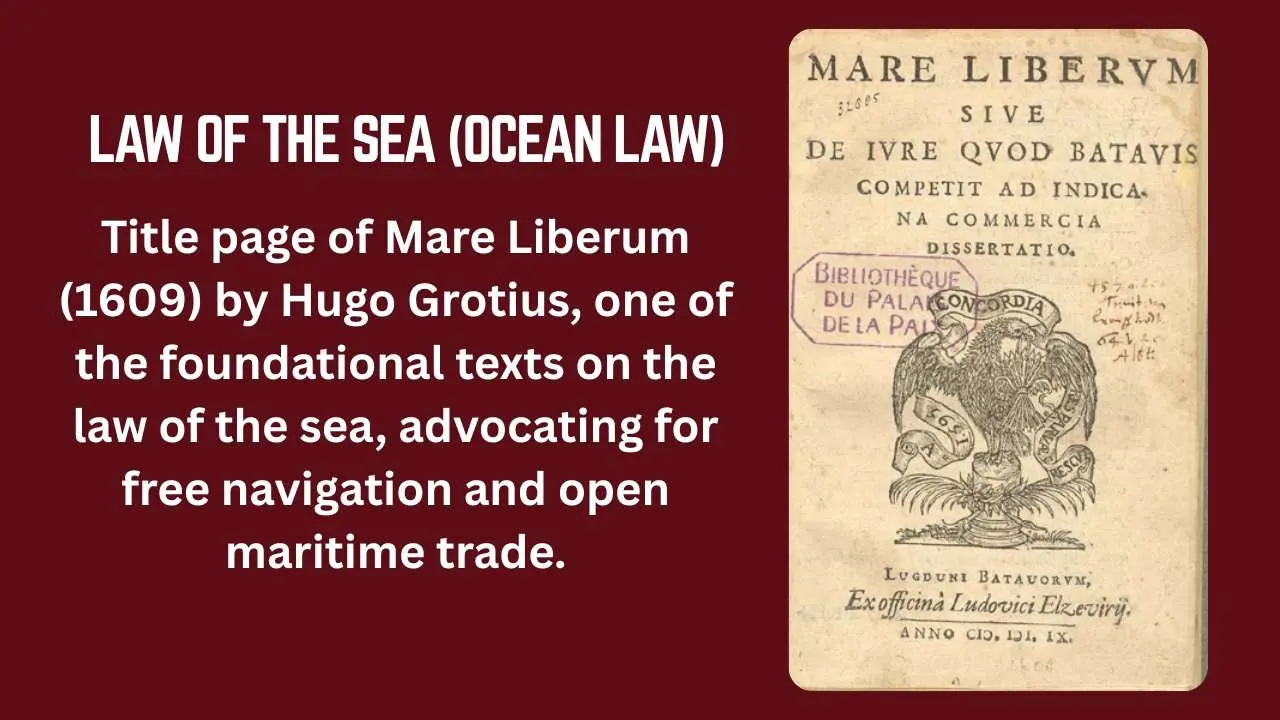
The modern concept of the Law of the Sea began to take shape in the 17th century, at a time of growing maritime competition among European empires. One of the most influential turning points came in 1609 with Dutch jurist Hugo Grotius, who published Mare Liberum (“The Free Sea”). In this groundbreaking treatise, Grotius argued that the sea was international territory and should remain free for navigation and trade by all nations — a revolutionary stance at a time when countries like Portugal and Spain claimed exclusive dominion over vast oceanic routes.
Grotius’ argument was grounded in the principle that the ocean, unlike land, could not be owned because it was boundless and inexhaustible. His doctrine laid the groundwork for the “freedom of the seas”, a legal concept that would remain dominant for over three centuries. It enabled the rise of international maritime commerce and solidified the idea that no nation could claim sovereignty over the high seas beyond a narrow belt of territorial waters.
While some countries contested Grotius’ views — notably English scholar John Selden, who argued in Mare Clausum that seas could be subject to national control — Grotius’ philosophy eventually prevailed in customary international law. The freedom of navigation became a cornerstone of international legal norms and a precursor to the more structured maritime treaties of the 20th century.
The Need for a Global Maritime Legal Framework
By the 20th century, the simplicity of the freedom-of-the-seas doctrine could no longer address the complexity of modern maritime affairs. Technological advancements, deep-sea mining, offshore oil exploration, overfishing, and increasing geopolitical tensions prompted the need for a more nuanced and enforceable global maritime legal framework. As nations began extending their territorial claims beyond traditional boundaries, disputes erupted over territorial waters, exclusive fishing zones, and marine resource rights.
Traditionally, a nation’s territorial sea extended just 3 nautical miles from its coastline — based on the “cannon shot rule” (the distance a shore-based cannon could fire). But this outdated standard became unsustainable in an era where economic interests in marine zones stretched far beyond coastal waters. The rising frequency of maritime conflicts — including disputes over oil-rich seabeds, access to fisheries, and control of shipping lanes — underscored the need for a codified international law of the sea.
This demand culminated in the United Nations Conference on the Law of the Sea, held in three major sessions between 1956 and 1982. The most significant outcome was the creation of the United Nations Convention on the Law of the Sea (UNCLOS) in 1982, often referred to as the “Constitution of the Oceans.” The treaty redefined maritime zones, such as Territorial Waters, Contiguous Zones, Exclusive Economic Zones (EEZs), and the Continental Shelf, offering a comprehensive legal structure governing nearly every aspect of ocean use and governance.
UNCLOS entered into force in 1994 and has since been ratified by more than 160 countries, becoming the primary international legal instrument for regulating the world’s oceans. It established bodies like the International Tribunal for the Law of the Sea (ITLOS) and the International Seabed Authority, which oversee legal disputes and the sustainable use of seabed resources. While not every nation (including the United States) has formally ratified the treaty, UNCLOS continues to influence global maritime law and serves as the foundation of international cooperation and ocean governance in the 21st century.
United Nations Convention on the Law of the Sea (UNCLOS)
The United Nations Convention on the Law of the Sea (UNCLOS), often described as the “Constitution of the Oceans,” is a landmark international agreement that governs maritime rights, ocean resource management, and jurisdiction over the seas. Adopted in 1982 after nearly a decade of negotiations, UNCLOS replaced older, fragmented maritime rules with a comprehensive legal framework, solidifying the modern law of the sea treaty.

Efforts to codify the laws of the sea began in earnest during the mid-20th century, driven by increasing global maritime activity and disputes over territorial waters, fishing rights, and seabed resources. Prior to UNCLOS, maritime law was governed loosely by customary practices and limited treaties. The first United Nations Conference on the Law of the Sea (UNCLOS I) convened in Geneva in 1958, followed by UNCLOS II in 1960, both of which made progress but failed to resolve key issues like maritime boundaries and deep-sea mining.
The pivotal moment came with the Third United Nations Conference on the Law of the Sea (UNCLOS III), which began in 1973 and concluded in 1982 with the adoption of the final text. Signed by 119 countries in Montego Bay, Jamaica, on December 10, 1982, UNCLOS entered into force on November 16, 1994, following ratification by 60 states. As of 2024, over 165 countries and the European Union are parties to the United Nations law of the sea treaty, though notable absentees include the United States, which has signed but not ratified the agreement.
Key Objectives and Scope of UNCLOS
UNCLOS was designed to ensure peace, stability, and equitable access to ocean resources through a universally accepted maritime convention. Its scope spans nearly every aspect of ocean governance — from navigation rights and environmental preservation to resource exploitation and maritime boundary delimitation.
One of the primary goals of UNCLOS is the establishment of maritime zones based on precise measurements from a nation’s coastline. These zones define a coastal state’s jurisdiction and responsibilities, addressing long-standing concerns over sovereign rights versus international access.
Key maritime zones defined under UNCLOS include:
Territorial Sea (up to 12 nautical miles): Full sovereignty, subject to the right of innocent passage by foreign vessels.
Contiguous Zone (12–24 nautical miles): States may enforce laws concerning customs, immigration, and pollution.
Exclusive Economic Zone (EEZ) (up to 200 nautical miles): A critical provision, the EEZ gives coastal states sovereign rights over natural resources in the water column and seabed.
Continental Shelf (natural extension of the land mass, up to 350 nautical miles): Grants rights over seabed resources like oil, gas, and minerals.
The united nations convention on the law of the sea (UNCLOS) also aims to regulate marine scientific research, promote the protection and preservation of the marine environment, and address emerging issues such as deep seabed mining through specialized bodies like the International Seabed Authority (ISA).
Important Articles and Provisions
UNCLOS is composed of 320 articles and nine annexes, divided across 17 parts. It comprehensively defines state rights and obligations in the maritime domain, incorporating both established and novel legal concepts. One of the most transformative elements is Part V, which defines the Exclusive Economic Zone (EEZ). Introduced for the first time in international law, the EEZ allows coastal states to claim exclusive rights to marine resources — a significant expansion of economic control beyond territorial waters. This provision is now foundational in international law of the sea.
Part VI addresses the Continental Shelf, enabling coastal states to exploit seabed resources beyond the EEZ if the shelf extends naturally. To prevent excessive claims, UNCLOS established the Commission on the Limits of the Continental Shelf (CLCS) to assess and validate such submissions. Part XI, perhaps the most debated section, governs the Area — the seabed and ocean floor beyond national jurisdiction, referred to as the “common heritage of mankind.” This part outlines how mineral resources in the Area are to be exploited for the benefit of all humanity under the supervision of the International Seabed Authority (ISA). Due to concerns over governance and mandatory technology transfers, this section was one reason the United States refrained from ratification.
Additionally, the International Tribunal for the Law of the Sea (ITLOS), established under Part XV, provides a dedicated judicial mechanism to resolve disputes related to the law of the sea convention. Based in Hamburg, Germany, ITLOS complements other international bodies like the International Court of Justice (ICJ).
Global Impact and Modern Relevance
UNCLOS has become the cornerstone of international law of the sea, guiding peaceful navigation, ensuring equitable access to ocean resources, and promoting marine environmental stewardship. Despite geopolitical tensions in regions such as the South China Sea, UNCLOS remains the primary legal instrument for resolving disputes and clarifying maritime entitlements.
As climate change accelerates coastal erosion and sea-level rise, new legal questions are emerging around baselines and maritime boundaries. Moreover, with growing interest in the Blue Economy, deep-sea mining, and ocean-based climate solutions, UNCLOS’s provisions are increasingly relevant for sustainable development and global cooperation. In summary, the United Nations Convention on the Law of the Sea is not just a treaty — it is a foundational framework underpinning modern maritime governance, balancing sovereign interests with global commons principles.
Maritime Zones and Jurisdiction under International Law
The law of the sea, codified by the United Nations Convention on the Law of the Sea (UNCLOS), provides a comprehensive framework for regulating the use of oceans and their resources. It delineates the rights and responsibilities of states regarding territorial waters, marine resources, and the high seas, thus establishing the legal basis for governance in maritime zones. The convention addresses various maritime zones, each with distinct rights and jurisdictional limits, shaping how countries manage their ocean spaces and interact with one another on the seas.
Territorial Sea and Contiguous Zone
The territorial sea is the maritime zone closest to a nation’s coastline, extending up to 12 nautical miles from the baseline, typically the low-water mark along the coast. In this zone, a coastal state exercises full sovereignty, similar to its sovereignty over land territories. This includes the right to regulate and control navigation, fishing, environmental protection, and law enforcement within its waters. The 12 nautical-mile rule is a cornerstone of the law of the sea, balancing the interests of coastal states with the principle of international freedom of navigation.
Adjacent to the territorial sea is the contiguous zone, which extends up to 24 nautical miles from the baseline. In this zone, the coastal state has limited jurisdiction to prevent or punish violations of its laws regarding customs, immigration, and sanitary regulations. However, the rights within this zone do not extend to the full spectrum of sovereignty exercised within the territorial sea. The concept of the contiguous zone allows states to ensure compliance with their national laws while still upholding the broader principles of the international maritime regime.
Exclusive Economic Zone (EEZ) and Continental Shelf
Further out, the Exclusive Economic Zone (EEZ) extends up to 200 nautical miles from the baseline of a coastal state. Within the EEZ, the state has sovereign rights to explore, exploit, conserve, and manage the natural resources, both living and non-living, of the waters, seabed, and subsoil. These resources include fisheries, oil, gas, and minerals. While the coastal state has exclusive rights to these resources, the EEZ also ensures that other countries retain certain freedoms, such as the right to conduct marine scientific research and the right to navigate through these waters.
The continental shelf refers to the submerged extension of a country’s land territory that extends beyond its territorial sea, typically up to 200 nautical miles or more, depending on the geological features. States are entitled to claim sovereignty over the continental shelf for the purposes of exploration and exploitation of its natural resources, such as oil and gas. The shelf may extend beyond the EEZ if a country can demonstrate that its continental margin reaches farther. The Commission on the Limits of the Continental Shelf (CLCS), established under UNCLOS, reviews and approves such claims, ensuring scientific and legal accuracy.
High Seas and International Waters
Beyond the EEZ lies the high seas, also known as international waters. This area, not under the jurisdiction of any state, constitutes about 50% of the Earth’s surface and represents a global commons. The high seas are open to all states, and the freedom of navigation is a core principle governing this zone. Ships and vessels from all countries have the right to navigate, fish, and conduct scientific research in the high seas, subject to international regulations, including agreements on fishing and marine conservation. This zone operates under the principle of “freedom of the high seas,” ensuring that no state can exercise sovereignty over these waters.
Despite the lack of national jurisdiction over the high seas, international treaties, such as the United Nations Fish Stocks Agreement and conventions on biodiversity and conservation, regulate activities in this area to prevent over-exploitation and preserve marine ecosystems. The International Tribunal for the Law of the Sea (ITLOS), established under UNCLOS, plays a critical role in settling disputes related to the high seas and other maritime zones, ensuring that international law is upheld in these shared spaces.
Impact on Global Maritime Governance
The concept of maritime zones under UNCLOS has fundamentally reshaped international maritime governance, balancing the rights of coastal states with the need for global cooperation in the use and protection of the world’s oceans. By clearly defining the jurisdictional limits and rights of states, the convention promotes peaceful co-existence and sustainable management of ocean resources. Moreover, it fosters international collaboration in maintaining the security of the seas and conserving marine environments. Through these mechanisms, UNCLOS provides a legal and institutional framework that governs how states interact with each other and with the oceans themselves, promoting the fair use of maritime resources while safeguarding the interests of all nations.
The modern era of international maritime law is deeply influenced by UNCLOS, ensuring that oceanic spaces remain open and accessible, yet properly regulated for the benefit of humanity as a whole.
Recognition, Enforcement, and Jurisdiction
The law of the sea provides a complex but vital framework for the regulation of maritime spaces, focusing on the rights and responsibilities of states and entities that use the oceans. It aims to protect the freedom of the seas while balancing national interests and global cooperation. Under international law, maritime zones are subject to the principle of recognition, enforcement, and jurisdiction, which defines how states can assert control and regulate activities within their waters and beyond.

Sovereign Rights of Coastal States
Coastal states enjoy sovereign rights over their territorial waters, exclusive economic zones (EEZs), and continental shelves, as defined by the United Nations Convention on the Law of the Sea (UNCLOS). These rights are integral to a country’s control over its maritime borders, ensuring national security, economic resources, and environmental protection.
The territorial sea, which extends up to 12 nautical miles from a nation’s coastline, falls under the full sovereignty of the coastal state. This includes the right to regulate all maritime activities within its waters, such as fishing, shipping, and resource extraction. Beyond the territorial sea, in the exclusive economic zone (EEZ), states have the sovereign right to explore, exploit, conserve, and manage resources. However, this does not extend to full territorial sovereignty, and freedom of navigation remains a fundamental principle in the EEZ.
Enforcement within these zones is critical for maintaining national security and managing resources. Coastal states have the authority to patrol their waters, prevent illegal activities, and take action against violations of their laws, such as illegal fishing or smuggling. This control, however, can be challenged by the presence of foreign vessels or the complexities of maritime boundaries, especially in areas of overlapping jurisdiction or disputed territories.
Flag State and Port State Jurisdiction
The flag state and port state regimes provide essential mechanisms for enforcing maritime law. According to UNCLOS, a vessel must be registered under a state’s flag, which grants the flag state jurisdiction over the ship’s activities, even when the vessel is outside the flag state’s territorial waters. This jurisdiction includes the responsibility to ensure that the ship complies with international conventions, such as the International Maritime Organization (IMO) regulations on safety, pollution, and labor rights.
The flag state thus plays a crucial role in overseeing the safety standards, environmental protection, and conduct of vessels flying its flag, regardless of where they sail on the high seas. Failure to uphold these standards can lead to sanctions or restrictions, with international pressure often compelling flag states to hold their vessels accountable.
In addition to flag state jurisdiction, the port state also has jurisdiction over vessels entering its ports. The port state control (PSC) system allows coastal states to inspect foreign ships visiting their ports to ensure compliance with safety, environmental, and labor standards. If violations are found, the port state can detain the vessel or prohibit it from departing until corrective measures are made. This system is particularly effective in curbing unsafe shipping practices, illegal pollution, and human trafficking.
Challenges in Enforcing Maritime Law
Enforcing maritime law is a complex challenge, primarily due to the vastness and remoteness of the oceans, limited resources for monitoring, and the ease with which transnational criminal activities can occur. Among the most pressing challenges is piracy, a crime that continues to plague certain regions, especially near the Horn of Africa, Southeast Asia, and the Gulf of Guinea. Pirates often target vulnerable ships for ransom or theft, undermining maritime security and threatening international trade.
While international treaties such as the International Maritime Bureau’s Piracy Reporting Centre and the United Nations Convention against Transnational Organized Crime (UNTOC) seek to curb piracy, the challenge remains due to the vastness of the oceans and the lack of enforcement capacity in some regions. Moreover, piracy often occurs in politically unstable areas, where enforcement of maritime law may be weak or non-existent.
Another significant challenge is illegal, unreported, and unregulated (IUU) fishing. This illegal activity depletes fish stocks and undermines legitimate fisheries, with devastating economic and environmental consequences. The lack of adequate monitoring and enforcement in the high seas—where no single state has jurisdiction—compounds the problem. International agreements, such as the UN Fish Stocks Agreement, have sought to address these issues, but enforcement remains a major hurdle.
Maritime crime extends beyond piracy and illegal fishing, encompassing activities such as drug smuggling, human trafficking, and weapons proliferation. These crimes are often facilitated by the anonymity provided by the vast, ungoverned spaces of the sea. The UN Convention on the Law of the Sea (UNCLOS) provides a framework for international cooperation to combat maritime crime, but challenges persist, particularly in regions with weak governance or territorial disputes.
Strengthening Maritime Law Enforcement
The jurisdictional framework established by the law of the sea treaty plays a vital role in balancing state sovereignty, freedom of the seas, and international cooperation. While enforcement remains challenging due to the vast expanse of the oceans and the complexity of transnational crime, international cooperation and robust legal mechanisms are vital to addressing these issues. Countries must work together through both bilateral and multilateral agreements to ensure the effective enforcement of maritime law, safeguarding global trade, marine resources, and security. As maritime challenges evolve, the law of the sea will continue to adapt, requiring continuous innovation in enforcement and governance to meet the needs of the global community.
Maritime Disputes and International Arbitration
Maritime disputes are a persistent and complex issue in international law, often involving competing territorial claims, resource rights, and strategic interests. These disputes can arise between nations over boundaries, exclusive economic zones (EEZs), and rights to undersea resources. As the global community continues to rely heavily on maritime trade, the resolution of these disputes through peaceful means, including arbitration and legal frameworks, becomes essential to maintaining global stability and cooperation.
Notable Maritime Boundary Disputes
One of the most high-profile and ongoing maritime disputes is the conflict in the South China Sea, an area of the Western Pacific Ocean that is claimed by several nations, including China, the Philippines, Vietnam, Malaysia, Brunei, and Taiwan. This region is rich in natural resources, including oil and natural gas, and serves as a critical maritime trade route, making the stakes particularly high. The United Nations Convention on the Law of the Sea (UNCLOS) outlines that coastal states have sovereign rights to explore and exploit resources within their EEZs, but it also emphasizes the importance of respecting other nations’ claims and upholding freedom of navigation.
The Nine-Dash Line, a boundary claimed by China, has been at the heart of the dispute. This line, which claims most of the South China Sea, overlaps with EEZs of other countries, leading to tensions over fishing rights, oil exploration, and military presence. In 2016, the Permanent Court of Arbitration (PCA) ruled against China in a case brought by the Philippines, stating that China’s claims in the South China Sea have no legal basis under international law. Despite this ruling, China has continued to assert its claims through military fortifications and naval presence in the region.
Other maritime boundary disputes are equally significant, such as the East China Sea, where Japan and China have conflicting claims over the Senkaku/Diaoyu Islands, and the Northeast Arctic waters, which are becoming more important due to melting ice and new shipping routes opening in the region.
Role of the International Tribunal for the Law of the Sea (ITLOS)
The International Tribunal for the Law of the Sea (ITLOS) plays a pivotal role in the peaceful resolution of maritime disputes. Established in 1996 under the UN Convention on the Law of the Sea, ITLOS is tasked with settling disputes concerning the interpretation and application of UNCLOS. It provides legal rulings on matters such as maritime boundaries, environmental protections, and the rights of states to exploit oceanic resources.
ITLOS handles cases brought before it by parties to UNCLOS, including disputes related to the delimitation of maritime boundaries, the conservation and management of marine resources, and the protection of the marine environment. For instance, in 2015, ITLOS issued a ruling in the case of Argentina v. Ghana, addressing the detention of an Argentine vessel by Ghana for violating international fishing regulations. The tribunal found that Ghana had acted unlawfully, reinforcing the legal principles of state sovereignty and enforcement within a state’s maritime jurisdiction.
One of the key aspects of ITLOS’s function is to offer a neutral and independent body for dispute resolution, avoiding the escalation of conflicts that could otherwise lead to diplomatic or even military confrontations. ITLOS decisions are binding on the parties involved, providing a mechanism for enforcing maritime law and ensuring compliance with international agreements.
Peaceful Settlement of Maritime Disputes
The peaceful settlement of maritime disputes is essential for maintaining international order and ensuring the free and safe use of the world’s oceans. UNCLOS encourages states to resolve their disputes through negotiation, mediation, conciliation, or arbitration, rather than through force or coercion. This system is designed to foster cooperation among nations and reduce the likelihood of conflict over maritime resources.
One of the prominent methods for resolving maritime disputes is arbitration, a process in which an impartial body, such as the International Court of Justice (ICJ) or ITLOS, makes a binding decision after considering the legal arguments and evidence presented by the parties involved. Arbitration has been used to resolve several high-profile maritime disputes, such as the Bangladesh-Myanmar maritime boundary dispute in 2012, where the ICJ ruled in favor of Bangladesh, awarding it a substantial portion of the Bay of Bengal.
Additionally, UNCLOS provides a detailed framework for resolving disputes related to marine environmental protection, shipping routes, and fishing rights through its dispute resolution mechanisms. The convention includes provisions for both compulsory arbitration and ad hoc tribunals, offering flexibility in how disputes are addressed.
While the legal mechanisms for dispute resolution are robust, political and strategic interests often complicate the process. Countries may resist arbitration if the outcome does not align with their national interests, as seen in the South China Sea dispute, where China has rejected the 2016 PCA ruling and continued to assert its territorial claims. This resistance to international rulings highlights the tension between international legal principles and national sovereignty, a recurring theme in maritime conflicts.
Environmental Protection
The law of the sea, encapsulated primarily by the United Nations Convention on the Law of the Sea (UNCLOS), governs not only the use of oceanic resources but also sets forth legal frameworks aimed at protecting the marine environment and its biodiversity. Environmental protection and conservation have become pivotal concerns within the broader scope of maritime law, especially as human activities increasingly impact the health of oceans worldwide.

UNCLOS Provisions on Marine Pollution
UNCLOS, adopted in 1982, serves as the cornerstone for international ocean law, providing provisions to regulate and prevent marine pollution. The treaty addresses various forms of marine pollution, including oil spills, chemical discharge, and waste dumping, focusing on the responsibility of coastal states to prevent harm to the marine environment. Under Part XII of UNCLOS, states are mandated to take necessary measures to reduce pollution from ships, land-based sources, and seabed activities. A notable aspect of this regulation is the International Maritime Organization (IMO), which establishes specific protocols for oil spill prevention and response. The International Convention for the Prevention of Pollution from Ships (MARPOL), a key amendment under UNCLOS, is designed to minimize marine pollution from operational and accidental discharges of oil, noxious liquids, and hazardous substances.
The 1992 Oil Spill Protocol further strengthens UNCLOS provisions by addressing liability and compensation for pollution caused by oil spills. This robust legal framework underscores the significant international effort to combat marine pollution, reflecting growing awareness of the ocean’s environmental fragility.
Protection of Marine Biodiversity
Marine biodiversity conservation is a critical component of UNCLOS and other international agreements. The law provides specific measures to protect endangered marine species and habitats, addressing the depletion of fish stocks and the preservation of fragile ecosystems like coral reefs. UNCLOS encourages the establishment of Marine Protected Areas (MPAs), where human activities are restricted to preserve biodiversity.
Key to marine conservation are provisions targeting overfishing, which has led to the depletion of many fish species and the disruption of marine ecosystems. Articles within UNCLOS require states to adopt sustainable fishing practices and cooperate regionally through Regional Fisheries Management Organizations (RFMOs). These agreements ensure that fishing quotas are in line with scientific assessments, protecting both fish stocks and the overall marine environment. UNCLOS also enforces regulations on illegal, unreported, and unregulated (IUU) fishing, a major threat to marine biodiversity, particularly in international waters.
Moreover, the Convention on International Trade in Endangered Species of Wild Fauna and Flora (CITES) plays a crucial role in the conservation of marine species by regulating international trade in endangered marine species, including sea turtles, whales, and sharks, all of which are vulnerable due to human activities.
Sustainable Use of Ocean Resources
The sustainable use of ocean resources is a central pillar of modern maritime law. The Blue Economy concept, which has gained prominence in recent years, emphasizes the balance between utilizing ocean resources for economic gain and ensuring their long-term sustainability. UNCLOS establishes a legal regime to promote responsible exploitation of oceanic resources such as fish, oil, natural gas, and minerals, while safeguarding the environmental integrity of the seas.
Sustainable development, particularly in the context of seabed mining and deep-sea exploration, is heavily regulated under UNCLOS. The International Seabed Authority (ISA), a body established by the treaty, oversees the exploration and exploitation of seabed mineral resources in international waters. It ensures that mining activities do not cause long-term environmental harm, placing a strong emphasis on environmental assessments and impact mitigation strategies.
The principle of integrated coastal zone management (ICZM) is another key component of sustainable ocean governance. By coordinating land and marine resource management, ICZM seeks to ensure that human development does not come at the expense of coastal ecosystems, promoting resilience against climate change and reducing environmental degradation.
In sum, UNCLOS provides a comprehensive framework for environmental protection and conservation under the law of the sea. By balancing the use of marine resources with the need to protect the delicate marine ecosystem, it plays a pivotal role in fostering a global commitment to ocean sustainability. However, the dynamic challenges of marine pollution, biodiversity loss, and over-exploitation underscore the importance of continuing international cooperation and legal enforcement to preserve the oceans for future generations.
Gallery