Table of Contents
The Family International (TFI)
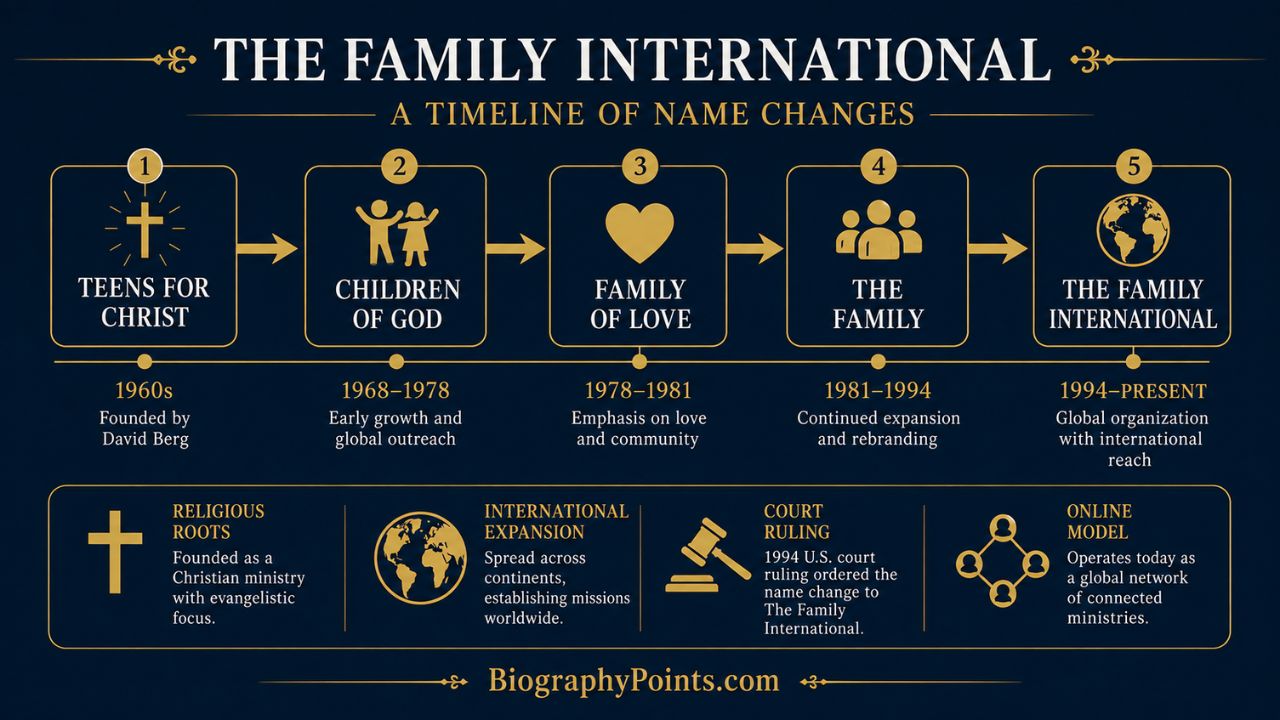
The Family International is one of the most scrutinized and controversial new religious movements in modern history — a group that began as a small Christian ministry in Huntington Beach, California, and grew into an international organization operating across dozens of countries. Founded in 1968 by American preacher David Brandt Berg, the group has operated under several names over the decades: Teens for Christ, the Children of God, the Family of Love, and simply the Family, before adopting its current name in 2004. Each name change tracked a shift in structure, doctrine, or public image — though the underlying controversies followed regardless of what the group called itself.
Berg, who led the movement under pseudonyms including Moses David and Father David, communicated with his global membership almost entirely through privately circulated publications known as the Mo Letters — a collection of nearly 3,000 documents covering everything from biblical prophecy to sexual practice. Those letters would later become central evidence in legal proceedings across multiple countries. The group’s most notorious practice, known as Flirty Fishing, directed female members to use sexual relations as a tool for recruitment and fundraising. The practice ran from the mid-1970s until its official abandonment in the late 1980s, reportedly due to the spread of AIDS.
The consequences were severe and lasting. A British court found the group to be an authoritarian cult that engaged in the systematic physical and sexual abuse of children, with survivors reporting trauma that has endured into adulthood. Investigations were launched by governments in Argentina, Australia, France, Spain, Venezuela, and Peru. Interpol and the FBI both examined the group’s activities.
This article covers the complete history of the Family International — from its origins in California’s counterculture of the 1960s through its transformation into a decentralized online network — as well as the teachings and practices that made it one of the most documented and legally examined new religious movements of the twentieth century. It draws on court records, survivor testimonies, academic research, and the group’s own official publications.

| Full Name | The Family International (TFI) |
| Also Known As | Teens for Christ; The Children of God (COG); The Family of Love; The Family |
| Founded | 1968 |
| Founder | David Brandt Berg (February 18, 1919 – October 1, 1994) |
| Founding Location | Huntington Beach, California, United States |
| Type | New Religious Movement (classified as authoritarian cult by British High Court) |
| Classification | Millenarian Christian sect |
| Renamed TFI | 2004 |
| Current Leader | Karen Zerby (retired 2025); successor not publicly confirmed |
| Previous Leader | David Brandt Berg (1968–1994) |
| Mo Letters Count | Nearly 3,000 publications |
| Flirty Fishing Period | 1976–1987 |
| Court Finding | British High Court of Justice, Family Division: authoritarian cult; widespread sexual abuse of children |
| Government Raids | Argentina (1989), Australia (1982), France, Spain, Venezuela, Peru |
| Investigations | FBI and Interpol (multiple countries) |
| Current Members | Approximately 1,100–1,450 globally |
| Countries Active | 70–100 countries |
| Organizational Model | Online decentralized network (since 2010 Reboot) |
| Charter Adopted | 1995 (last updated 2020) |
| Official Website | thefamilyinternational.org |
What is The Family International?
The Family International (TFI) is an American new religious movement founded in 1968 by David Brandt Berg in Huntington Beach, California, originally called the Children of God. A British court found the group guilty of widespread child sexual abuse. It now operates as a small online Christian network with approximately 1,100–1,450 members worldwide.
What Is The Family International?
The Family International is an American new religious movement founded in Huntington Beach, California, by David Brandt Berg. It began as a small street ministry targeting counterculture youth and expanded into an international organization with members across dozens of countries. Over the decades, it has been the subject of government investigations, court proceedings, and extensive academic study — making it one of the most documented new religious movements of the twentieth century.
Official Classification and Type
The question of what The Family International actually is depends heavily on who is answering it. The group describes itself as a Christian ministry focused on evangelism, humanitarian work, and the personal love of Jesus Christ. According to its official website, TFI operates as an online Christian network committed to sharing the Gospel worldwide.
Academic and legal institutions have reached different conclusions. The High Court of Justice, Family Division in the United Kingdom found the group to be an authoritarian cult that engaged in the systematic physical and sexual abuse of children — a ruling that remains the most significant legal characterization the group has received. Scholars of religion typically classify it as a new religious movement, a neutral academic term applied to groups that fall outside established mainstream denominations. That classification, however, does not contradict the court’s findings on conduct.
The tension between these positions — a self-described Christian ministry versus a court-designated authoritarian cult — sits at the center of nearly every serious discussion about the group. Both descriptions are documented. Both are relevant.
Name Changes Through the Decades
Few organizations have reinvented their public identity as many times as this group has. Each name change marked either a structural shift, a doctrinal evolution, or an attempt to move past controversy.
Teens for Christ was the original name, used in the period immediately before the group’s formal founding. David Berg used this name during his early outreach to young people in southern California.
The Children of God became the group’s first widely known name, coined not by Berg himself but by a journalist covering the group’s activities while members were camped in a public park. Under this name, the group grew rapidly, established communal “colonies” across the United States, and then relocated the bulk of its membership internationally in what Berg called the “Great Escape” — a mass exodus driven by his prophecy of imminent disaster striking the United States. It was also under this name that the group’s first major anti-cult opposition formed: FREECOG, or Free the Children of God, organized by parents of members.
The Family of Love replaced the Children of God name following a period of internal controversy over abuses of leadership authority. The structure shifted toward greater autonomy for individual homes. This was also the period during which the Flirty Fishing practice was most actively organized and expanded.
The Family was a shortened form used for over two decades, encompassing some of the most legally scrutinized years in the group’s history. Government raids in Argentina, Australia, and several European countries occurred during this period.
The Family International is the current name, adopted after a formal reorganization. According to the group’s official history, a comprehensive restructuring known as “the Reboot” dissolved mandatory communal centers and transitioned the organization into a fully online network of autonomous members.
Core Beliefs and Theology
At its foundation, The Family International teaches a form of evangelical Christianity centered on a personal relationship with Jesus Christ. Members believe in the authority of the Bible, the imminence of the Second Coming of Jesus, and the importance of active missionary outreach to the unconverted.
What distinguishes the group’s theology from mainstream Christianity are the additional doctrines introduced by Berg and later expanded by his successor Karen Zerby.
Berg’s Mo Letters as doctrine. Berg taught that his own writings — the privately circulated Mo Letters — carried prophetic authority equivalent to or surpassing scripture. This elevated his personal interpretations, including controversial ones, to the level of divine instruction within the group.
Spirit Helpers. Berg claimed to have made contact with the spirit of a deceased Gypsy named Abrahim, and taught members that communication with spirits of the dead was both possible and spiritually beneficial. This doctrine is considered heretical by mainstream Christian denominations. According to academic analyses of the group’s publications, the Spirit Helpers doctrine was formalized through Mo Letters and later expanded.
The Keys of the Kingdom. Developed further under Karen Zerby’s leadership, this doctrine taught members to invoke spiritual “keys” — drawn from a passage in the Gospel of Matthew — as a source of divine power in prayer and spiritual warfare.
The Loving Jesus doctrine. Introduced by Karen Zerby, this teaching encouraged members to visualize an intimate, romantic union with Jesus during prayer. Former members and religious scholars have criticized it as theologically and psychologically manipulative. It remains one of the most controversial doctrinal developments in the group’s post-Berg era.
Together, these beliefs placed the group far outside the boundaries of conventional Christianity — a distance that its own founder not only acknowledged but embraced.
The History of The Family International
Few religious movements of the modern era have undergone as many transformations — in name, structure, doctrine, and public standing — as The Family International. What began as a handful of young people gathered around a preacher in coastal California grew into a global organization active across dozens of countries. That growth came at a significant cost: persistent legal scrutiny, government raids on multiple continents, and a British court ruling that remains the most damning legal characterization any religious group of its kind has received.
Origins — The Children of God (1968–1977)
David Brandt Berg did not set out to found a new religion. In 1968, he arrived in Huntington Beach, California, with his wife and four teenage children, intending to help his retired mother with her existing Christian outreach. What he found instead was an audience — the disaffected, spiritually searching young people of the counterculture era who had gathered in the beach towns of southern California with nowhere particular to go.
Berg’s ministry to these young people grew quickly. Within months, dozens of followers had attached themselves to him, drawn by his apocalyptic message and his rejection of mainstream churches, which he characterized as corrupt and spiritually dead. He encouraged his followers to sever ties with their families, surrender their possessions to the group, and commit to full-time communal life. The early structure was built around what the group called “colonies” — communal households where members lived, worked, and evangelized together.
The name “Children of God” was not Berg’s own invention. According to documented accounts, a journalist covering the group’s activities while members were camped at Lewis and Clark Park coined the phrase. Berg adopted it. It stuck. The group formally operated under this name from 1968 through 1978.
By 1971, the group claimed approximately four thousand members, most of them teenagers and young adults. That same year, Berg had declared himself a prophet — a self-appointment he formalized through his written communications to followers. Parents of members were alarmed. Many believed their children had been psychologically manipulated into abandoning their education, families, and futures. In response, a group of parents formed FREECOG — Free the Children of God — one of the earliest organized anti-cult movements in American history.
Also in November 1971, the group’s first major American base — a 425-acre colony near Thurber, Texas, operating on land owned by the American Soul Clinic — was evicted following a serious disagreement with the property’s owner, Fred Jordan. The eviction accelerated Berg’s decision to relocate his followers internationally.
Berg responded to mounting domestic pressure with a dramatic move. He prophesied that a comet would strike the United States, triggering catastrophic destruction. This prophecy became the justification for what he called the “Great Escape” — a mass relocation of Children of God members out of the United States. Members scattered across Europe, South America, India, and Australia, establishing new colonies wherever they landed. By 1972, the group had reached over 130 communities internationally. The international phase of the group’s history had begun.
To sustain itself financially during this expansion, Berg introduced a practice he called “litnessing” in 1973 — the distribution of religious literature, primarily Mo Letters in pamphlet form, in exchange for donations on street corners and public spaces. It became the group’s primary source of income and a defining feature of its public presence throughout the decade.
Also in the mid-1970s, Berg began privately circulating a new theological concept to senior members that would soon become the group’s most notorious practice. By 1976, it had been formally introduced to the wider membership under the name Flirty Fishing.
The Family of Love (1978–1981)
In 1978, the Children of God rebranded as the Family of Love. The name change followed a period of internal controversy in which abuses of authority within the leadership had been exposed. The previous rigid hierarchy — built around Berg at the top, followed by apostles, elders, and deacons — was replaced by a more decentralized model in which individual “homes” operated with considerable autonomy. Each communal household became, in theory, a self-governing unit.
In practice, Berg’s authority remained absolute. He had been living in complete seclusion since 1971, his identity and location hidden even from most members. His Mo Letters remained the primary instrument of governance — arriving regularly and carrying the weight of prophetic scripture within the group. Members anticipated each new letter as potentially life-altering, capable of introducing doctrinal shifts or behavioral requirements that would reshape daily life overnight.
It was during this period that the Flirty Fishing practice was most actively organized and expanded. What had begun as a privately circulated theological concept in 1976 was developed into a structured program by 1978. Female members were organized into outreach teams, and Berg’s internal reports boasted of the practice’s reach — claiming hundreds of thousands of “witnessing” encounters and tens of thousands of sexual contacts with outside men. International law enforcement took notice. Investigations by Interpol and the FBI increased in frequency as reports from former members and concerned families reached authorities in multiple countries.
The Family (1982–1994)
In 1982, the group shortened its name to simply “The Family” — a change that coincided with continued efforts to moderate its public image while maintaining internal doctrinal continuity.
The most significant practical change of this era was the official end of the Flirty Fishing practice in 1987. Berg formally discontinued it, citing the spread of AIDS and the health risks it posed to members. The decision was pragmatic rather than moral — the practice had become operationally unsustainable. Sexually transmitted infections had spread within the group, and the legal exposure it created had become increasingly difficult to manage.
The end of Flirty Fishing did not end scrutiny of the group’s practices. In 1982, Australian authorities conducted their first significant raids on Family homes. In 1989, the Argentine government launched one of the most extensive raids on Family properties to date, citing concerns about child welfare. Further raids followed in 1992 in Australia.
In the United Kingdom, a landmark court case produced conclusions that would define the group’s public identity for decades. The High Court of Justice, Family Division found that there had been widespread sexual abuse of young children and teenagers by adult members of The Family — a finding based on extensive documentation, including Berg’s own writings and videotape evidence submitted to him by members.
Berg’s health declined sharply through the early 1990s. Karen Zerby, his common-law wife since 1970, had been managing increasing operational and spiritual responsibilities within the group. Berg died on October 1, 1994, in Costa de Caparica, Portugal, where he had been living in hiding. He was buried there, and his remains were later cremated. He was 75 years old. Despite years of legal investigation across multiple countries, he was never criminally convicted for any of the conduct documented in court proceedings.
The Family Under Charter (1995–2003)
With Berg’s death in October 1994, Karen Zerby assumed full spiritual and administrative leadership of the group. She had been Berg’s secretary since 1969, then his companion, then effectively his co-leader — and she was already the dominant operational force within the organization by the time he died. Her succession was not disputed internally. Shortly after assuming leadership, she formally married her long-time partner Steven Douglas Kelly, known within the group as Peter Amsterdam.
One of Zerby’s first major acts as leader was the adoption of a formal Membership Charter in 1995. The Charter codified the group’s beliefs, membership requirements, and the rights and responsibilities of full-time members — a significant structural shift for an organization that had previously operated entirely on the basis of Berg’s personal directives. The Charter represented an attempt to institutionalize the movement and give it the kind of documented governance framework that established religious organizations possessed.
Critically, the 1995 Charter explicitly prohibited any form of sexual activity involving minors — an acknowledgment, however indirect, that such activity had occurred within the group’s history.
Continued international investigations marked this period. Law enforcement agencies in France, Spain, Venezuela, and Peru examined Family homes and practices throughout the late 1990s and early 2000s. Meanwhile, a generation of members who had been born and raised within the group — known internally as second-generation adults, or SGAs — were reaching adulthood. Many began to leave. Some began to speak publicly. By the early 2000s, memoirs and formal testimonies from former members were beginning to appear, adding personal accounts to the legal and academic record that had been accumulating for decades.
In 1997, Karen Zerby legally changed her name to Katherine Rianna Smith, continuing the group’s pattern of leadership secrecy.
The Family International (2004–Present)
In 2004, the group adopted its current name, The Family International — a change intended to signal institutional maturity and distance from the controversies attached to earlier names.
The name change was followed, several years later, by the most dramatic structural transformation in the organization’s history. Following a two-year internal review process beginning in 2008, the group undertook a comprehensive reorganization it called “the Reboot,” finalized in 2010. Mandatory communal living — the defining feature of the group’s structure since its founding in 1968 — was discontinued. The majority of communal centers worldwide were closed. Members were released from the obligation to live together and were encouraged to continue their faith and missionary work as autonomous individuals and families, connected through an online network rather than physical households.
The Membership Charter was last updated in 2020 to reflect the post-Reboot organizational structure and revised membership requirements.
The practical effect of the Reboot was a significant reduction in membership and organizational scale. From a peak membership of several thousand members across fifty countries at the time of Berg’s death in 1994, the group contracted to an estimated 1,100 to 1,450 active members globally by the 2020s. Those members continue to conduct missionary and humanitarian work in 70 to 100 countries, focusing on personal evangelism, distribution of religious materials, and charitable activities including food distribution and support for vulnerable populations such as refugees, orphans, and the homeless.
Karen Zerby served as co-director of the reorganized network alongside Steven Kelly until her retirement in 2025 — marking the end of a leadership tenure that had spanned more than three decades. Since the group’s founding in 1968, its members have collectively produced and distributed over 1.1 billion pieces of gospel literature in 61 languages and over 16.6 million audio and visual recordings in 20 languages, according to TFI’s own official records.
Whether the organization’s current form represents genuine reform or institutional continuity under a different structure remains a matter of significant debate among scholars, survivors, and observers of new religious movements.
Who Was David Brandt Berg?
David Brandt Berg was an American preacher born on February 18, 1919, in Oakland, California, who founded one of the most controversial religious movements of the twentieth century. The group he created in 1968 in Huntington Beach, California — originally called the Children of God — would eventually operate under multiple names across dozens of countries, attract tens of thousands of followers at its peak, and become the subject of criminal investigations on multiple continents.
Berg came from a deeply religious family. His mother, Virginia Brandt Berg, was a well-known Christian evangelist. His father, Hjalmer Emmanuel Berg, was a minister affiliated with the Christian and Missionary Alliance. His maternal grandfather, Rev. John Lincoln Brandt (1860–1946), was a Disciples of Christ minister, author, and lecturer from Muskogee, Oklahoma. Religion was not simply a household presence in Berg’s upbringing — it was the family profession, across multiple generations.
He graduated from Monterey High School in California in 1935 and later attended the Elliott School of Business Administration, though no university degree is documented in verified sources. In 1941, he was drafted into the United States Army but was discharged on medical grounds. He was subsequently ordained by the British-American Ministerial Federation. On July 22, 1944, he married Jane Miller in Glendale, California. The couple had four children: Linda, Paul Brandt, Jonathan Emanuel, and Faith.
For the next two decades, Berg attempted to establish himself within mainstream Christian institutions. He joined the Christian and Missionary Alliance in 1948 and worked in ministry in Valley Farms, Arizona, and elsewhere. None of it took root. He was passed over, pushed aside, and failed to build a lasting congregation within any established denomination. By the mid-1960s, he was working alongside his mother in her television and radio ministry — and growing increasingly disillusioned with organized Christianity as a whole.
That disillusionment would become the theological fuel for everything that followed.
Berg is remembered today not for conventional ministry but for what a British court formally characterized as cult leadership — the founding and direction of an authoritarian organization found by the High Court of Justice, Family Division to have engaged in the systematic physical and sexual abuse of children. He authored nearly 3,000 Mo Letters — privately circulated documents that functioned as doctrine, law, and personal instruction for his followers worldwide. He introduced the Flirty Fishing practice, directing female members to use sexual relations as a tool for recruitment. He lived in complete seclusion from 1971 until his death, communicating entirely through written letters while evading law enforcement across multiple countries.
He died on October 1, 1994, in Costa de Caparica, Portugal, at the age of 75. He was never criminally convicted.
Founding The Children of God (1968)
In 1968, Berg made a decision that would define the rest of his life. He moved with his wife Jane and their four children to Huntington Beach, California, where his retired mother was running a small Christian coffeehouse ministry targeting the young counterculture crowd that had flooded the town. Berg was forty-nine years old. He had no particular plan beyond helping his mother. What happened instead was the beginning of the Children of God.
The young people Berg encountered in Huntington Beach were unlike the congregations he had tried and failed to build in mainstream churches. They were disaffected, spiritually curious, suspicious of institutions, and hungry for community. Berg spoke their language. He rejected the same establishments they rejected. He told them that mainstream churches were corrupt, that society was collapsing, and that they — the outcasts and the wanderers — were the ones God had chosen. The message landed.
Growth was rapid. Within months, a small group of coffeehouse regulars had become a dedicated following of dozens, then hundreds. Members began living communally, pooling resources, and committing to full-time evangelism. These early communal households were called “colonies” — a term that reflected the group’s self-image as a separate society living apart from the corrupt world outside.
Berg responded to this growth by consolidating his authority. He began presenting himself not merely as a pastor or teacher but as a prophet — a figure with direct divine communication and unique spiritual authority. He adopted a series of prophetic pseudonyms that he would use interchangeably for the rest of his life: Moses David, Mo, Father David, and King David. The names were deliberate. Moses led people out of bondage. David was a king chosen by God. Berg was positioning himself as both.
By 1969, the group had grown to approximately two hundred members and had begun traveling the country, preaching an urgent apocalyptic message. It was during this period, while the group was encamped at Lewis and Clark Park, that a journalist covering their activities first referred to them as “the Children of God.” Berg adopted the name. It became the group’s first widely known public identity — and the name under which its earliest and most formative controversies would unfold.
The Children of God had begun.
The Mo Letters — David Berg's Written Doctrine
The Mo Letters were the primary instrument through which David Brandt Berg controlled, directed, and shaped the beliefs of his followers across the world — without ever meeting most of them in person. Comprising more than 3,000 individual publications written and distributed over nearly three decades, they functioned simultaneously as sacred scripture, legal code, and personal correspondence for the Children of God and its successor organizations.

What Are the Mo Letters?
The Mo Letters are a series of more than 3,000 publications produced by David Brandt Berg, founder of the Children of God and The Family International. The name “Mo” derives from Berg’s prophetic pseudonym “Moses David.” The letters consisted of Berg’s personal writings, theological teachings, and transcribed speeches, and were distributed to members worldwide as the authoritative voice of both God and leadership.
Berg began writing to his followers in the earliest years of the movement, initially as practical guidance for colony life. Over time, the letters evolved into something far more encompassing — a continuously expanding body of doctrine that members were expected to read, study, and obey. The letters were recorded primarily by Karen Zerby, Berg’s common-law wife and personal secretary, who transcribed his spoken words and submitted them to World Services — the group’s internal publishing operation — for editing, security censorship, and reproduction.
Distribution was swift. Most letters reached Family members within weeks of their initial creation, often accompanied by illustrated artwork. Members described the arrival of new letters as a major event — an experience they called receiving “new wine.” This term reflected the belief that each new letter might contain fresh revelation capable of altering doctrine, daily life, or behavioral expectations overnight. The anticipation was by design. It kept members psychologically engaged with Berg’s authority even across vast geographic distances.
Berg produced letters continuously from the late 1960s until his death in October 1994 — a period of roughly twenty-six years. The complete collection was compiled into more than a dozen volumes, representing one of the most extensive bodies of written material produced by any single leader of a new religious movement in the twentieth century.
Categories and Classification
Not all Mo Letters were created equal — and not all of them were meant for the same eyes. Berg developed a formal classification system that determined who could read each letter, how it could be shared, and what consequences would follow if distribution rules were violated.
DO — Disciples Only was the most restricted category. Letters marked DO contained internal doctrine, sensitive instructions, and material that Berg explicitly prohibited from sharing with anyone outside the group. These letters formed the inner core of the movement’s private belief system — the teachings that members lived by but were forbidden to discuss publicly. Violation of DO distribution rules was treated as a serious offense, carrying the threat of excommunication from the community.
DFO — Disciples and Friends Only represented a middle tier. These letters could be shared with individuals who had a close relationship with the group — sympathizers, prospective members, or trusted outside contacts — but were not intended for general public distribution.
GP — General Public letters were designed for street distribution. These were the pamphlets and tracts that members handed out during litnessing activities in exchange for donations. GP letters presented a carefully curated version of Berg’s message — accessible, spiritually appealing, and stripped of the more extreme content reserved for DO and DFO distribution. To an outsider receiving a GP letter on a street corner, the Children of God might have appeared to be an enthusiastic but otherwise unremarkable evangelical ministry.
The gap between what the GP letters presented and what the DO letters contained was vast. That gap was intentional.
Content and Doctrinal Scope
The range of subjects Berg addressed across nearly 3,000 letters was extraordinary. No aspect of a member’s life was considered outside the scope of his written authority.
Biblical teaching and prophecy formed the theological backbone of the letters. Berg wrote extensively on end-times prophecy, the imminent Second Coming of Jesus, the rise of the Antichrist, and the corruption of modern civilization. These teachings gave the movement its urgent, apocalyptic character and justified members’ separation from mainstream society.
Practical commune management was covered in considerable detail — letters addressed finances, food distribution, evangelism quotas, interpersonal conflicts, and the daily logistics of communal life. For a movement that operated dozens and eventually hundreds of colonies across multiple continents, the letters served as a management system as much as a religious text.
Sexual doctrine evolved significantly through the letters and represents their most legally consequential dimension. Beginning in the mid-1970s, Berg used the letters to introduce and then formally establish the Flirty Fishing practice, providing explicit instructions for how female members should engage in sexual relations with outside men as a form of evangelism. Later letters expanded the group’s sexual theology further, introducing doctrines of “sexual sharing” among adult members and, in some cases, content that endorsed or normalized sexual contact involving minors.
Antisemitic and anti-capitalist content appeared throughout the letters with regularity. Berg characterized Jews, mainstream churches, capitalism, and Western governments as instruments of corruption and spiritual oppression. These positions were not peripheral — they were woven into the movement’s theological framework.
Spirit Helpers and communication with the dead were addressed in multiple letters. Berg claimed personal contact with the spirit of a deceased Gypsy named Abrahim and taught members that communication with spirits of the departed was spiritually legitimate and beneficial. These teachings placed the group in direct conflict with orthodox Christian theology.
Letters endorsing sexual contact with minors constituted the most damaging material in the collection. When the High Court of Justice in the United Kingdom examined the group’s activities, the Mo Letters themselves were entered as evidence. Specific letters containing explicit content involving children were cited in the court’s findings of widespread child sexual abuse within the group. Berg’s own written words, distributed to members as divine instruction, became the documentary foundation for the British court’s landmark ruling.
Legacy of the Mo Letters
The Mo Letters outlasted their author. Berg died in October 1994, but the letters he produced remained the foundational sacred text of The Family International long after his death. More than 3,000 letters, compiled into over a dozen volumes, constitute the core of the movement’s doctrinal archive — a body of writing that members of the group treated as prophetic scripture for decades.
As a historical and legal document, the collection is equally significant. The letters were used as evidence in legal proceedings in multiple countries, including the United Kingdom, where the court’s findings relied substantially on what Berg had written and distributed to his own followers. The letters did not require interpretation or extrapolation — they stated Berg’s positions in his own words, often with explicit detail.
After Berg’s death, Karen Zerby and Steven Kelly continued the tradition of written leadership communication through a successor publication series known as the “Good News” magazines — referred to by members simply as “GNs.” These publications continued the Mo Letter tradition of written prophetic direction from leadership, though their content reflected the doctrinal revisions and organizational changes of the post-Berg era.
The Mo Letters remain publicly documented through archives maintained by former members and academic researchers. The xFamily.org database — a resource compiled by ex-members — contains records of the majority of Mo Letters by title and number, providing one of the most comprehensive public catalogs of the collection. The letters are also referenced extensively in academic studies of new religious movements, survivor memoirs, and journalistic investigations of the group.
For researchers, survivors, and anyone seeking to understand how David Brandt Berg maintained absolute authority over tens of thousands of people across dozens of countries without ever meeting most of them — the Mo Letters are the answer.
Flirty Fishing — The Most Controversial Practice
Of all the practices associated with the Children of God and The Family International, none attracted more legal scrutiny, public outrage, or lasting damage to the group’s reputation than Flirty Fishing. It was not a peripheral experiment or a misunderstood policy. It was a formally introduced, doctrinally justified, organizationally structured program — directed in writing by David Brandt Berg himself — in which female members of the group used sexual relations with outside men as a tool for evangelism, recruitment, and fundraising. It ran for over a decade.

What Was Flirty Fishing?
Flirty Fishing was an evangelism practice employed by the Children of God — later known as The Family International — in which female members used flirtation and sexual relations to attract, convert, and financially support the recruitment of male outsiders. The practice was active from 1976 to 1987 and was introduced by founder David Brandt Berg through his privately circulated Mo Letters.
The theological justification Berg offered was drawn from the Gospel of Matthew, chapter 4, verse 19, in which Jesus tells two fishermen: “Follow me, and I will make you fishers of men.” Berg reinterpreted this passage to mean that women in his movement should act as literal lures — using their physical and sexual appeal to “catch” men for God. The men being targeted were called “fish.” The women who participated were called “FFers” — short for Flirty Fishers.
Berg’s own Mo Letters were explicit about the nature and intent of the practice. He referred to participating women as “Hookers for Jesus” and “God’s Whores” — language that appeared in the internally circulated letters that governed members’ lives. The primary targets of Flirty Fishing were described in those same letters as “lonely traveling businessmen” — men staying in hotels, frequenting bars, and considered socially vulnerable to the kind of personal attention the practice was designed to provide.
The term itself was derived from Berg’s reading of scripture, but the practice it described was, by any legal or conventional definition, prostitution conducted under religious framing.
How Flirty Fishing Worked in Practice
The practice was not left to individual interpretation. Berg organized it, documented it, and reported on it with the same administrative detail he applied to financial quotas and colony management.
Women were sent out to bars, hotels, nightclubs, and public spaces — anywhere that lonely or socially isolated men might be found. Their instructions were to make contact, build a personal connection, and ultimately engage in sexual relations as an expression of what Berg called “God’s Love.” The sexual encounter was framed not as exploitation but as ministry — a physical demonstration of divine care for a man who had not yet found God.
Donations or conversions were expected outcomes. A man who had been “fished” was ideally expected to either convert to the group, contribute financially, or both. In practice, many encounters produced donations without conversion — which the group accepted as a legitimate result, given the fundraising pressures faced by international communes.
Berg tracked the practice’s results and reported on them internally. His own annual reports to members claimed that FFers had witnessed to over a quarter of a million men and had “loved” — meaning engaged in sexual relations with — over 25,000 of them. These figures appeared in his Mo Letters as evidence of the practice’s spiritual success.
The practice expanded rapidly following the group’s 1978 rebranding to the Family of Love. Under the new, more decentralized structure, individual homes had greater autonomy, and Flirty Fishing became more widely and systematically organized. Women were grouped into teams for “FFing” expeditions, with activity concentrated in tourist areas, international hotels, and cities with large populations of traveling foreign businessmen. Some women engaged in the practice on a near-daily basis. Some received payment directly, which was contributed to commune funds — a feature that made the practice indistinguishable from organized prostitution in the jurisdictions where it operated.
A Family spokesman quoted in a 1993 report by The New York Times described the primary targets as “lonely traveling businessmen” staying in hotels — a characterization that aligned precisely with what Berg had written in the Mo Letters years earlier.
Why Flirty Fishing Ended
Flirty Fishing did not end because leadership concluded it was morally wrong. It ended because it became unsustainable. The most immediate cause was the spread of sexually transmitted infections within the group. Women engaged in Flirty Fishing were having unprotected sexual contact with large numbers of men outside the group, and infections spread both into the communes and between members internally. The health consequences were documented and serious.
The formal announcement ending the practice came in 1987, with the AIDS epidemic cited as the official reason. Berg acknowledged in his communications to members that the risk of HIV transmission made continuation of Flirty Fishing untenable. The decision was presented as a protective measure for members — not as a moral reversal or an admission that the practice had been wrong.
External pressure had also been building for years. Interpol and the FBI had both opened investigations into the group’s activities, partly in response to the Flirty Fishing reports that had reached law enforcement through former members and concerned family contacts. Anti-cult organizations, including the Cult Awareness Network, had been gathering and publicizing member testimonies throughout the 1980s. The combination of legal exposure, health risk, and public attention made the practice impossible to continue without existential consequences for the organization.
Member testimonies — many of which began reaching the media through the mid-1980s — described the practice in detail, providing journalists, researchers, and law enforcement with first-hand accounts that corroborated what the Mo Letters had already documented in the group’s own words.
Legal and Social Consequences
The consequences of Flirty Fishing extended well beyond its official end date of 1987. The practice generated legal and investigative responses that continued for years afterward — and its documentation in Berg’s own Mo Letters ensured that it remained permanently on the record.
Interpol and FBI investigations were triggered in part by the volume and consistency of reports about Flirty Fishing emerging from former members across multiple countries. The international scale of the practice — operating across Europe, South America, Asia, and Australia — brought it within the jurisdiction of multiple national law enforcement agencies simultaneously.
The Argentine government’s 1989 raids on Family homes were among the most extensive government actions taken against the group. While the raids were motivated by broader concerns about child welfare, the documented history of Flirty Fishing formed part of the evidentiary background that made authorities willing to act. Australian raids in the same period followed similar patterns.
In the United Kingdom, the High Court of Justice, Family Division addressed Flirty Fishing as part of its broader examination of the group’s sexual practices. The court’s findings — that there had been widespread sexual abuse of young children and teenagers by adult members of The Family — situated Flirty Fishing within a larger pattern of sexual exploitation that the group had institutionalized through Berg’s written doctrine. The Mo Letters, which contained Berg’s own instructions for the practice, were presented as evidence.
The practice has been documented extensively in survivor literature. Faith Jones, granddaughter of David Brandt Berg, published her memoir Sex Cult Nun — a first-hand account of growing up within the Children of God that details the Flirty Fishing practice, its organizational structure, and its impact on the women who were directed to participate. Jones’s account, along with those of other former members, brought renewed public attention to the practice and contributed to ongoing scholarly and journalistic examination of the group’s history.
Flirty Fishing remains, in the documented record of new religious movements, one of the most extensively evidenced cases of institutionalized sexual exploitation conducted under religious justification in the modern era.
Teachings and Beliefs of The Family International
To understand the controversies surrounding The Family International, it is necessary to first understand what the group actually taught — and how those teachings evolved over decades of leadership, doctrinal revision, and organizational change. The group’s theology began as a form of apocalyptic evangelical Christianity and progressively incorporated doctrines that placed it far outside the boundaries of any mainstream Christian tradition. Some of those doctrines were unusual. Others were, by the assessment of courts, scholars, and survivors, actively harmful.
What follows is a summary of the group’s core teachings as documented in its own publications, academic analyses, and verified historical records.
Biblical Interpretation
At its foundation, The Family International built its theology on the Bible — specifically on an apocalyptic, millenarian reading of Christian scripture that treated the end of the world not as a distant theological abstraction but as an imminent, lived reality that demanded immediate and radical action.
David Brandt Berg taught his followers that the Second Coming of Jesus Christ was approaching rapidly — that the signs described in the Book of Revelation, the Gospel of Matthew, and the prophecies of Daniel were being fulfilled in real time. This conviction gave the movement its urgent character. If the world was ending, there was no justification for conventional life — no reason to stay in school, maintain a career, preserve family ties outside the group, or invest in the kind of future that ordinary society offered. Berg used this framework to justify the total commitment he demanded from members: forsaking possessions, severing outside relationships, and surrendering personal autonomy to the group’s communal structure.
Mainstream Christian churches occupied a particular position in Berg’s theology — they were not simply inadequate. They were corrupt. Berg characterized organized Christianity, along with Western governments, capitalism, and conventional society broadly, as “the system” — a spiritually bankrupt structure controlled by forces opposed to God. This framing served a clear organizational purpose: it positioned leaving the group as spiritually catastrophic, since the only legitimate Christian community, in Berg’s teaching, was the one he led.
This apocalyptic framework was not static. Berg updated and revised his prophetic timeline repeatedly through the Mo Letters, introducing new predictions, reinterpreting failed ones, and continuously reinforcing the sense of urgency that kept members psychologically bound to the group and its leadership.
Spirit Helpers Doctrine
Among the more theologically distinctive — and, to mainstream Christians, doctrinally alarming — teachings of The Family International was the Spirit Helpers doctrine: the belief that the spirits of deceased individuals could be contacted, communicated with, and enlisted as spiritual guides and helpers by living members of the group.
The doctrine originated with David Berg’s own claimed experiences. Berg reported that while in a Gypsy camp, he had made contact with the spirit of a deceased Gypsy man named Abrahim, who became his personal spiritual guide. Berg described Abrahim in his Mo Letters with considerable detail — his personality, his speech patterns, his humor — and presented the relationship as a model for the kind of spiritual companionship that all members could potentially access.
From this starting point, the doctrine expanded. Members were taught that they could pray for and receive the guidance of departed spiritual figures — not only anonymous Gypsy spirits, but historical figures, biblical characters, and others from beyond the grave. This practice of communication with the dead placed the group in direct and irreconcilable conflict with orthodox Christian theology, which across virtually all major traditions explicitly prohibits such contact on scriptural grounds.
Academic scholars of new religious movements have noted the Spirit Helpers doctrine as one of the clearest examples of the group’s departure from any form of recognizable Christian orthodoxy. For members inside the group, however, the doctrine was presented as an extension of divine grace — a gift that allowed believers to access spiritual wisdom and support unavailable to those outside the movement.
The Keys of the Kingdom
The Keys of the Kingdom doctrine was developed and formalized primarily under the leadership of Karen Zerby following David Berg’s death in October 1994, though its scriptural foundation had been referenced in Berg’s writings during his lifetime.
The doctrine drew on a passage from the Gospel of Matthew, chapter 16, verse 19, in which Jesus tells the apostle Peter: “I will give you the keys of the kingdom of heaven.” Zerby’s teaching reinterpreted this passage to mean that members of The Family International had been given access to specific spiritual “keys” — invocable sources of divine power that could be called upon in prayer, spiritual warfare, and daily life.
Members were instructed to invoke these keys by name during prayer — treating them not as a metaphor but as active spiritual instruments. The practice was presented as a source of protection, guidance, and supernatural empowerment available exclusively to committed members of the group. Published extensively through the “Good News” magazines — the successor publications to Berg’s Mo Letters, produced by Zerby and Steven Kelly — the Keys of the Kingdom doctrine became one of the defining theological features of the post-Berg era.
Critics of the doctrine, including former members and scholars of religion, noted that its practical effect was to reinforce the group’s claim to exclusive spiritual access — the suggestion that members possessed a divine resource unavailable anywhere else. This exclusivity served the same organizational function that Berg’s prophetic authority had served during his lifetime: it made leaving the group feel spiritually costly in a way that went beyond ordinary religious disaffiliation.
The "Loving Jesus" Doctrine
Of all the theological developments introduced under Karen Zerby’s leadership, none generated more controversy — internally and externally — than the doctrine known as “Loving Jesus.”
Introduced in the mid-1990s, the Loving Jesus doctrine encouraged members to cultivate what Zerby described as an intimate, romantic, and physically expressive union with Jesus Christ during prayer and worship. Members were directed to visualize Jesus as a physical presence and to express their devotion to him in language and imagery drawn from romantic and sexual experience. Male members, in particular, were instructed to set aside any discomfort with the feminized posture this required — framing such discomfort as a spiritual obstacle to be overcome.
The doctrine was published and distributed through the Good News magazines and presented as a deepening of the group’s existing emphasis on the personal love of Jesus. According to Zerby’s framing, physical and spiritual intimacy were not separate categories — and the fullest expression of love for Jesus was one that engaged the whole person, including the body.
The response from former members and outside observers was sharply critical. Ex-members described the doctrine as psychologically manipulative — an extension of the group’s broader pattern of using sexual framing to override personal boundaries and normalize intimate contact as a form of spiritual obligation. Scholars of new religious movements noted that the Loving Jesus doctrine represented a significant escalation of the group’s tendency to sexualize its theology, building on the same ideological foundation that had previously produced the Flirty Fishing practice.
Mainstream Christian theologians uniformly rejected the doctrine as having no basis in orthodox Christian teaching. The visualization of Jesus in romantic or sexual terms is considered by virtually all Christian traditions — Catholic, Protestant, and Orthodox — to be theologically indefensible and spiritually dangerous.
The Loving Jesus doctrine has remained one of the most discussed and documented aspects of The Family International’s post-Berg theology, appearing in survivor memoirs, academic studies, and journalistic investigations of the group’s practices.
Criticism, Investigations, and Legal Actions
The Family International — across its various names and incarnations — has been the subject of more sustained legal scrutiny, government investigation, and formal judicial examination than almost any other new religious movement of the twentieth century. The investigations were not the product of isolated complaints or cultural misunderstanding. They were triggered by consistent, corroborated, and extensively documented reports of physical abuse, sexual exploitation, and child endangerment — reports that came from former members, concerned families, law enforcement agencies, and ultimately from the group’s own published writings.

This section documents the major legal proceedings, government actions, individual criminal cases, and survivor accounts that form the verified record of criticism against The Family International.
The British Court Ruling
The most significant legal characterization of The Family International came from the High Court of Justice, Family Division in the United Kingdom — one of the most authoritative judicial bodies in the English-speaking world for matters involving child welfare and family law.
The court’s findings were unambiguous. It ruled that there had been “widespread sexual abuse of young children and teenagers by adult members of The Family” — a conclusion reached after extensive examination of evidence that included the group’s own internal publications, the Mo Letters, and testimony from former members. The court further characterized the organization as an “authoritarian cult” — a legal designation that carried significant weight in subsequent public and academic discussions of the group’s nature.
The ruling documented not merely isolated incidents but a systematic pattern of abuse — one that had been enabled, justified, and in some cases directly instructed by the group’s leadership through written doctrine. Survivors of that abuse have described lasting psychological trauma that has extended into adulthood, a finding that has been referenced in both academic literature and subsequent legal proceedings in other jurisdictions.
The British ruling remains the most authoritative single legal document in the public record concerning The Family International’s conduct toward children. It has been cited extensively in scholarly analyses of the group and continues to serve as the foundational legal reference point for journalists, researchers, and former members seeking to establish the verified historical record.
Government Raids Worldwide
The British court ruling did not occur in isolation. By the time it was handed down, government authorities across multiple continents had already been investigating The Family International for years — conducting raids, interviewing members, removing children from homes, and attempting to assess the welfare conditions inside the group’s communal residences.
Argentina, 1989, saw the largest single government action against the group. Argentine authorities raided Family homes across the country, citing concerns about child welfare and the practices documented in former members’ testimonies. The scale of the operation reflected the seriousness with which the Argentine government treated the accumulated evidence against the group. Children were temporarily removed from Family homes as part of the investigation.
Australia was among the first countries to take direct action, with raids on Family homes beginning as early as 1982 and continuing in subsequent years. Australia’s geographic position — the group had established a presence there as early as 1972 — made it one of the earliest international jurisdictions to grapple with the group’s activities outside the United States.
France, Spain, Venezuela, and Peru all conducted formal investigations into Family operations during the 1980s and 1990s. The consistency of the pattern across jurisdictions — multiple governments on multiple continents reaching similar conclusions through independent investigations — is itself a significant feature of the historical record.
Interpol and the FBI both opened formal investigations into the group’s international activities. The cross-border nature of the group’s operations — members moved between countries, children were relocated internationally, and leadership remained in deliberate hiding — made international law enforcement cooperation essential to any meaningful investigation.
The outcome of most individual investigations was legally inconclusive in terms of criminal prosecution. Authorities in several countries found no evidence of ongoing abuse at the time of their investigations, though they could not — and in several cases explicitly did not — deny the historical evidence of past abuse. The absence of criminal convictions in most jurisdictions reflected the practical difficulties of prosecuting offenses that had occurred years earlier within a closed community whose members were instructed not to cooperate with outside authorities, rather than the absence of documented harm.
Notable Member Crimes
Beyond the broader pattern of institutional abuse, the documented record includes specific criminal cases involving individual members of The Family International — cases that illustrate the legal consequences that eventually reached some of those operating within the group’s orbit.
Peter Bevan Riddell, an Australian member of the group, was directly connected to child abduction facilitation. The Australian government cancelled his passport, and he was subsequently deported from Japan to Australia, where he was convicted of committing forgery and making false statements in connection with the unlawful abduction of a child. After serving his sentence, Riddell returned to Japan, where he continued to work on behalf of David Berg and Karen Zerby through the group’s internal World Services operation — the same body responsible for producing and distributing the Mo Letters.
Brian Edward Pickus, another member, became the subject of an Interpol arrest warrant issued at the request of the United States and the state of Hawaii. The warrant covered charges of kidnapping, burglary, and unlawful flight to avoid prosecution. Pickus remained a wanted fugitive for decades, his case representing one of the most longstanding unresolved individual criminal matters connected to the group.
Ricky Rodriguez — born Davidito, the biological son of David Brandt Berg and Karen Zerby, and raised within the group as a kind of living doctrinal example — became one of the most tragic figures in the organization’s history. Rodriguez had been the subject of a children’s publication produced by the group called The Story of Davidito, which documented his upbringing within the commune in terms that former members and legal experts later identified as evidence of child abuse. As an adult, Rodriguez became an outspoken critic of the group and of his mother, Karen Zerby. In January 2005, he murdered Angela Smith, a former nanny who had been present during his childhood, and subsequently died by suicide. His case drew international media attention and renewed public scrutiny of The Family International’s history of child-rearing practices.
Survivor Accounts and Memoirs
The documented record of The Family International’s history is not built solely on court rulings and government raids. It is also built on the testimonies of people who lived inside the group — who were born into it, raised within it, and who eventually left and spoke publicly about what they had experienced.
Faith Jones, the granddaughter of David Brandt Berg and daughter of one of Berg’s senior lieutenants, published her memoir Sex Cult Nun — a detailed, first-hand account of growing up within the Children of God and The Family International. Jones’s book, published to significant critical attention, described the group’s mandatory sexual sharing practices, the educational neglect experienced by children raised in the communes, the psychological mechanisms used to maintain member compliance, and the profound difficulties of leaving a community that had been the entirety of one’s known world. Jones became one of the most publicly prominent voices among the group’s second-generation survivors.
River Phoenix, the American actor, was a child member of the Children of God whose family had joined the group during his early childhood. Phoenix, who later became one of the most celebrated young actors of his generation before his death in 1993, disclosed in interviews that he had experienced sexual abuse as a young child within the group. His account was among the earliest high-profile public testimonies from a former member and contributed to the growing public awareness of the group’s practices during the 1980s.
Academic research has suggested that second-generation exit rates from The Family International exceeded fifty percent by some estimates — meaning that the majority of people raised within the group ultimately left it as adults. The precise figure is difficult to verify given the organization’s historical opacity regarding membership data, but the general pattern of high departure rates among those raised within the group has been consistently noted in scholarly literature.
The ongoing stream of documentaries, investigative journalism, and media reporting about The Family International — which has continued into the present decade — reflects the sustained public interest in the group’s history and the degree to which that history remains unresolved for many of those affected by it. Each new memoir, documentary, or news investigation adds to a public record that began accumulating in the early 1970s with the formation of FREECOG and has never fully closed.
The Family International Today — Current Status and Structure
The Family International still exists. That fact alone surprises many people who assumed that the legal proceedings, government raids, and public scrutiny of the late twentieth century had brought the organization to an end. They did not. The group survived — restructured, rebranded in emphasis if not entirely in identity, and significantly reduced in scale — and continues to operate as an active religious organization with members across dozens of countries.
What exists today bears little structural resemblance to the commune-based, hierarchically controlled organization that David Brandt Berg founded in 1968. The physical colonies are gone. The mandatory communal living is gone. The centralized command structure that allowed Berg to govern tens of thousands of people through written letters from an undisclosed location has been replaced by a decentralized network of autonomous individuals. But the organization itself — its name, its charter, its theology, and its stated mission — continues.
The 2010 Reboot
The most transformative moment in The Family International’s post-Berg history was not a court ruling or a government raid. It was a decision made from within — a voluntary, comprehensive restructuring that the group itself called “the Reboot.”
The process began with a two-year internal review, initiated in 2008, in which the organization’s leadership evaluated its structure, doctrine, and practices in light of decades of organizational experience and the realities of operating in the early twenty-first century. The review concluded that the communal model — the defining feature of the group’s structure since its very first colonies in 1968 — was no longer viable or appropriate as an organizational framework.
In 2010, the Reboot was formally implemented. Its consequences were sweeping. The majority of TFI’s communal centers worldwide were closed. Members who had spent their entire adult lives — in some cases their entire lives — living in group households were released from the obligation of communal residence. The network of physical homes that had once connected members across Europe, South America, Asia, Australia, and North America was dissolved.
In its place, the organization established itself as a fully online, decentralized network. Members were encouraged to continue their missionary and charitable work independently — as individuals and family units operating within their own communities — connected to one another and to the broader organization through digital platforms rather than shared physical space.
The practical effect was an organization that became, in structural terms, almost unrecognizable from its earlier form. Members retained the TFI Charter as their governing document — the framework of beliefs, rights, and responsibilities that Karen Zerby had introduced in 1995 and which was most recently updated in 2020 to reflect the post-Reboot reality. But the day-to-day experience of membership shifted from the intense, total-immersion environment of communal colony life to something closer to conventional independent religious practice, conducted by individuals who happened to share a common theological heritage and organizational affiliation.
Whether the Reboot represented genuine reform or institutional survival strategy remains a point of significant debate among former members and scholars of the group. What is not debated is its scale. The Reboot fundamentally altered what it meant to be a member of The Family International.
Current Membership and Geography
The Family International today is a fraction of its former size — a reality that reflects both the consequences of the Reboot and the long-term demographic effects of decades of high departure rates among members raised within the group.
At its peak, during the years following David Berg’s death in 1994, the group claimed approximately six thousand adult members and three thousand children across fifty countries. Those numbers have declined substantially. Current estimates place active global membership at approximately 1,100 to 1,450 individuals, operating across 70 to 100 countries.
The geographic spread remains broad even as the absolute numbers have diminished. Members are active across Africa, Asia, Latin America, Europe, and the Pacific — continuing the international missionary footprint that the group established during its rapid expansion in the early 1970s. The focus of current missionary activity, as described on the group’s official platforms, centers on personal evangelism — one-on-one sharing of the Christian Gospel — alongside digital dissemination of religious content and humanitarian aid in communities served by individual members.
Documented charitable activities have included food distribution, medical assistance, disaster relief, and support for vulnerable populations — including refugees, orphans, and homeless individuals. The group has reported humanitarian involvement in countries including Nigeria, where a mission presence has existed since the mid-1990s, and various other nations across the developing world.
The group’s own historical records, published on its official website, state that since its founding in 1968, members have collectively produced and distributed over 1.1 billion pieces of gospel literature in 61 languages and over 16.6 million audio and visual recordings in 20 languages — figures that reflect the cumulative output of more than five decades of active international missionary work.
Leadership After Karen Zerby
The question of who leads The Family International today is one that public sources do not fully answer — a reflection of the organization’s longstanding practice of maintaining significant opacity around its leadership structure and the identities of those in authority.
Karen Zerby — born July 31, 1946, in Camden, New Jersey — served as the spiritual and administrative leader of The Family International from the death of David Berg in October 1994 until her retirement in 2025. Her tenure spanned more than three decades and encompassed the most dramatic structural transformations in the group’s post-founding history, including the 1995 Charter, the 2010 Reboot, and the transition from communal to online organization.
Zerby served alongside her husband Steven Douglas Kelly — known within the group as Peter Amsterdam — who functioned as co-director of the organization throughout the same period. Kelly legally changed his name to Christopher Smith and, like Zerby, maintained a heavily guarded public profile throughout his leadership tenure. The couple’s identities and location remained closely protected by inner-circle members for decades — a security posture inherited directly from Berg’s own practice of total leadership seclusion.
Zerby’s official website, established in connection with her retirement, describes her as “a Christian author and retired co-director of The Family International” — a characterization that frames her career in terms of writing and ministry leadership without reference to the legal and historical controversies that have defined the organization she led.
Following Zerby’s retirement in 2025, the structure of the group’s leadership has not been fully documented in publicly available sources. The decentralized nature of the post-Reboot organization means that centralized leadership carries less operational significance than it did during the Berg era — but the absence of clear public information about current leadership reflects a continuity of the group’s historical pattern of institutional opacity.
Media and Online Presence
The Family International maintains an active and professionally produced digital presence that reflects its current self-presentation as a mainstream evangelical Christian network.
The group’s official website — thefamilyinternational.org — serves as the primary public face of the organization. The site presents TFI’s missionary work, theological statements, and humanitarian activities in accessible, professionally written language. Its Statement of Faith and Membership Charter are publicly available on the site, as is a curated selection of Berg’s writings — edited and presented in a context that emphasizes their evangelical content while omitting the more controversial doctrinal material contained in the full Mo Letters archive.
The organization also operates TFI Online — a community platform for active members that serves as the practical hub of the post-Reboot decentralized network. It is through this digital infrastructure that members share resources, communicate with leadership, and maintain organizational cohesion in the absence of physical communal structures.
The counter-documentation to TFI’s self-presentation is equally accessible. xFamily.org — a website maintained by former members of the group — provides one of the most comprehensive public archives of The Family International’s history, including an extensive database of Mo Letters by title and number, documented accounts of abuses, profiles of key figures, and links to legal proceedings and academic research. The site functions as a critical resource for journalists, researchers, and individuals seeking information about the group that goes beyond its official self-description.
The gap between what TFI’s official platforms present and what the historical record — including court rulings, government investigations, survivor memoirs, and the group’s own archived publications — documents remains significant. That gap has been the subject of ongoing journalistic and academic attention, and it continues to define the public conversation about what The Family International is, what it was, and what relationship those two things bear to each other.
Notable Members (Past and Present)
| Name | Role / Connection | Status | Notes |
|---|---|---|---|
| David Brandt Berg | Founder and Leader | Deceased (d. October 1, 1994) | Founded the Children of God in 1968; authored nearly 3,000 Mo Letters; died in Costa de Caparica, Portugal |
| Karen Zerby (Maria Fontaine) | Co-Director and Successor Leader | Retired (2025) | Common-law wife of Berg; assumed leadership in 1994; legally changed name to Katherine Rianna Smith in 1997 |
| Steven Kelly (Peter Amsterdam) | Co-Director | Former (retired alongside Zerby) | Husband of Karen Zerby; legally changed name to Christopher Smith; co-led TFI through Reboot era |
| Ricky Rodriguez (Davidito) | Raised in group; son of Berg and Zerby | Deceased (d. January 2005) | Subject of The Story of Davidito publication; became prominent critic of the group; died by suicide in January 2005 after killing former nanny Angela Smith |
| Faith Jones | Granddaughter of David Berg; raised in COG | Former member (left as adult) | Published memoir Sex Cult Nun (2021); prominent survivor advocate and public voice against the group |
| River Phoenix | Child member (family joined COG) | Deceased (d. October 31, 1993) | American actor; reported sexual abuse as a child within the group; family left before his acting career began |
| Joaquin Phoenix | Child member (family joined COG) | Former member (left as child with family) | American actor; brother of River Phoenix; born in Puerto Rico while family was connected to the group |
| Peter Bevan Riddell | Member; World Services operative | Former member | Convicted in Australia of forgery and making false statements in connection with child abduction facilitation; continued working for Berg and Zerby after conviction |
| Brian Edward Pickus | Member | Fugitive (Interpol warrant active) | Subject of Interpol arrest warrant issued by the United States and Hawaii for kidnapping, burglary, and unlawful flight to avoid prosecution |
Notable Media Reports
| Publication / Outlet | Report Type | Subject / Focus | Notable Detail |
|---|---|---|---|
| The New York Times | Investigative report (1993) | Flirty Fishing practice | Quoted Family spokesman John Francis describing primary “fish” as “lonely traveling businessmen” staying in hotels; one of earliest major US newspaper investigations of the practice |
| BBC News | News report | Children of God — survivor accounts | Reported on survivor testimonies describing life within the Children of God communes; headline referenced “hell on earth” description by former members |
| Christianity Today | Investigative feature (February 1977) | Children of God doctrinal investigation | Titled “Children of God: Disciples of Deception”; one of the earliest detailed examinations of Berg’s Mo Letters and the group’s doctrinal departures from mainstream Christianity |
| Britannica | Encyclopedia entry (ongoing) | The Family International overview | Academic reference entry classifying TFI as a millenarian Christian communal group; covers Flirty Fishing, child abuse allegations, and organizational history |
| EBSCO Research Starters | Academic reference | The Family International and David Berg | Peer-reviewed academic entry covering Berg’s biography, the group’s organizational history, and documented controversies including child abuse allegations |
| Texas State Historical Association | Historical reference entry | Children of God — Texas colony history | Documents the group’s 1969–1971 presence at a 425-acre colony near Thurber, Texas; covers early COG structure and 1971 eviction by American Soul Clinic |
| Wired Magazine | Feature report | Flirty Fishing practice | Featured a “Daily Wikiweirdness” entry on Flirty Fishing archived from January 2007; contributed to broader public awareness of the practice |
| Yahoo News Australia | Investigative feature | Flirty Fishing, incest, and child abuse | Detailed examination of the group’s practices including Flirty Fishing organized structure; reported on Australian raids and survivor accounts |
Related Films, Documentaries, and Media
| Title | Year | Type | Subject / Focus | Notable Detail |
|---|---|---|---|---|
| Cult Killer | 2023 | Feature Film | Ricky Rodriguez and The Family International | Based on the story of Ricky Rodriguez (Davidito), son of David Berg and Karen Zerby; dramatizes events surrounding his life inside and exit from the group |
| Children of God: Lost and Found | 2007 | Documentary Film | Second-generation survivors of the Children of God | Directed by Noah Thomson; follows three second-generation adults navigating life after leaving The Family International; won multiple documentary awards |
| The Love Prophet and the Children of God | 1993 | Documentary (BBC) | David Berg and the Children of God | BBC documentary examining Berg’s leadership and the group’s controversial practices; one of the earliest major television investigations of the movement |
| Davidito: A Story of God, Sex, and Murder | 2008 | Documentary | Ricky Rodriguez and The Family International | Examines the life of Ricky Rodriguez — raised as a living doctrinal example within the group — and the events leading to his death in January 2005 |
| Sex Cult Nun | 2021 | Memoir (adapted for media) | Faith Jones; life inside the Children of God | Memoir by Faith Jones, granddaughter of David Berg; documents growing up in the group, mandatory sexual sharing practices, and educational neglect; widely reviewed in major press |
| My Commune, My Cult | Various | Television Documentary Series | Children of God as a case study | Various television documentary programs have featured the Children of God and The Family International as case studies in cult formation and survivor recovery |
Autobiographical Accounts by Former Members
| Author | Title | Published | Author’s Connection | Key Subject Matter |
|---|---|---|---|---|
| Faith Jones | Sex Cult Nun: Breaking Away from the Children of God, a Wild, Radical Religious Cult | 2021 | Granddaughter of David Brandt Berg; raised in the Children of God | Mandatory sexual sharing among adults; educational neglect of children raised in communes; psychological control mechanisms; process of leaving the group as an adult; legal battles after departure |
| Celeste Jones, Kristina Jones, Juliana Buhring | Not Without My Sister | 2007 | Three sisters raised within the Children of God | Physical and sexual abuse of children within the group; separation of siblings across international communes; isolation from outside society; life after leaving the group; healing and recovery as adults |
| Miriam Williams | Heaven’s Harlots: My Fifteen Years as a Sacred Prostitute in the Children of God Cult | 1998 | Adult member who joined the Children of God voluntarily | First-hand account of Flirty Fishing practice from a participating member’s perspective; recruitment into the group; communal life across multiple countries; decision to leave after fifteen years |
| Don Irwin | The Jesus People: Old-Time Religion in the Age of Aquarius | 1971 | Journalist; early external observer of the Children of God | Early journalistic account of the Children of God during its foundational years; documents the group’s origins in the counterculture youth movement; one of the earliest published accounts of the group |
| Ricky Rodriguez (Davidito) | Video testimony (recorded before death) | 2005 (posthumous release) | Son of David Berg and Karen Zerby; raised as living doctrinal example within the group | Personal testimony recorded by Rodriguez before his death in January 2005; details abuse experienced during childhood within the group; directed toward his mother Karen Zerby and the leadership that had overseen his upbringing |
| Alexandra Berg (pseudonym) | Various interviews and public testimonies | Ongoing | Second-generation adult (SGA) raised within the Family International | Represents the broader category of second-generation adult testimonies from individuals born and raised within the group; covers educational deprivation, sexual abuse, psychological control, and the difficulties of integration into mainstream society after leaving |
FAQ: Everything You Need to Know About The Family International
Key questions answered about the Children of God cult, its founder David Berg, and the group's history
The group has operated under several names — Teens for Christ, the Children of God, the Family of Love, and simply the Family — before adopting its current name in 2004. A British High Court of Justice ruling found the group to be an authoritarian cult that engaged in the widespread sexual abuse of children. The group currently operates as a decentralized online network with approximately 1,100 to 1,450 members active across 70 to 100 countries.
Born in Oakland, California, Berg founded the movement in 1968 among counterculture youth in Huntington Beach. He led the group entirely from seclusion under prophetic pseudonyms including Moses David, Mo, and Father David. He authored nearly 3,000 Mo Letters — documents that governed every aspect of members' lives. He died in Costa de Caparica, Portugal, in October 1994, and was never criminally convicted despite extensive investigations across multiple countries.
Berg produced the letters from the late 1960s until his death in 1994, covering topics ranging from biblical prophecy and commune management to sexual doctrine and Spirit Helpers theology. The letters were classified into categories — Disciples Only (DO), Disciples and Friends Only (DFO), and General Public (GP) — controlling who could read each document. Mo Letters were later used as key evidence in legal proceedings in multiple countries, including the landmark British court case that found the group guilty of widespread child sexual abuse.
The practice was introduced by David Berg through his Mo Letters and was justified using a reinterpretation of Matthew 4:19 — "fishers of men." Women who participated were called "FFers." Men targeted were called "fish." Berg's own letters referred to participating women as "Hookers for Jesus" and "God's Whores." The practice was officially abandoned in 1987, cited by leadership as a response to the AIDS epidemic. It triggered investigations by Interpol and the FBI and was cited in the British court's findings of widespread sexual abuse within the group.
Following the 2010 Reboot — a comprehensive internal restructuring — the group dissolved its mandatory communal centers and transitioned to a fully online organizational model. Members now operate autonomously within the framework of the group's Membership Charter, last updated in 2020. Karen Zerby, who led the group from 1994 following David Berg's death, retired as co-director in 2025. The group continues to engage in missionary and humanitarian work internationally.
The Argentine government conducted its largest raid on Family homes in 1989. Australian authorities raided Family homes as early as 1982. Both Interpol and the FBI opened formal investigations into the group's international activities. The most significant legal outcome was the British High Court of Justice ruling, which found that there had been widespread sexual abuse of young children and teenagers by adult members of The Family — a finding based substantially on the group's own published Mo Letters.
Zerby joined the group in 1969 and became Berg's personal secretary and companion. She assumed full spiritual and administrative leadership following Berg's death in October 1994 and served as co-director alongside her husband Steven Kelly (known as Peter Amsterdam) until her retirement in 2025. She legally changed her name to Katherine Rianna Smith in 1997 and used pseudonyms including Maria Fontaine and Mama Maria throughout her leadership tenure.
Following decades of government raids, court proceedings, and legal scrutiny, the group underwent a comprehensive restructuring in 2010 known as the Reboot, dissolving its communal centers and transitioning to a decentralized online model. From a peak of several thousand members across fifty countries, the group has contracted to approximately 1,100 to 1,450 active members globally. Its founder David Berg died in 1994 without criminal conviction. His successor Karen Zerby retired in 2025.
Gallery