Table of Contents
Flirty Fishing (Children of God Cult Practice)
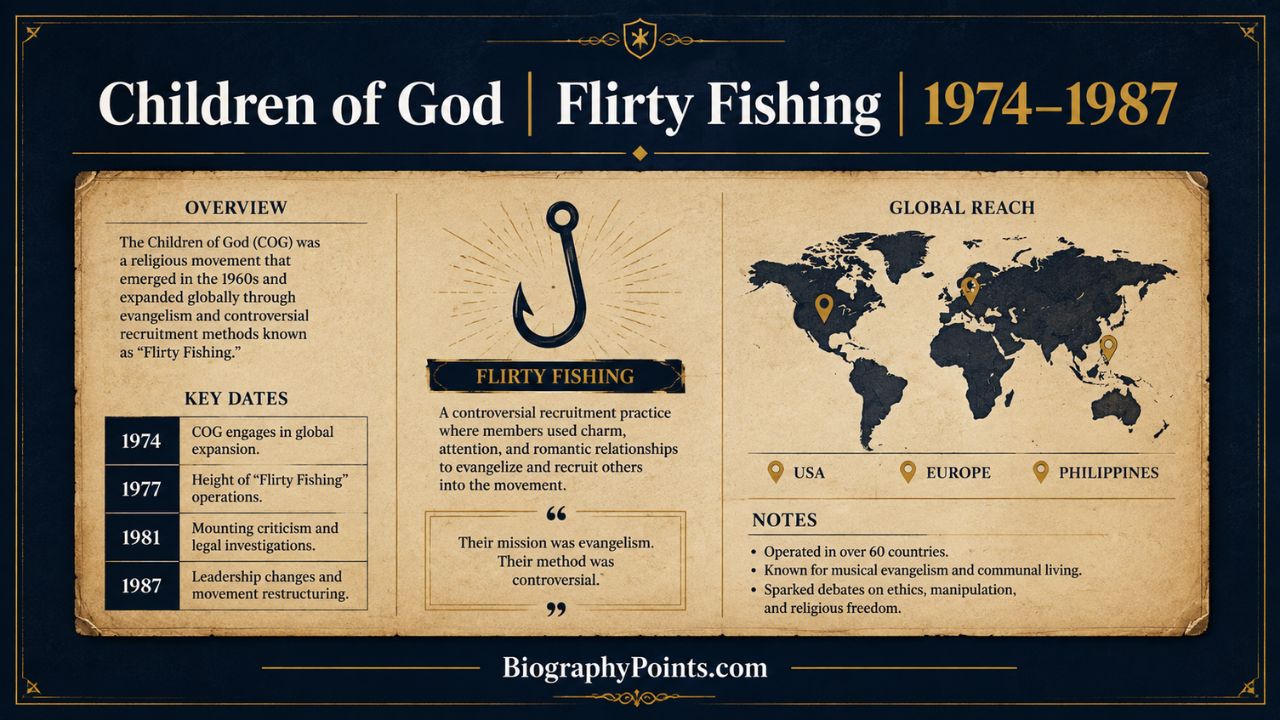
Flirty Fishing, commonly abbreviated as FFing, was one of the most controversial and disturbing practices ever carried out in the name of religion. Introduced in 1974 by David Berg, the founder of the cult known as the Children of God, it directed female members to use sexual attraction — and in most cases, sexual intercourse — to recruit men into the group and solicit financial donations. What made it especially troubling was not just what it was, but how it was justified. Berg did not hide it. He celebrated it.
Berg built his theological case on a single verse. Matthew 4:19, in which Jesus tells his disciples “Follow me, and I will make you fishers of men,” became the foundation for an entire system of religiously mandated prostitution. Female members were given the title of “fisherwomen.” The men they targeted were called “fish.” The language was deliberate, the doctrine was written down, and the instructions were distributed to communes around the world through Berg’s internal letters, known as “Mo Letters.”
The practice did not stay small. At its peak, the Children of God had spread across more than 50 countries, with membership swelling to over 50,000 people by the late 1970s. Investigators and journalists later estimated that as many as 200,000 men were approached through Flirty Fishing. Women inside the cult were expected to participate regardless of their marital status. Contraception was forbidden. More than 10,000 children were reportedly born to cult women between 1971 and 2001 as a direct consequence.
The practice was officially discontinued in 1987, primarily because of the global AIDS epidemic, which made the cult’s activities impossible to continue safely. In 1995, Berg’s successor and longtime partner Karen Zerby formally repudiated Flirty Fishing through a document called the “Love Charter.” The Children of God later rebranded as The Family International.

| Full Name | Flirty Fishing (FFing) |
| Type | Sexual Evangelism / Religious Prostitution |
| Practiced By | Children of God (later known as The Family International) |
| Introduced By | David Berg (Moses David), founder of the Children of God |
| Date Introduced | 1974 |
| Date Discontinued | 1987 |
| Reason Discontinued | HIV/AIDS epidemic; public image concerns |
| Country of Origin | United States (Huntington Beach, California) |
| Countries Active | USA, France, Italy, Monaco, Argentina, Australia, Spain, Philippines, and others |
| Biblical Basis Claimed | Matthew 4:19 — “Follow me, and I will make you fishers of men” |
| Practitioners Called | Fisherwomen / Bait |
| Targets Called | Fish |
| Related Doctrine | Law of Love (David Berg) |
| Internal Documents | Mo Letters (including “Adventures of a Flirty-Fish” and “God’s Whores?”) |
| Estimated Men Approached | Approximately 200,000 |
| Children Born (1971–2001) | Over 10,000 (referred to internally as “Jesus babies”) |
| Related Practice | Escort Servicing (ESing) |
| Scholarly Classification | Religious prostitution; cult-sanctioned sexual exploitation |
| Formally Repudiated | 1995 — Karen Zerby’s “Love Charter” |
| Organization Rebranded | The Family International (2004) |
| Current Membership | Approximately 1,700 members in 80 countries |
| Legal Investigations | Argentina, Italy, Australia, Spain, France, Philippines — all charges eventually dropped |
| Notable Survivors | River Phoenix, Joaquin Phoenix, Rose McGowan, Ricky Rodriguez, Miriam Williams, Angel DeSantis |
What is Flirty Fishing?
Flirty Fishing (FFing) was a form of sexual evangelism practiced by the Children of God cult from 1974 to 1987. Female members used sexual attraction and intercourse to recruit men and seek donations, framing it as spreading “God’s love.” It was discontinued in 1987 due to the AIDS epidemic.
Etymology and Definition of Flirty Fishing
The term “Flirty Fishing” did not emerge randomly. It was a calculated theological construction built by one man, applied to thousands of women, and documented in writing from the very beginning.
Origin of the Term
The phrase draws directly from the New Testament. In Matthew 4:19, Jesus tells his disciples, “Follow me, and I will make you fishers of men.” David Berg, founder of the Children of God, took this verse and reinterpreted it in a way no mainstream Christian tradition had ever endorsed. He concluded that women in his movement should become literal “fishers of men” — using their bodies as the bait.
From this interpretation, a structured vocabulary emerged. Female members who participated were called “fisherwomen” or simply “bait.” The men they targeted were called “fish.” The practice itself was abbreviated internally as “FFing,” a term that appeared consistently across Berg’s written communications to cult communes, known as “Mo Letters.” The language was not accidental. It was designed to make the practice feel scripturally grounded and spiritually legitimate to those inside the group.
Official Definition and Framing by the Cult
According to documented internal Children of God materials, Flirty Fishing was formally defined as using sex appeal for proselytizing — the active recruitment of new members and the solicitation of donations through sexual means.
Berg arrived at what he called the “rather shocking conclusion” that Christians were free, through God’s grace, to go to great lengths to demonstrate divine love — including meeting the sexual needs of strangers. The Family framed the practice as “bearing witness” for Jesus. Their defense, repeated in official statements, was that they were reaching people “who would never even go near a church.”
Academic scholars have rejected this framing entirely. Researcher Susan Raine, whose work examined Children of God literature in detail, described the practice’s terminology and imagery as “saturated with the rhetoric of prostitution.” The broader scholarly consensus classifies Flirty Fishing as religious prostitution and a form of cult-sanctioned sexual exploitation — not evangelism.
Theological Rationale
Flirty Fishing did not exist in isolation. It was rooted in Berg’s wider theological framework known as the “Law of Love” — a doctrine that rejected conventional sexual morality as a tool of what Berg called “the corrupt system” of mainstream society.
Under this doctrine, Berg taught that God’s love was most authentically expressed through physical, sexual love. The sharing of one’s body with another person was presented not as a moral compromise, but as the highest form of spiritual commitment a member could make. Women inside the group were told they were doing God’s work. Internal terminology reinforced this framing in deeply troubling ways — members were referred to as “God’s Whores” and “Hookers for Jesus,” phrases that appeared in Berg’s own Mo Letters without apology.
The Law of Love effectively removed any personal boundary a member might assert. Refusal was not framed as a right. It was framed as a failure of faith.
History and Origins of Flirty Fishing
Flirty Fishing did not appear overnight. It was the product of a decade-long process — a cult building its infrastructure, isolating its members, and gradually pushing its doctrines toward territory that no legitimate religious movement would cross.

The Children of God — Background
The organization behind Flirty Fishing began in 1968 in Huntington Beach, California. It grew out of a street ministry led by David Brandt Berg, a former evangelical preacher who had turned his attention to the hippies, runaways, and young people drifting through Southern California during the counterculture era. Berg had a talent for reaching the disillusioned. He offered community, spiritual purpose, and a sense of belonging to people who felt rejected by mainstream society.
The group was originally called “Teens for Christ.” It did not stay that name for long. As Berg’s influence grew and his theology became increasingly unorthodox, the organization restructured and rebranded as the Children of God (CoG). Berg himself adopted the title “Moses David” — positioning himself not merely as a pastor but as a prophetic figure, an end-times messenger with direct divine authority.
Growth was rapid and, by conventional measures, remarkable. By 1972, the Children of God had established 130 communes across the world. Members left their families, surrendered their finances, and relocated to communal homes where Berg’s teachings governed every aspect of daily life. By the late 1970s, membership had surpassed 50,000 people spread across dozens of countries. An anti-cult organization called FREECOG — Free the Children of God — was formed by concerned parents desperate to bring their adult children home.
What outsiders could not fully see at the time was how completely Berg controlled the group. His authority was absolute. His written communications, distributed to every commune, were treated as scripture. And it was through those communications that Flirty Fishing was born.
Introduction of Flirty Fishing (1974)
Flirty Fishing was formally introduced in 1974. Before it became policy for the wider group, Berg first tested it privately with his long-term companion and eventual successor, Karen Zerby. What began as a personal experiment was quickly codified into doctrine and pushed outward to the entire membership through Berg’s internal letter system.
Those letters — the “Mo Letters” — were the engine of the practice. Berg wrote prolifically, and his letters on Flirty Fishing were detailed, explicit, and illustrated. Titles distributed to communes included “Adventures of a Flirty-Fish” and “God’s Whores?” — documents that left no ambiguity about what was expected of female members. The letters included not just theological justification but practical instruction: where to go, how to dress, how to behave, and how to transition from sexual encounter to spiritual recruitment.
The practice launched in settings where Berg believed “fish” could most easily be found. Hippie communities, hotel bars, discotheques, and clubs were identified as prime locations. A Family spokesman later described the primary targets as “lonely traveling businessmen” staying in hotels — men who were, in Berg’s calculation, both financially generous and spiritually vulnerable. Women were sent out into these environments with a dual mission: secure donations, and bring men into the fold.
Expansion and Spread
What started in California spread across the world with the same speed that the Children of God itself had expanded. Flirty Fishing became active across Europe, Asia, Latin America, the Philippines, and beyond — wherever Children of God communes had established a presence. Women practiced it in France, Italy, Monaco, and across Southeast Asia. Former member Miriam Williams documented practicing Flirty Fishing for approximately five years, between 1973 and 1978, across France, Italy, and Monaco.
The scale eventually reached numbers that are difficult to comprehend. Investigators and researchers who later examined the practice estimated that as many as 200,000 men were “fished” over the course of the practice’s operation. That figure does not represent converts alone — it represents the total number of men approached, seduced, and in most cases involved in sexual contact with cult members operating under Berg’s direct instructions.
The outside world began to take notice. Media coverage, when it came, was damning. Journalists and broadcasters labeled the Children of God the “sex for salvation cult” — a phrase that spread widely and permanently attached itself to the group’s public identity. Rather than prompting internal reform, the attention hardened Berg’s resolve. The cult doubled down, expanded its operations internationally, and continued to grow both in membership and in the donations that Flirty Fishing was generating. For Berg, the results validated the doctrine. For the women carrying it out, the consequences would prove far more complicated.
How Flirty Fishing Was Practiced
Understanding how Flirty Fishing actually operated — day to day, woman to woman, city to city — is essential to understanding why survivors, scholars, and legal investigators have consistently described it as organized sexual exploitation. The practice was not informal or improvised. It was structured, instructed, and enforced from the top down.
Role of Female Members
Flirty Fishing was exclusively carried out by female members of the Children of God. Men in the group did not participate in the practice as practitioners. The burden fell entirely on women, and it fell on them regardless of their personal circumstances.
Members selected for FFing were typically chosen based on physical attractiveness. The expectation was clear and non-negotiable: women were required to have sexual encounters with different men regularly — in many cases daily — even if they were married. A husband’s existence inside the cult offered no protection. Berg’s Law of Love doctrine overrode the boundaries of marriage entirely, framing jealousy or reluctance as spiritual weakness rather than legitimate human feeling.
Contraception was strictly forbidden. This was not an oversight — it was deliberate policy. The children born as a result were given a specific name inside the group: “Jesus babies.” These children were raised inside the cult, with no documentation, no outside contact, and no knowledge of any life beyond the commune. Women inside the group were therefore managing an impossible combination of roles simultaneously — functioning as wives, as mothers to young children, and as active practitioners of Flirty Fishing, all at the same time, all under Berg’s authority.
The Process — Step by Step
The operational mechanics of Flirty Fishing were laid out explicitly in Berg’s Mo Letters, which were distributed to communes worldwide. These were not vague spiritual encouragements. They were illustrated, detailed, practical guides — and they told women exactly what to do and where to go.
Women were deployed to bars, hotels, nightclubs, discotheques, and public spaces where they were likely to encounter men without family commitments nearby. The approach always began with flirtation — romantic attention, conversation, physical warmth — designed to make the target feel genuinely wanted. The goal in the early stage was emotional connection, not immediate recruitment. Berg understood that men who felt lonely or isolated were more receptive, and his instructions reflected that calculation precisely.
Sexual intercourse followed in the majority of documented cases. It was the primary mechanism, not a side effect. After the encounter, women were expected to transition the relationship toward proselytizing and donation requests — introducing Children of God theology to the man and encouraging financial contributions to the group.
The Mo Letters Berg produced on this subject were extraordinary in their explicitness. Internal illustrations, later released by former members and examined by researchers, depicted women holding fishhooks with captions reading “FISHERS OF MEN!” Another showed a woman as a mermaid embracing a man under the heading “HOOKER FOR JESUS.” Scholar Susan Raine, who analyzed this material in published academic work, described the imagery as “saturated with the rhetoric of prostitution.” These were not unofficial materials circulating on the margins. They were distributed by Berg himself to every commune in the network.
Escort Servicing (ESing) — The Escalation
Flirty Fishing, as disturbing as it was from the outset, did not remain static. Over time it escalated into something more formalized and more openly commercial. That evolution had a name inside the Children of God: Escort Servicing, abbreviated as ESing.
Berg himself described ESing as “making FFing pay” — an explicit acknowledgment that the financial dimension of the practice had become primary. Under Escort Servicing, female cult members moved beyond spontaneous encounters in bars and hotels. They began working as regular call girls, either through established escort agencies or operating freelance across multiple cities and countries. The evangelical dimension of the practice — the proselytizing, the invitation to join the group — was reduced to an afterthought. Women were expected to witness to clients “when the occasion offered itself,” but the religious framing had largely become cover for what was, in operational terms, organized prostitution.
The shift was significant. Escort Servicing represented a complete departure from even the cult’s own stated justification for the practice. Berg had framed Flirty Fishing as evangelism with a sexual component. ESing removed the evangelism and left only the sex work — structured, income-generating, and operating across Europe, Asia, Latin America, and the Philippines under the Children of God’s global network. Women who had joined a religious community were, in effect, working as prostitutes in multiple countries, with the proceeds flowing back to the group.
No woman in this system had chosen it freely. The doctrine, the isolation, the communal structure, and Berg’s absolute authority ensured that. Refusal was not presented as an option. It was presented as a failure of love — and in a group where love was the central theology, that was the most powerful coercion available.
Impact on Members and Criticism
The harm caused by Flirty Fishing was not abstract or theoretical. It was documented, personal, and in many cases permanent. Women lost years of their lives. Children were born into isolation. Survivors carried the consequences long after they left the group. And the world outside, when it finally looked closely enough, was largely horrified by what it found.
Physical and Psychological Impact on Women
The women who practiced Flirty Fishing did not do so by free choice. That distinction matters enormously. Inside the Children of God, refusal was not framed as a personal right — it was framed as a spiritual failure. To decline was to withhold God’s love. To hesitate was to submit to the corrupt values of the outside world. Berg’s doctrine left no room for dissent, and the communal structure of the group ensured that dissent carried real social consequences — isolation, shame, and loss of standing within the only community many members had ever known.
The physical consequences were severe and predictable. Women conducting regular sexual encounters with strangers, with contraception forbidden, faced constant exposure to sexually transmitted infections. The AIDS epidemic of the 1980s would eventually force the practice to stop — but by that point, the damage to thousands of women’s health had already been done. Unwanted pregnancies were a routine outcome, not an exception.
The psychological toll has been documented extensively through survivor testimony. Former members have described long-term post-traumatic stress disorder, chronic difficulty forming trusting relationships, and deep identity trauma — the particular disorientation that comes from having been taught that exploitation was love, and then having to rebuild an understanding of oneself outside that framework.
Angel DeSantis, born into the Children of God and a member for 23 years, became one of the most prominent and publicly recognized survivor voices to speak out about the abuse she and others endured. Her testimony, and those of others like her, provided some of the most detailed firsthand accounts of what life inside the group actually looked like for the women required to participate in FFing.
Impact on Children Born of FFing
The children produced by Flirty Fishing occupied one of the most vulnerable positions imaginable. They were born inside a closed communal system, to mothers who had no access to contraception and no real agency over their own bodies. Inside the Children of God, these children were given a specific designation: “Jesus babies.”
According to documented sources, more than 10,000 children were born to cult women between 1971 and 2001. Many of these children had no legal identity. They were not registered with state authorities in the conventional sense. They had no birth certificates in accessible form, no connection to the outside world, and no frame of reference beyond the commune walls. Their entire reality was shaped by Berg’s doctrine from the moment they were born.
The situation for many of these children deteriorated further as they grew older. Former members and legal investigators documented that children inside the Children of God were subjected to further abuse within the group — physical, psychological, and sexual. Berg’s writings had, by the late 1970s and early 1980s, begun to address children in deeply troubling ways, normalizing adult contact with minors as an extension of the same Law of Love doctrine that had produced Flirty Fishing. The children of FFing were, in many cases, not protected from the cult’s worst practices. They were exposed to them.
Notable Survivors and Their Stories
The reach of the Children of God was broad enough to touch people who would later become publicly known figures — and their stories helped bring wider attention to what had happened inside the group.
River Phoenix and Joaquin Phoenix were born into a family that was connected to the Children of God during their early years. Their family eventually escaped the cult. River Phoenix went on to become an Academy Award-nominated actor before his death from a drug overdose in 1993, outside the Viper Room in Los Angeles, at the age of 23. Joaquin Phoenix has spoken publicly about the family’s experience.
Rose McGowan, who later became widely known as an actress and activist, was born into the group in Italy. Her family left when she was a child. She has spoken about the experience in interviews and in her memoir.
Two early members of Fleetwood Mac were also connected to the Children of God during the group’s early years — a detail that illustrated how the cult had penetrated the edges of the music and counterculture world it had originally targeted for recruitment.
Perhaps the most tragic story connected directly to Flirty Fishing belongs to Ricky Rodriguez — the son of Karen Zerby, Berg’s companion and successor. Rodriguez had been fathered by a man that Zerby herself had “fished.” He was raised inside the cult’s inner circle, subjected to severe abuse throughout his childhood, and spent his adult years consumed by rage and trauma he could not escape. In 2005, Rodriguez murdered his former nanny — a longtime cult member — and then died by suicide. He had reportedly hoped to find and kill Zerby but was unable to locate her.
Miriam Williams practiced Flirty Fishing for approximately five years, between 1973 and 1978, across France, Italy, and Monaco. She later left the group and wrote a memoir documenting her experience — one of the earliest and most detailed firsthand accounts of FFing from the inside.
External Criticism and Academic Analysis
Outside the cult, the response to Flirty Fishing — once it became publicly known — was almost universally condemnatory. Academic scholars who examined Children of God materials in detail drew clear conclusions. Susan Raine, whose published research analyzed internal CoG literature extensively, described the practice’s terminology and imagery as “saturated with the rhetoric of prostitution.” That framing — religious on the surface, exploitative in every practical dimension — was precisely what made Flirty Fishing so difficult for authorities to prosecute and so damaging for members to escape. It had been designed to look like devotion.
Multiple researchers across sociology, religious studies, and gender studies independently classified Flirty Fishing as religious prostitution — a category that sits at the intersection of coercive institutional control and sexual exploitation. The theological justification Berg provided did not, in the academic consensus, change what the practice was. It only made it more insidious.
Mainstream media coverage, when investigations began surfacing in the 1970s and 1980s, was overwhelmingly negative. The label “sex for salvation cult” attached itself to the Children of God permanently. Human rights organizations condemned the practice on the grounds of coercion, bodily autonomy, and the absence of meaningful consent within a closed authoritarian group. The cult’s defense — that women were willing participants expressing God’s love — was rejected by virtually every outside observer who examined the evidence.
What the criticism could not do, at least not immediately, was stop it. The practice continued for thirteen years, across dozens of countries, before the AIDS epidemic provided the external pressure that Berg’s own members could not.
Legal Investigations and Consequences
The Children of God operated for decades in plain sight — publishing documents, running communes, and conducting activities that investigators in multiple countries eventually concluded were criminal. Yet prosecution proved extraordinarily difficult. The gap between what was known and what could be proven in court became one of the defining features of the group’s history, and one of the greatest failures of international child protection in the late twentieth century.

Global Investigations
Law enforcement agencies across multiple continents opened investigations into the Children of God at various points during and after the Flirty Fishing era. The countries involved read like a list of every region where the cult had established a significant presence: Argentina, Italy, Australia, Spain, France, and the Philippines all launched formal investigations at different points. These were not minor inquiries. In several cases, they resulted in dramatic interventions.
In some of these countries, authorities moved to remove children from cult communes entirely. Hundreds of children were temporarily taken into state care during raids on group homes — a measure that reflected the severity of what investigators believed was happening inside. The removals were headline news in several countries and brought intense public scrutiny to the group for the first time in many of those regions.
The outcomes, however, were deeply frustrating for investigators and survivors alike. In every case, charges were eventually dropped. The reasons cited were consistent: lack of sufficient evidence to meet the legal standards required for prosecution. Children who had been removed were returned to the group. Communes that had been raided reopened. The cult absorbed each investigation, regrouped, and continued operating.
Leadership responded to legal pressure with a strategy that proved highly effective: relocation. When scrutiny became too intense in one country, the group moved its key figures and its most sensitive operations to another — typically one with weaker child protection laws, less experienced law enforcement, or limited international legal cooperation frameworks. This was not reactive improvisation. It became standard practice.
Berg himself had established the template for this approach as early as 1971, when he went into hiding and began a period of constant relocation that lasted until his death. He moved between Europe, North Africa, and Asia, rarely staying in one place long enough for authorities to act. His followers rarely saw him in person again after that point. His presence in the group was maintained entirely through the Mo Letters — a system that allowed him to exercise total control while remaining physically unreachable. Berg lived in seclusion until his death in November 1994 in Portugal, where he was initially buried in Costa de Caparica before later being cremated.
Why Prosecutions Failed
The failure to successfully prosecute the Children of God was not simply a matter of insufficient evidence — though that was the proximate cause in every case. It was the product of a set of structural conditions that the cult had, deliberately or otherwise, arranged in its favor.
The group operated simultaneously across dozens of countries, which meant that no single national legal system had jurisdiction over the full scope of its activities. Evidence gathered in Australia could not easily be used in proceedings in Argentina. Witnesses in the Philippines were beyond the reach of French investigators. The cult’s international structure, which had developed as a means of spreading its religious mission, functioned simultaneously as a near-perfect shield against coordinated legal action. International legal cooperation frameworks in the 1970s and 1980s were far less developed than they would later become, and the Children of God exploited that gap consistently.
Inside the communes, members were trained not to cooperate with outside authorities. This was framed theologically — the outside world was corrupt, law enforcement was an instrument of the system Berg had rejected, and loyalty to the group superseded any obligation to state institutions. When investigators arrived, they encountered walls of silence from people who had been conditioned to regard them as enemies. Children who had been removed and then returned frequently refused to corroborate allegations, either out of genuine loyalty, fear, or because they had no framework for understanding their experiences as abuse.
Berg was also deliberate about destroying evidence when legal pressure intensified. In 1991, he directed that copies of the Davidito book — an internal document that contained explicit material involving children and constituted some of the most damning evidence of abuse within the group — be destroyed. Members complied. The directive itself, and the fact that some copies survived and were later obtained by investigators and journalists, provided a window into how aware Berg was of his legal exposure and how actively he worked to eliminate the paper trail.
The cumulative effect of these factors — jurisdictional fragmentation, witness non-cooperation, deliberate evidence destruction, and constant leadership relocation — meant that a group whose practices were documented in its own published materials, distributed to communes around the world, was never successfully brought to account in a court of law during the years those practices were actively occurring. It remains one of the more striking examples of how closed, internationally mobile religious organizations can operate outside the reach of legal systems not designed to pursue them.
Discontinuation of Flirty Fishing (1987)
Flirty Fishing did not end because the Children of God experienced a moral awakening. It did not end because of the investigations, the media coverage, the survivor testimonies, or the international condemnation. It ended because a virus made it too dangerous to continue. That distinction is important. It tells you everything about how the group’s leadership understood what it had been doing — and how little it regretted it.
The AIDS Epidemic as Catalyst
By the mid-1980s, the HIV/AIDS epidemic had fundamentally changed the global landscape around sexual behavior. What had previously been framed as risk was now, in many documented cases, a death sentence. For a practice built entirely on unprotected sexual contact with large numbers of strangers across multiple countries, the emergence of AIDS represented an existential operational problem that no theological reframing could resolve.
Berg’s response followed the pattern he had established throughout his leadership: he incorporated the crisis into his existing prophetic framework. He cited the AIDS epidemic as a divine signal — evidence that it was “time to reconsider Family policy” on sexual contact with outsiders. The language was carefully chosen. It positioned the decision as spiritually motivated rather than practically forced, preserving the fiction that the group’s leadership was responding to God rather than to a public health catastrophe that made their practices untenable.
The discontinuation happened in stages. The practice was restricted first — tightened, limited, reframed — before being fully halted in 1987. The staged approach reflected the group’s reluctance to abandon something Berg had spent over a decade presenting as divinely sanctioned. Stopping abruptly would have required acknowledging that the entire theological foundation of FFing had been wrong. Restricting it gradually allowed the leadership to manage the transition without triggering that admission.
The official statement the group eventually released framed the decision in characteristically self-serving terms. According to the Children of God’s own account, Flirty Fishing was discontinued in 1987 in order to “emphasize other means of ministering the Word of God to others” and to take advantage of opportunities to reach more people than the highly personalized ministry of FFing had allowed. The AIDS epidemic was mentioned — but as a secondary consideration, almost incidental to the primary spiritual reasoning the group preferred to present publicly.
Thirteen years. That was how long the practice ran. From its introduction in 1974 to its official halt in 1987, Flirty Fishing operated across dozens of countries, involved tens of thousands of women, and affected an estimated 200,000 men and more than 10,000 children born as a direct result.
Official Position After Discontinuation
Ending Flirty Fishing in practice did not mean the Children of God repudiated it in principle. That distinction became clear almost immediately in the language the group used when discussing the practice after 1987.
The Family International’s official website later carried a statement that captured the group’s position with uncomfortable precision: “Although we no longer practice FFing, we believe the scriptural principles behind the ministry remain sound.” The practice had stopped. The theology that produced it had not been abandoned. In the group’s own framing, Flirty Fishing had been tactically suspended — not morally condemned.
The formal repudiation, when it finally came, arrived not from Berg but from his successor. Berg died in November 1994 in Portugal, having spent his final decades in hiding. Leadership passed to Karen Zerby — known within the group as “Mama Maria” — who had been Berg’s companion, collaborator, and the woman with whom Flirty Fishing had first been privately tested back in 1974.
In 1995, Zerby issued a foundational governance document known as the “Love Charter.” The Charter was significant for several reasons. It codified the rights and responsibilities of members for the first time in a formal written framework. It declared child sexual abuse a sin punishable by excommunication — a direct, if implicit, acknowledgment of what had been happening inside the group for decades. And it formally repudiated Flirty Fishing, removing it from sanctioned practice in explicit terms.
Whether the Love Charter represented genuine reform or institutional self-preservation in the face of mounting legal and public pressure is a question survivors and scholars have debated at length. What is not debated is what it did not do: it did not compensate victims, it did not cooperate with law enforcement, and it did not result in any member of the group’s leadership being held legally accountable for thirteen years of documented exploitation carried out in the name of God.
The group subsequently rebranded as The Family International in 2004, continuing to operate internationally with a significantly reduced membership. The name changed. The survivors remained.
FAQ: Everything You Need to Know About Flirty Fishing
Key questions answered about the Children of God's controversial practice of sexual evangelism
Introduced by cult founder David Berg in 1974, the practice was built on a reinterpretation of Matthew 4:19 and disseminated to communes worldwide through Berg's internal letters known as "Mo Letters." Scholars and legal investigators have classified it as religious prostitution. It was officially discontinued in 1987 due to the HIV/AIDS epidemic.
Berg, who went by the title "Moses David," first tested the practice privately with his companion Karen Zerby before distributing detailed written instructions — including illustrated guides — to cult communes around the world. He framed the practice using the Biblical verse Matthew 4:19 and incorporated it into his broader "Law of Love" doctrine.
David Berg cited AIDS as a divine sign that it was "time to reconsider Family policy." The group's official statement framed the decision as a shift toward "other means of ministering," though the AIDS crisis was the undeniable catalyst. The practice was restricted first, then fully halted in 1987. In 1995, Karen Zerby's "Love Charter" formally repudiated it.
Women inside the Children of God were forbidden from using contraception, meaning pregnancies were a routine and predictable outcome. The children born were called "Jesus babies" inside the group and were raised in cult communes, many without legal documentation or any contact with the outside world.
The Children of God rebranded as The Family International in 2004 and does not practice FFing. The group's own website has stated: "Although we no longer practice FFing, we believe the scriptural principles behind the ministry remain sound" — a position that drew significant criticism from survivors and scholars. The organization currently has approximately 1,700 members across 80 countries.
David Berg himself described ESing as "making FFing pay." It represented a complete shift from even the cult's own stated justification — evangelism through sexual contact — into organized, income-generating prostitution operating across multiple countries. The practice ran alongside FFing and represented its most commercially explicit form.
The cult's leadership — including Berg himself, who went into hiding around 1971 — evaded prosecution by constantly relocating across countries with weaker child protection laws. Members were trained not to cooperate with authorities. Berg also directed the destruction of key incriminating documents, including the Davidito book, in 1991. Berg died in November 1994 in Portugal without facing legal accountability.
River Phoenix, who died of a drug overdose in 1993 at age 23, grew up in a family connected to the cult before they escaped. Rose McGowan was born into the group in Italy. Ricky Rodriguez — son of Karen Zerby, fathered by a man Zerby had "fished" — was so severely traumatized by his childhood inside the cult that he murdered his former nanny and died by suicide in 2005.
Gallery