Table of Contents
Meteorologist (Staff Weather Profession Guide)
A staff weather meteorologist is one of the most scientifically demanding and publicly visible professionals in the modern world — responsible for the forecasts that help millions of people make daily decisions, prepare for disasters, and stay safe. Whether delivering a televised weather report or working inside a government operations center, meteorologists apply atmospheric science, mathematics, and advanced technology to understand and predict the behaviour of Earth’s atmosphere.
The word meteorologist traces back to ancient Greece. Around 340 B.C., the philosopher Aristotle wrote Meteorologica, one of history’s earliest systematic studies of weather and climate. From that foundation, meteorology has grown into a rigorous scientific discipline, formally defined by the American Meteorological Society as the use of scientific principles to observe, understand, and forecast atmospheric phenomena. That definition matters, because meteorologists are often confused with metrologists — scientists who study measurement and calibration — a distinction this article addresses directly.
Today, a meteorologist may work as a staff weather forecaster for a national weather service, as a broadcast meteorologist on television, as a researcher studying climate patterns, or as a consultant advising industries from aviation to agriculture. The job title varies, but the scientific core remains the same.
This article covers everything readers need to know about the meteorologist profession — what they do, what a weather person is called, how they predict the weather, how to become one, what they earn, and who the most famous meteorologists and weathermen in history are. It also clears up the widely searched confusion between a meteorologist and a metrologist, two very different scientific roles that share a similar name.

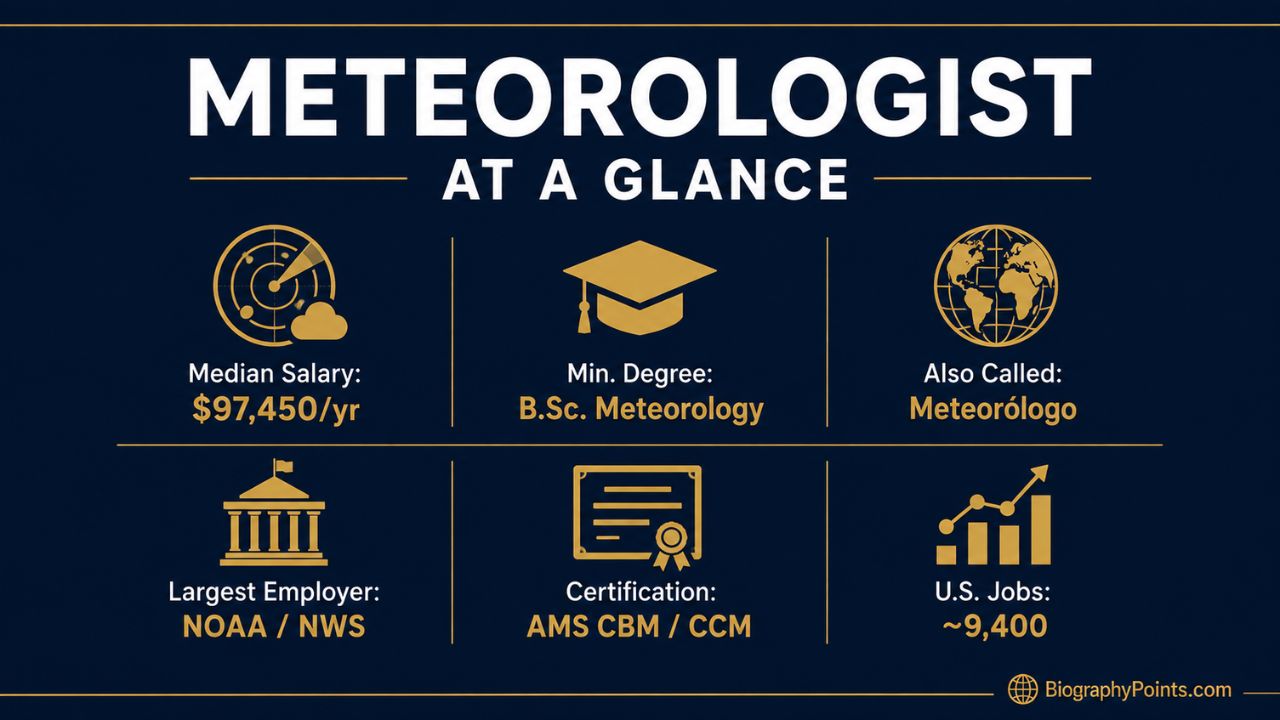
| Profession Name | Meteorologist |
| Also Known As | Staff Weather Forecaster, Weatherman, Weatherwoman, Weathercaster, Weather Broadcaster, Weather Presenter, Meteorólogo (Spanish) |
| Field of Study | Meteorology (the scientific study of Earth’s atmosphere and weather) |
| Confused With | Metrologist — a scientist who studies measurement and calibration (entirely different field) |
| Minimum Education | Bachelor of Science (B.Sc.) in Meteorology or Atmospheric Science |
| Advanced Degrees | Master’s Degree (research/consulting); Ph.D. (university teaching and independent research) |
| Key Subjects | Atmospheric Physics, Mathematics, Chemistry, Computer Science, Fluid Dynamics, Thermodynamics |
| Federal Education Requirement (U.S.) | Minimum 24 semester hours in meteorology or atmospheric science coursework (NWS/NOAA standard) |
| Professional Certifications | AMS Certified Broadcast Meteorologist (CBM); AMS Certified Consulting Meteorologist (CCM) |
| Primary Professional Body | American Meteorological Society (AMS) — founded 1919, Boston, Massachusetts |
| Largest Employer (U.S.) | NOAA / National Weather Service (NWS) — federal government |
| Other Employers | TV and radio stations, private weather services, airlines, military, agriculture, energy, academic institutions |
| Median U.S. Salary | $97,450 per year (U.S. Bureau of Labor Statistics, May 2024) |
| Entry-Level Salary Range | $49,990 – $65,000 per year |
| Experienced/Senior Salary | $100,000 – $160,710+ per year |
| U.S. Jobs (Current) | Approximately 9,400 positions (BLS) |
| Projected Job Openings (Annual) | Approximately 700 per year (BLS projection, 2024–2034) |
| Job Growth Projection | 1% (2024–2034, BLS) — stable demand with consistent annual openings |
| Specialisations | Operational Forecaster, Broadcast Meteorologist, Research Meteorologist, Aviation, Agricultural, Military, Forensic, Climate Scientist |
| Key Prediction Tools | Doppler Radar, Weather Satellites, Weather Balloons (Radiosondes), Weather Stations, Ocean Buoys, Supercomputer Models (GFS, ECMWF, HRRR) |
| Origin of the Word | From Aristotle’s Meteorologica (~340 B.C.); Greek root meteoros meaning “things high in the air” |
| Spanish Term | Meteorólogo |
| Notable Pioneers | Aristotle, Luke Howard (“Father of Meteorology”), Vilhelm Bjerknes, Edward Lorenz, Dr. Theodore Fujita, Joanne Simpson |
| International Coordinating Body | World Meteorological Organization (WMO) — UN agency, Geneva, Switzerland; 193 member states |
What is a meteorologist?
A meteorologist is a scientist who studies Earth’s atmosphere to understand and predict weather. Also called a staff weather forecaster or weatherman, they analyze data from satellites, radar, and weather stations to issue forecasts, severe weather warnings, and climate reports for government agencies, TV stations, and private organizations.
What Is a Meteorologist? Definition, Title, and Origin of the Name
A meteorologist is a scientist who studies Earth’s atmosphere to understand, observe, and predict weather. The role sits at the intersection of physics, mathematics, and environmental science — and it carries a formal definition that most people never encounter outside a textbook.
According to the American Meteorological Society, a meteorologist is an individual with specialized education who uses scientific principles to explain, understand, observe, or forecast atmospheric phenomena and their effects on life and the planet. That definition was formally adopted by the AMS in September 1990 and remains the professional standard today.
What Is the Study of Weather Called?
The study of weather is called meteorology — a word with roots in ancient Greece. Around 340 B.C., the philosopher Aristotle wrote Meteorologica, one of the earliest known attempts to systematically document and explain atmospheric events, from rainfall and wind to clouds and climate. Aristotle borrowed the term from the Greek word meteoros, meaning “things high in the air.” That single text gave the entire discipline its name, and the word has remained in use ever since.
Modern meteorology has expanded far beyond Aristotle’s observations. It now encompasses atmospheric physics, climate science, numerical weather modeling, and environmental forecasting — a field vast enough to support dozens of specialized career paths.
What Is a Weather Person Called?
This is one of the most commonly searched questions about the profession, and the answer depends on the person’s credentials.
A fully qualified weather scientist with a degree in meteorology or atmospheric science is called a meteorologist. On television and radio, these professionals are often referred to informally as a weatherman, weatherwoman, or weather broadcaster. The gender-neutral terms weathercaster and weather presenter are also widely used.
The AMS draws a clear line between these titles. Individuals who present forecasts prepared by others, without formal atmospheric science training, are correctly called weathercasters — not meteorologists. The distinction matters because the title “meteorologist” carries a specific educational and professional standard.
In Spanish-speaking countries, the same professional is called a meteorólogo, with identical educational requirements and responsibilities recognized internationally through the World Meteorological Organization.
Official Definition — American Meteorological Society
“A meteorologist is an individual with specialized education who uses scientific principles to explain, understand, observe or forecast the Earth’s atmospheric phenomena and/or how the atmosphere affects the Earth and life on the planet.”
— American Meteorological Society, Professional Guideline (Source: ametsoc.org — official)
This definition is the benchmark used by employers, broadcasters, and government agencies when hiring or credentialing weather professionals. It distinguishes the profession from related roles and protects the integrity of the title across both broadcast and scientific settings.
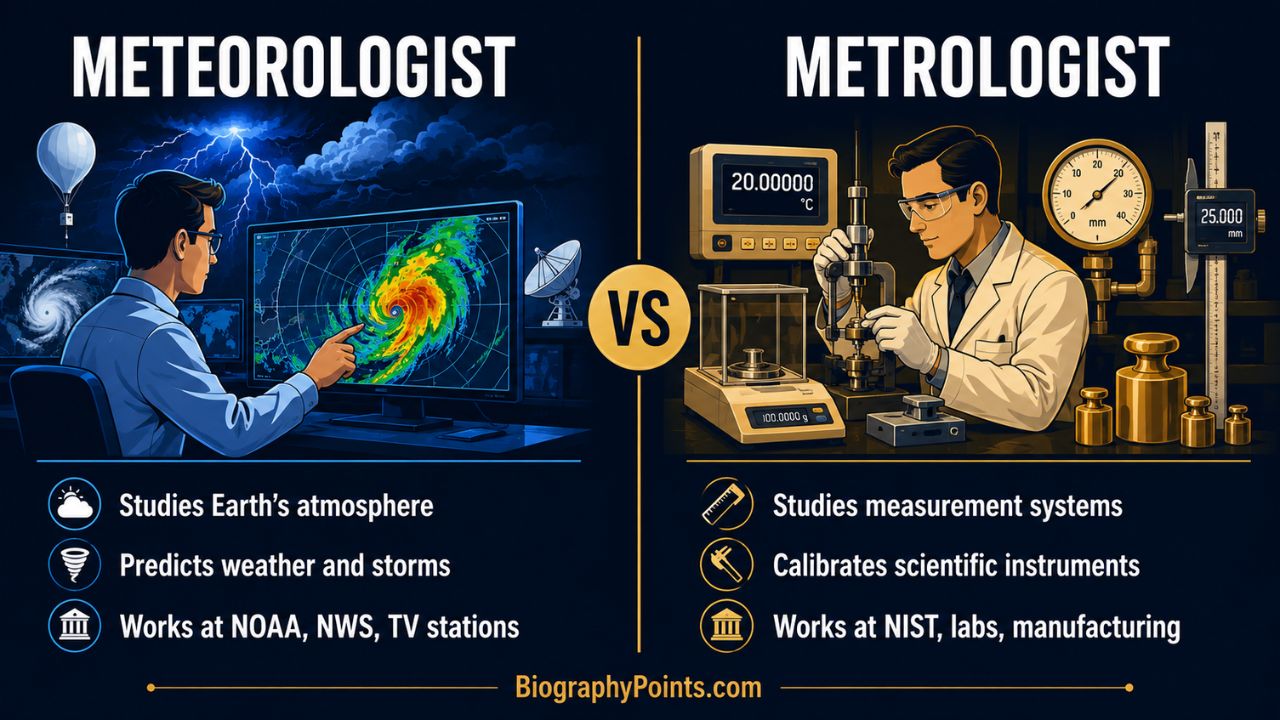
Meteorologist vs. Metrologist — What Is the Difference?
Two words. One letter apart. Entirely different sciences. The terms meteorologist and metrologist are among the most commonly confused professional titles in the English language. They sound nearly identical when spoken aloud, appear similar in print, and both belong to fields that rely heavily on precision and data. Yet they describe two completely separate scientific disciplines with no professional overlap.

The confusion is widespread enough that the American Meteorological Society has publicly noted the mix-up, and search data confirms that hundreds of thousands of people each year type “metrologist” when they mean “meteorologist” — or genuinely do not know which is which. This section answers both questions directly.
What Is a Metrologist?
A metrologist is a scientist or technical expert who specialises in metrology — the science of measurement. The field is not concerned with weather in any way. Instead, metrologists focus on developing, maintaining, and improving the systems that ensure measurements are accurate, consistent, and universally understood.
Their work underpins almost every precision-dependent industry on Earth. A metrologist might calibrate the instruments used in a pharmaceutical laboratory, verify the accuracy of industrial weighing equipment, or establish the standards that define a unit of measurement at a national or international level.
Metrologists typically work in:
- Manufacturing and engineering — ensuring machinery and production equipment meets precise tolerances
- Laboratory and scientific research — calibrating instruments used in experiments
- National standards bodies — such as the National Institute of Standards and Technology (NIST) in the United States, or the Bureau International des Poids et Mesures (BIPM) internationally
- Healthcare and pharmaceuticals — verifying the accuracy of medical devices and dosage equipment
- Legal and trade industries — ensuring weights and measures used in commerce are correct and certified
The academic path into metrology typically runs through physics, engineering, or applied mathematics, rather than atmospheric science. The two professions recruit from entirely different educational backgrounds and serve entirely different purposes.
What Is a Meteorologist? (Comparison)
A meteorologist, by contrast, is a scientist who studies Earth’s atmosphere — its composition, behaviour, and the weather systems it produces. Where a metrologist asks “is this measurement accurate?”, a meteorologist asks “what will the atmosphere do next?”
The field of meteorology encompasses weather forecasting, climate research, atmospheric physics, and severe storm analysis. A meteorologist’s tools include satellites, Doppler radar, weather balloons, and supercomputer models. A metrologist’s tools include calibration equipment, reference standards, and precision instruments.
The table below shows the core differences at a glance:
| Comparison Metric | Meteorologist | Metrologist |
| Studies | Earth’s atmosphere and weather | Measurement systems and calibration |
| Field | Meteorology | Metrology |
| Core Question | What will the weather do? | Is this measurement accurate? |
| Tools Used | Radar, satellites, weather models | Calibration instruments, reference standards |
| Typical Employers | NOAA, NWS, TV stations, research labs | NIST, BIPM, manufacturing firms, labs |
| Minimum Education | B.Sc. in Meteorology or Atmospheric Science | B.Sc. in Physics, Engineering, or Applied Science |
| Professional Body | American Meteorological Society (AMS) | National and international standards bodies |
The Simple Clarification
Meteorologist = weather.
Metrologist = measurement.
Both are legitimate and important scientific professions. Both require rigorous education and technical expertise. But they are entirely distinct, and using one term in place of the other is a factual error — not a minor spelling variation.
If a person is seen on television presenting a weather forecast, they are a meteorologist — or more precisely, a staff weather forecaster or weathercaster depending on their credentials. A metrologist would not appear in that role under any circumstances, as their expertise lies in an entirely unrelated scientific domain.
What Does a Meteorologist Do? Job Roles and Responsibilities
A meteorologist’s job is to make sense of one of the most complex and constantly changing systems on Earth — the atmosphere. On any given day, that work might involve analysing satellite imagery of a developing hurricane, issuing a severe thunderstorm warning for a major city, or building a computer model that forecasts rainfall patterns weeks in advance. The role is as varied as the weather itself.
What a meteorologist does depends largely on where they work and what specialisation they pursue. But across every setting, the foundation remains the same: observe, analyse, interpret, and communicate.
Core Daily Duties of a Meteorologist
The daily responsibilities of a meteorologist combine scientific rigour with clear communication. According to the National Oceanic and Atmospheric Administration (NOAA), general forecasters and lead forecasters are responsible for analysing meteorological data from a variety of sources and preparing forecast products, advisories, and warnings for hazardous weather conditions including severe storms, high winds, flash floods, and winter weather events.
In practice, that work involves several consistent tasks:
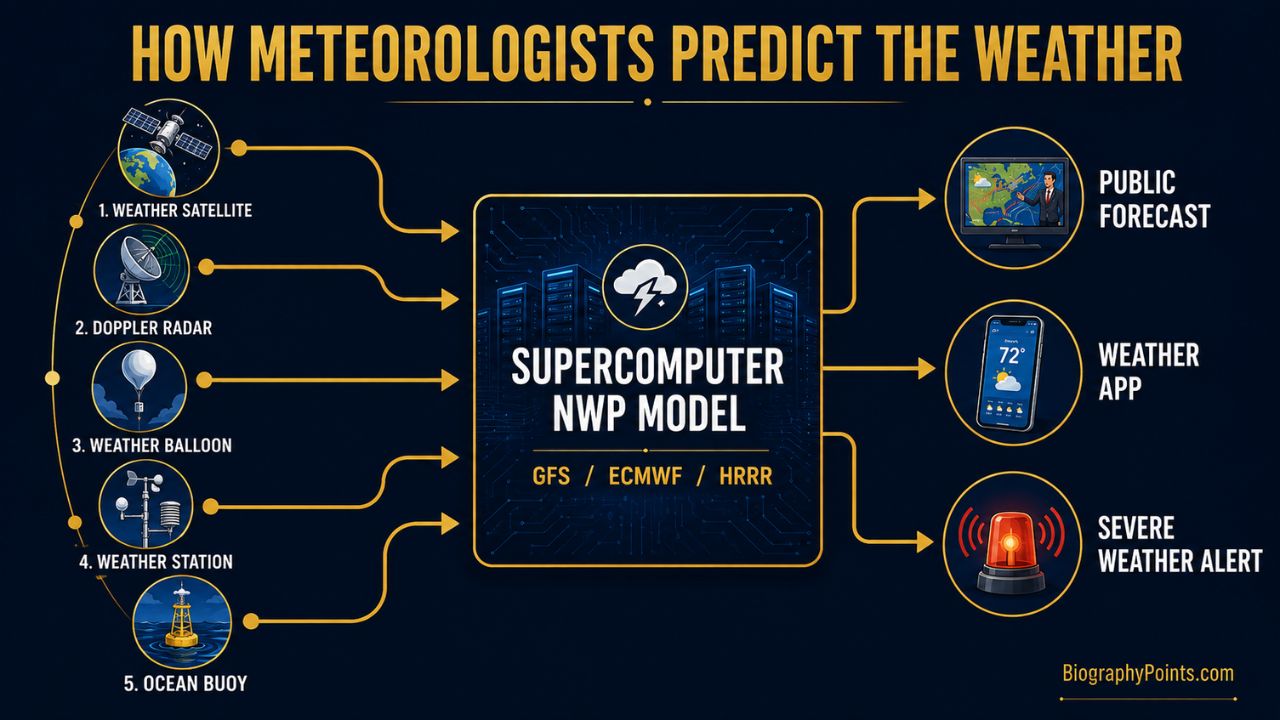
Data collection and analysis forms the foundation of every forecast. Meteorologists gather real-time data from weather stations positioned across the ground, Doppler radar systems that track precipitation and wind, weather satellites orbiting the Earth, weather balloons that carry instruments into the upper atmosphere, and ocean buoys that monitor sea surface temperatures. This data is continuous, global, and vast.
Numerical weather prediction comes next. Meteorologists feed collected data into sophisticated computer models — systems that apply the laws of physics and atmospheric dynamics to calculate how conditions will evolve over hours, days, or weeks. No forecast is produced from instinct alone. Every prediction is grounded in quantitative data processed through these models.
Issuing official products is a core operational duty. These include public forecasts, hazardous weather outlooks, severe weather watches and warnings, marine forecasts, aviation weather advisories, and hydrological reports covering flood risk. In government settings, these products are legally significant — emergency management agencies and public safety services rely on them to make life-affecting decisions.
Preparing written and broadcast reports rounds out the communication side of the role. Whether writing a technical forecast discussion for other scientists or presenting a live weather segment for a television audience, meteorologists translate complex atmospheric data into information that is accurate, timely, and usable by the public.
Types of Meteorologist Jobs
Meteorology is not a single job — it is a profession with a wide range of specialisations, each serving a different sector of society. The following are the most established and widely recognised roles within the field.
Operational or Forecast Meteorologist is the most common government-based role. These professionals work within agencies such as NOAA and the National Weather Service, producing the official forecasts, watches, and warnings that inform the public and guide emergency response. They work in shifts, around the clock, because weather does not follow office hours.
Broadcast or TV Meteorologist is the most publicly visible role in the profession. A staff weather meteorologist working for a television or radio station presents forecasts to general audiences, explains weather events in accessible language, and often specialises in live coverage of severe weather. The AMS Certified Broadcast Meteorologist (CBM) credential is increasingly expected for positions in major broadcast markets.
Research Meteorologist works within universities, government laboratories, or private research institutions to advance the scientific understanding of atmospheric processes. Their work may focus on improving forecast models, studying the dynamics of extreme weather events, or analysing long-term climate trends. Advanced degrees — typically a Master’s or Ph.D. — are standard in this track.
Aviation Meteorologist provides weather intelligence for the aviation industry. Airlines, air traffic control agencies, and military flight operations depend on these specialists for route planning, turbulence forecasting, ceiling and visibility reports, and severe weather avoidance. Accuracy in this role has direct consequences for flight safety.
Agricultural Meteorologist serves the farming and food production industries. Their forecasts help farmers make decisions about planting schedules, irrigation, frost protection, and harvest timing. As climate variability increases, this specialisation has grown in strategic importance.
Military Meteorologist provides tactical weather support to armed forces. Weather conditions directly affect military operations — visibility, wind speed, precipitation, and atmospheric stability can determine the outcome of missions involving aircraft, naval vessels, or ground forces. Military meteorologists operate in both domestic and deployed settings.
Forensic Meteorologist applies historical weather data to legal and insurance cases. When a dispute involves an accident, property damage, or personal injury in which weather played a role, a forensic meteorologist reconstructs the atmospheric conditions at that specific time and location. Their analysis is used as expert evidence in court proceedings.
Climate Scientist or Climatologist focuses on long-term atmospheric patterns rather than short-term forecasts. While a meteorologist predicts tomorrow’s weather, a climatologist studies decades or centuries of data to understand how climate systems behave, how they are shifting, and what those changes mean for the planet. The two fields overlap significantly and often operate within the same institutions.
Where Do Meteorologists Work?
The professional settings for meteorologists span government, media, private industry, and academia — a range that reflects how deeply weather affects almost every sector of modern life.
The federal government is the single largest employer of meteorologists in the United States. Most work as forecasters within the National Weather Service, stationed at weather offices located at airports, in or near cities, and in remote regions across the country. NOAA oversees this network and coordinates atmospheric science at the national level.
Television and radio stations employ staff weather meteorologists in every major and mid-sized market. Local broadcast meteorologists are often among the most recognised faces in their communities, serving as the public’s primary source of weather information during severe events. National networks maintain their own meteorology teams for large-scale and breaking weather coverage.
Private consulting firms and weather services provide customised forecasting to businesses that need weather intelligence beyond what public services offer. Energy companies, logistics firms, construction businesses, and event organisers all require tailored forecasts that account for their specific operational needs.
Military branches maintain dedicated meteorological units within each of the armed services. Military weather support is an operational necessity, not an optional resource.
Airlines and airports employ aviation meteorologists on-site and through contracted weather service providers to ensure that flight operations remain as safe and efficient as possible under varying atmospheric conditions.
Energy and agriculture industries are growing employers. Renewable energy companies — particularly those operating wind farms and solar installations — depend on precise atmospheric data to optimise output and manage grid contributions. Agricultural enterprises use meteorological expertise to protect crops and manage resources efficiently.
Academic institutions — including universities with atmospheric science programmes — employ meteorologists as faculty and research staff, where they train the next generation of forecasters while advancing the discipline through published scientific work.
How Do Meteorologists Predict the Weather?
Weather prediction is not guesswork. It is one of the most computationally intensive scientific operations on Earth — a process that begins with a global network of instruments measuring the atmosphere in real time and ends with a forecast delivered to a phone screen, a television broadcast, or an emergency alert system. Understanding how meteorologists predict the weather requires understanding three interconnected stages: observation, modelling, and human interpretation.

Data Collection — The First Step
Before any forecast can be made, meteorologists need an accurate picture of what the atmosphere is doing right now. That picture is assembled from thousands of data points collected simultaneously from instruments positioned across the surface of the Earth, in the oceans, in the air, and in orbit.
Weather stations form the ground-level backbone of the observation network. These fixed installations measure temperature, atmospheric pressure, humidity, wind speed, wind direction, and precipitation at regular intervals. They are located at airports, in cities, across open countryside, and in remote areas including polar regions and high-altitude mountain sites. Together, they provide a continuous record of surface-level conditions across the globe.
Weather satellites operate from two primary orbital positions. Geostationary satellites remain fixed above a specific point on the equator, providing continuous imagery of the same region and allowing meteorologists to track the movement and development of cloud systems, tropical cyclones, and large-scale weather patterns in near real time. Polar-orbiting satellites pass over different parts of the Earth on each pass, collecting detailed vertical profiles of the atmosphere including temperature and humidity at various altitudes.
Doppler radar is one of the most important tools in operational forecasting. It works by emitting microwave pulses that bounce off precipitation — rain, snow, hail — and return to the sensor. By measuring the frequency shift of the returning signal, Doppler radar can determine not only where precipitation is occurring but also how fast and in which direction it is moving. This makes it essential for tracking severe thunderstorms, identifying rotation within supercells that may produce tornadoes, and estimating rainfall totals for flood forecasting.
Weather balloons — formally known as radiosondes — are launched twice daily from hundreds of sites around the world, typically at the same times each day to allow global comparison. Each balloon carries a small instrument package that measures temperature, humidity, and pressure as it ascends through the atmosphere, transmitting data back to ground stations in real time. By the time the balloon bursts — usually at an altitude of around 30 kilometres — it has provided meteorologists with a detailed vertical cross-section of the atmosphere above that location. This upper-air data is critical for identifying jet streams, temperature inversions, and the instability that drives severe weather.
Ocean buoys and ships extend the observation network across the world’s oceans — vast areas where land-based instruments cannot reach. Moored and drifting buoys measure sea surface temperature, wave height, wind speed, and atmospheric pressure. Merchant ships and research vessels equipped with weather instruments contribute additional surface-level marine observations. Since oceans drive much of the world’s large-scale weather and climate patterns, this data is indispensable for accurate medium and long-range forecasting.
All of this data — from every source, across every continent and ocean — is collected, quality-controlled, and fed into computer modelling systems within minutes of being recorded.
Computer Modelling and Numerical Weather Prediction
Once observational data has been gathered, it enters the next stage of the forecasting process: numerical weather prediction, commonly abbreviated as NWP.
Numerical weather prediction works by representing the atmosphere as a three-dimensional grid of points covering the entire Earth, from the surface up through the stratosphere. At each grid point, the current state of the atmosphere — temperature, pressure, wind speed, humidity, and other variables — is defined using the observational data collected in the previous step. The model then applies mathematical equations derived from the laws of physics — specifically fluid dynamics and thermodynamics — to calculate how those conditions will change over time, projecting forward in small time steps that may be as short as a few minutes.
The result is a numerical forecast: a mathematical simulation of how the atmosphere will evolve over the coming hours, days, or weeks. This is the backbone of every modern weather forecast, from the daily outlook on a smartphone app to the extended forecast issued by a national weather service.
Several major global models are used and compared by meteorologists worldwide. The GFS (Global Forecast System), operated by the United States National Centers for Environmental Prediction, is one of the most widely used. The ECMWF (European Centre for Medium-Range Weather Forecasts), based in Reading, England, is widely regarded among meteorologists as the most consistently accurate global model for medium-range prediction — a reputation it earned through decades of continued refinement. The UK Met Office Unified Model provides another independent forecast perspective used across international meteorological agencies.
These global models provide the large-scale picture — tracking where major pressure systems, jet stream patterns, and storm tracks are headed. But their grid spacing, which may cover areas tens of kilometres across, limits their ability to resolve fine-scale weather features such as individual thunderstorms or localised fog.
For higher-resolution detail, regional models fill the gap. The HRRR (High-Resolution Rapid Refresh), operated by NOAA in the United States, runs on a grid spacing of three kilometres and updates every hour, making it particularly valuable for short-range severe weather forecasting. It can simulate individual convective storms — thunderstorms and squall lines — in a way that global models cannot.
Running these models requires extraordinary computing power. National weather services operate some of the most powerful supercomputers in existence specifically for this purpose. The ECMWF and NOAA both maintain supercomputing facilities capable of performing quadrillions of calculations per second, because even small delays in model output reduce the value of the resulting forecast.
Human Analysis and Experience
Supercomputers do the calculation. Meteorologists make the forecast.
Model output is not handed directly to the public. It is interpreted, compared, and refined by trained forecasters who bring scientific knowledge and accumulated experience to the final prediction. This human layer remains essential because no model is perfect, and the atmosphere — as the mathematician and meteorologist Edward Lorenz demonstrated through his work on chaos theory — is inherently sensitive to small variations in initial conditions. A tiny measurement error in today’s data can translate into a significantly different model outcome several days out.
Experienced forecasters learn to read model output critically. They know which models tend to perform better for certain types of weather patterns, in which seasons, and in which geographic regions. When the major global models disagree — which they frequently do beyond three or four days — a skilled forecaster weighs the evidence from multiple sources rather than defaulting to any single output.
Collaboration is a standard part of the process. In offices operated by the National Weather Service and equivalent agencies around the world, forecasters discuss developing situations, challenge each other’s interpretations, and reach collective judgements on the most likely outcome. During high-impact events — a strengthening hurricane, a major winter storm, a significant flood threat — that collaboration intensifies and may involve coordination across multiple offices and agencies.
The limitations of weather prediction are real and scientifically established. Short-range forecasts covering one to two days are generally highly accurate, with modern models performing reliably for temperature, precipitation type, and wind speed at this timescale. Medium-range forecasts covering three to seven days carry progressively greater uncertainty. Beyond ten days, forecasts shift from specific predictions to probabilistic guidance — broad indications of whether conditions are likely to be warmer, cooler, wetter, or drier than average, rather than precise day-by-day outlooks.
That uncertainty is not a failure of meteorology. It is an honest reflection of the physical limits of predicting a chaotic system. Communicating that uncertainty clearly — telling the public not just what is most likely, but how confident the forecast is — is itself a core professional skill for any working meteorologist.
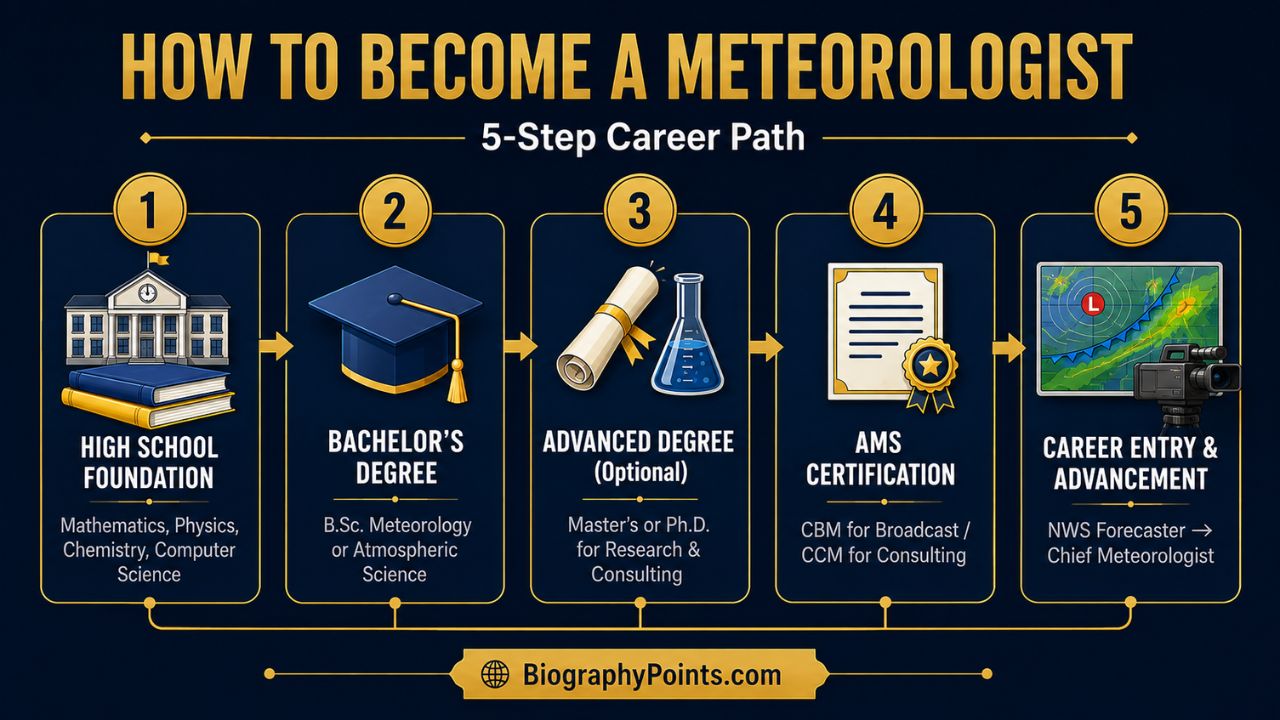
How to Become a Meteorologist — Education and Career Path
Becoming a meteorologist is a structured process that begins long before a person steps into a forecast office or stands in front of a television camera. The path combines formal education in science and mathematics, practical field experience, and in many cases professional certification. It is demanding — but it is also clearly defined, and those who follow it enter a profession that is both scientifically rigorous and genuinely consequential.

The route varies depending on which branch of meteorology a person wants to pursue. A staff weather forecaster working for a national weather service follows a different path than a broadcast meteorologist presenting on television, or a research scientist studying atmospheric dynamics at a university. What they share is a common educational foundation built on the same core disciplines.
Step 1 — High School Foundation
The groundwork for a career in meteorology is laid in secondary school, well before any university application is submitted.
Mathematics is the single most important subject at this stage. Meteorology is a quantitative science. Calculus, statistics, and algebra are used daily in atmospheric modelling, data analysis, and forecast interpretation. Students who arrive at university without a strong mathematics background typically struggle with the technical demands of an atmospheric science degree.
Physics is equally essential. The behaviour of the atmosphere — air pressure, temperature gradients, fluid dynamics, radiation — is governed by physical laws. A working understanding of physics at secondary level makes the transition to university-level atmospheric science significantly more manageable.
Chemistry supports understanding of atmospheric composition, air quality, and the chemical processes that occur within cloud systems. Computer science has become increasingly important as meteorology relies more heavily on programming languages such as Python, MATLAB, and R for data analysis and model visualisation. Geography builds spatial awareness of how terrain, coastlines, and large bodies of water influence local and regional weather patterns.
Beyond formal subjects, genuine curiosity about weather helps. Many practising meteorologists trace their interest to childhood — tracking storms, recording temperatures, or simply paying close attention to the sky. That early observational habit, while not a formal requirement, reflects the kind of sustained attention to atmospheric detail that the profession demands throughout a career.
Step 2 — Bachelor's Degree Requirements
The minimum educational requirement for professional meteorology is a Bachelor of Science in Meteorology or Atmospheric Science from an accredited university. This is the standard entry-level credential across government agencies, private weather services, and broadcast organisations.
The degree typically covers atmospheric dynamics, thermodynamics, synoptic meteorology, climate science, remote sensing, and numerical weather prediction, alongside supporting coursework in calculus, physics, and computer programming. It is not a light curriculum. The technical content is comparable in rigour to an engineering or applied physics degree.
For students pursuing a degree in a related field — physics, mathematics, or environmental science — entry into meteorology is still possible, but requires supplementary coursework in atmospheric science to meet professional standards. The National Weather Service, for federal employment purposes, requires a minimum of 24 semester hours of meteorology or atmospheric science coursework, including at least six hours in the analysis and prediction of weather systems and two hours in remote sensing or atmospheric instrumentation. Calculus and physics are also required components.
Those aiming for a career in broadcast meteorology have a slightly different path to consider. Television and radio roles require strong on-camera communication skills alongside scientific knowledge. Many broadcast meteorologists complete a degree in meteorology and add a minor in journalism or communications, while others pursue a journalism or communications degree and take extensive meteorology electives. Either route can lead to a broadcast career, but the AMS strongly recommends that individuals presenting themselves as meteorologists on air hold genuine atmospheric science credentials.
Step 3 — Advanced Degrees (Optional but Recommended)
A bachelor’s degree is sufficient for many operational forecasting and entry-level broadcast roles. For those with ambitions in research, specialised consulting, or academic teaching, advanced education is not optional — it is required.
A Master’s degree in Meteorology or Atmospheric Science opens access to senior forecasting positions, research roles within government agencies, private-sector consulting, and specialist fields such as forensic meteorology, renewable energy forecasting, and climate services. The master’s programme typically takes two years and involves both advanced coursework and original research, usually culminating in a thesis.
A Ph.D. is required for independent research positions and university faculty roles. Doctoral candidates conduct original scientific research contributing new knowledge to the field — developing improved forecast models, studying specific atmospheric phenomena, or advancing understanding of climate dynamics. The degree typically takes four to six years beyond the bachelor’s level.
Several universities are internationally recognised for the strength of their atmospheric science programmes. Pennsylvania State University has one of the oldest and most respected meteorology departments in the United States. Texas A&M University is noted for its broad atmospheric science faculty and research output. The University of Oklahoma is closely associated with severe weather and tornado research, benefiting from its location within one of the most active storm regions in North America. Florida State University has produced meteorologists at all levels of the profession, including researchers and broadcast professionals.
Step 4 — Certifications and Professional Credentials
Formal certification is not universally required to work as a meteorologist, but it significantly strengthens professional credibility — particularly in broadcast and consulting settings. The American Meteorological Society offers two primary certifications that are widely recognised across the profession.
The AMS Certified Broadcast Meteorologist (CBM) credential is designed for television and radio meteorologists. Applicants must hold a qualifying degree in meteorology or atmospheric science, pass a written examination, and submit on-air work for review by a panel assessing scientific accuracy, communication clarity, and technical competence. In major television markets, the CBM is increasingly an expectation rather than a differentiator — stations in larger cities routinely require it for staff weather positions.
The AMS Certified Consulting Meteorologist (CCM) credential applies to professionals working in private consulting — providing weather analysis for legal cases, insurance claims, industrial projects, or private clients. The CCM requires documented professional experience alongside passing an examination, and holders are expected to maintain the credential through continuing professional development.
The National Weather Association (NWA) provides an additional professional home for operational meteorologists, offering continuing education, an annual conference, and networking opportunities across the government and private forecasting communities. Membership and active participation in the NWA signals professional commitment and helps forecasters stay current with evolving tools and techniques.
Step 5 — Career Entry and Advancement
The first professional role in meteorology is rarely the most visible one. Most careers in the field begin with practical experience accumulated during and immediately after the degree.
Internships are the most effective entry point. The National Weather Service, NOAA, private weather companies such as AccuWeather and The Weather Company, and local television stations all offer internship programmes that give students hands-on forecasting experience, exposure to professional workflows, and introductions to the networks of people who shape hiring decisions. A strong internship record is frequently the deciding factor between candidates with comparable academic qualifications.
Entry-level roles typically carry titles such as general forecaster, meteorological technician, weather analyst, or broadcast weather assistant. In government settings, new hires may begin as General Forecasters within a NWS Weather Forecast Office, working under the supervision of experienced Lead Forecasters before taking on independent shifts. In broadcast, entry-level meteorologists often begin in smaller media markets — smaller cities and regional stations — where they develop their on-air skills before moving to larger markets.
Advancement follows a path built on demonstrated expertise, professional reputation, and in many cases additional credentials. Within a NWS office, the progression runs from General Forecaster to Lead Forecaster, then to positions such as Science and Operations Officer and ultimately Meteorologist-in-Charge — the senior leadership role within each regional office. In broadcasting, the career arc moves from smaller markets to larger ones, with the title of Chief Meteorologist representing the senior editorial and on-air weather role at a television station. In research and academia, advancement is measured through publications, grant funding, and faculty rank. In private consulting, senior meteorologists may establish independent practices or move into firm leadership roles.
Across every path, the profession rewards those who combine strong scientific foundations with effective communication, continuous learning, and the professional credibility that comes from verified credentials and a consistent record of accurate, responsible forecasting.
Meteorologist Salary and Job Outlook
A career in meteorology offers genuine financial stability alongside scientific purpose. Salaries vary considerably depending on sector, experience level, geographic location, and specialisation — but across the profession, compensation reflects the technical expertise and public responsibility the role carries. The figures below are drawn from official U.S. Bureau of Labor Statistics data and should be understood as national benchmarks rather than guaranteed individual outcomes.
Meteorologist Salary — What to Expect
The median annual wage for atmospheric scientists, including meteorologists, was $97,450 as of May 2024, according to the U.S. Bureau of Labor Statistics Occupational Outlook Handbook. That figure represents the midpoint of the profession nationally — half of all meteorologists earn below it, and half earn above.
The full salary range across the profession is wide. Entry-level positions — typically general forecasters, weather technicians, or junior broadcast meteorologists entering smaller markets — start in the range of $49,990 to $65,000 per year. At the upper end, experienced meteorologists working in specialised roles, senior government positions, or private consulting earn $100,000 to $160,710 or more annually, according to BLS data.
These figures are estimates based on publicly available information from the U.S. Bureau of Labor Statistics and represent national averages. Individual salaries vary based on employer, location, experience, and specialisation.
Breaking salary down by sector reveals meaningful differences.
Federal government roles — primarily within NOAA and the National Weather Service — offer competitive base salaries structured under the federal General Schedule (GS) pay system, alongside comprehensive benefits packages that include health insurance, retirement contributions, and paid leave. Job security in government meteorology is generally strong, and the structured pay scale provides predictable progression as forecasters gain experience and seniority.
Broadcast meteorology presents the widest salary variation of any sector in the profession. A staff weather meteorologist working at a local television station in a small market may earn considerably less than the national median, while a chief meteorologist at a major network affiliate in a large metropolitan market can command a salary well above $160,000. Market size is the dominant factor. The gap between entry-level local broadcast and senior network-level positions is among the largest salary spreads in any science-based profession.
Private sector and consulting roles frequently offer compensation above equivalent government positions. Companies providing customised weather services to energy firms, airlines, agriculture businesses, insurance companies, and logistics operators compete for experienced meteorologists and often structure compensation packages accordingly. Forensic meteorologists and independent consulting meteorologists with established reputations can command significant fees for expert analysis and court testimony.
Research and academic positions vary by institution and funding source. University faculty roles typically fall within institutional pay scales and may be supplemented by research grants. Government research positions within agencies such as NOAA’s research laboratories generally align with federal pay structures.
Meteorologist Job Outlook and Demand
The employment picture for meteorologists is stable rather than expansive — a profession with consistent demand but limited overall growth in total positions.
According to the U.S. Bureau of Labor Statistics, employment of atmospheric scientists, including meteorologists, is projected to grow approximately 1 percent from 2024 to 2034 — slower than the average growth rate across all occupations. That modest growth figure does not tell the full story of opportunity within the field, however.
Despite the low overall growth projection, approximately 700 job openings for atmospheric scientists are projected each year on average over the coming decade. The majority of those openings will arise not from newly created positions but from the need to replace professionals who retire, change careers, or exit the workforce — a consistent and reliable source of vacancies in a field where experienced practitioners are difficult to replace quickly.
As of the most recent BLS count, approximately 9,400 atmospheric scientist and meteorologist positions are held in the United States, with the federal government — specifically NOAA and the National Weather Service — accounting for the largest share of that total.
Several sectors show stronger growth potential than the overall average suggests.
Renewable energy is an emerging and rapidly expanding employer of meteorological expertise. Wind farms and solar installations are highly sensitive to atmospheric conditions — wind speed, solar irradiance, cloud cover, and seasonal variability all directly affect energy output and grid planning. Energy companies increasingly employ or contract staff weather meteorologists to optimise forecasting for their facilities, and this demand is growing alongside the broader expansion of the renewable energy sector.
Climate services and environmental consulting represent another growth area. As governments, corporations, and financial institutions seek to understand and manage climate-related risk, demand for professionals who can interpret atmospheric data and model future conditions has increased across sectors far beyond traditional weather forecasting.
Private weather services continue to expand their client base, offering hyper-local and sector-specific forecasting to businesses that require more tailored information than public weather services provide. This segment of the market has grown steadily and provides employment across forecasting, data science, and client-facing advisory roles.
Broadcast meteorology maintains consistent demand at the local television level. Every major and mid-sized television market employs staff weather professionals, and those positions turn over regularly as broadcast careers evolve. While the number of positions has not grown dramatically, the combination of retirements and market movement creates a steady flow of openings for qualified broadcast meteorologists — particularly those holding the AMS Certified Broadcast Meteorologist credential.
Across every sector, the professionals best positioned to advance are those who combine a strong scientific foundation with technical skills in data analysis and programming, communication ability suited to their specific setting, and the professional credentials that signal credibility to employers, colleagues, and the public alike.
Famous Meteorologists and Weathermen in History
The history of meteorology is shaped by individuals who looked at the sky with scientific curiosity and refused to accept that weather was beyond human understanding. From ancient philosophers to modern broadcast professionals, the people who built this field did so through observation, mathematical rigour, and a willingness to challenge the limits of what could be known about the atmosphere. Some became famous within scientific circles. Others became household names. All of them moved the discipline forward.
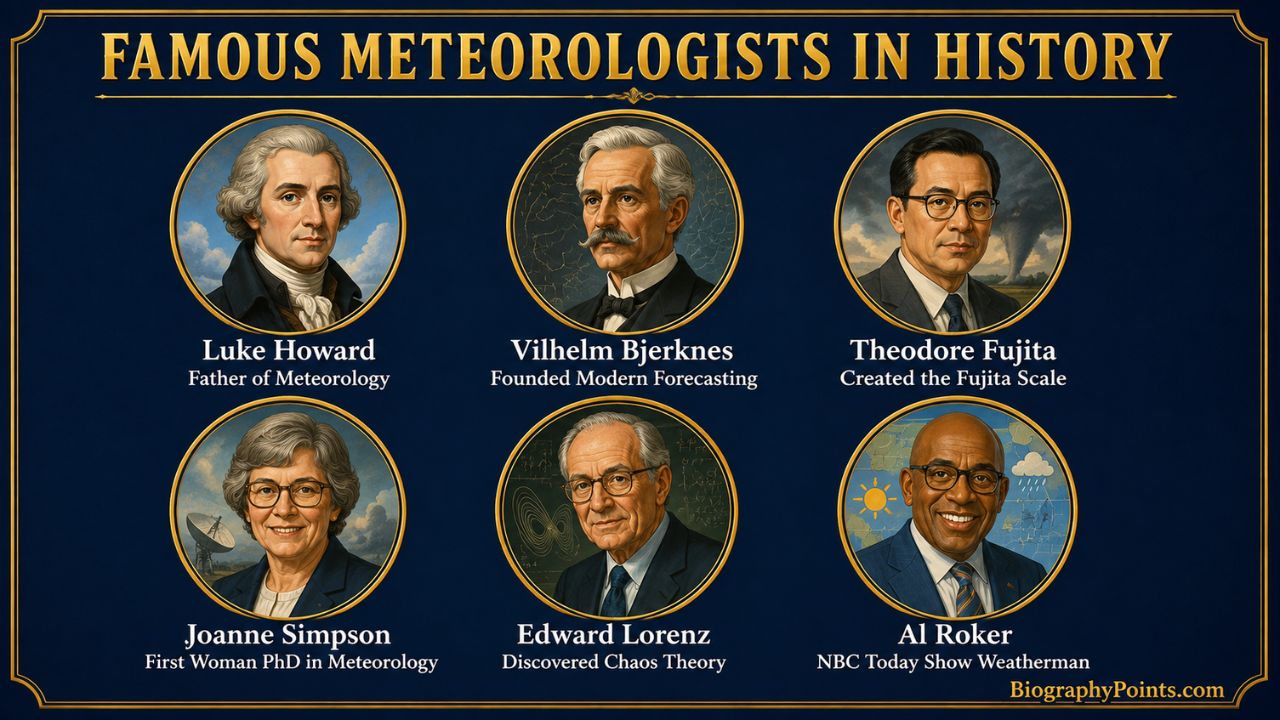
Pioneers Who Shaped Meteorology
Aristotle (384–322 B.C.) did not predict tomorrow’s weather, but he is responsible for the word meteorology existing at all. Around 340 B.C., the Greek philosopher wrote Meteorologica — one of the earliest systematic attempts in Western history to explain atmospheric phenomena through reasoned observation rather than mythology. He addressed rain, wind, clouds, thunder, lightning, and climate in a single comprehensive text. While many of his conclusions have since been revised or disproved by modern science, the framework he established — that atmospheric events have natural causes that can be studied and explained — laid the intellectual foundation for everything that followed. The word meteorology derives directly from his title.
Luke Howard (1772–1864) gave the world a language for the sky. A British manufacturing chemist and dedicated amateur scientist, Howard published his landmark essay On the Modifications of Clouds in 1803, in which he proposed a systematic classification of cloud types using Latin names: cirrus, cumulus, stratus, and nimbus, along with their combinations. That nomenclature, developed by a man with no formal scientific post and no institutional backing, is still in use today in every meteorological agency and weather textbook on Earth. For that contribution, Howard is widely referred to as the “Father of Meteorology” and the “Namer of Clouds.” His work also pioneered the study of urban climate, with a twenty-year statistical record of London’s weather providing the foundation for his influential work The Climate of London.
Vilhelm Bjerknes (1862–1951) is one of the founders of modern scientific weather forecasting. A Norwegian physicist and mathematician, Bjerknes was the first to articulate the theoretical basis for forecasting as a mathematical problem — the idea that if the current state of the atmosphere could be measured precisely enough, its future state could be calculated using the laws of physics. That principle underpins every numerical weather prediction model operating today. Bjerknes also led the Bergen School of Meteorology in Norway, where he and his colleagues developed the concept of atmospheric fronts — the boundaries between air masses of different temperatures — which became a cornerstone of practical weather analysis and forecasting worldwide.
Edward Lorenz (1917–2008) changed how scientists think about prediction itself. An American mathematician and meteorologist at the Massachusetts Institute of Technology, Lorenz discovered in the early 1960s that even tiny differences in the initial conditions fed into a weather model could produce dramatically different forecast outcomes over time. He called this sensitive dependence on initial conditions, and it became the foundation of what is now known as chaos theory. Lorenz’s work established, with mathematical rigour, why precise long-range weather forecasting has fundamental limits regardless of how powerful the computers become — not because the science is inadequate, but because the atmosphere is inherently chaotic. His famous illustration of the concept — the idea that the flap of a butterfly’s wings in Brazil might set off a tornado in Texas — gave chaos theory one of its most enduring metaphors.
Dr. Theodore Fujita (1920–1998) spent his career studying the most violent atmospheric phenomena on Earth. A Japanese-American meteorologist at the University of Chicago, Fujita developed the Fujita Scale — commonly known as the F-Scale — in 1971, a system for rating the intensity of tornadoes based on the damage they cause to structures and vegetation. The scale, later updated as the Enhanced Fujita Scale (EF-Scale) and adopted across the United States in 2007, remains the standard tool for tornado intensity classification. Fujita also made pioneering contributions to the understanding of microbursts — sudden, intense downdrafts from thunderstorms — research that directly improved aviation safety after a series of fatal aircraft accidents were linked to the phenomenon.
Joanne Simpson (1923–2010) broke barriers that had nothing to do with the atmosphere. In 1949, she became the first woman in the world to earn a Ph.D. in meteorology, doing so at a time when female scientists faced significant institutional resistance and were frequently discouraged from pursuing advanced degrees in physical sciences. Her scientific contributions were equally groundbreaking. Simpson conducted pioneering research into tropical clouds and weather systems, developed some of the earliest mathematical models of cumulus convection, and later became the first chief scientist of the NASA Goddard Space Flight Center’s Laboratory for Atmospheres. Her career demonstrated both the scientific depth and the professional endurance required to succeed in a field that did not always welcome her.
Famous TV Weathermen and Broadcast Meteorologists
Alongside the scientists who built meteorology as a discipline, a separate group of professionals shaped how the public understands and relates to weather — the broadcast meteorologists and on-air weathermen who brought atmospheric science into living rooms, newsrooms, and daily conversation.
Al Roker is among the most recognised weathermen in American television history. A graduate of the State University of New York at Oswego with a degree in communications, Roker joined NBC’s Today show in 1996 and has remained one of its most prominent figures. He is also the host of the Weather Channel’s Wake Up with Al and has received multiple Emmy Awards for his broadcast work. Roker has used his platform to communicate weather science and climate awareness to one of the largest morning television audiences in the United States, making him one of the most influential broadcast weather personalities of his generation.
Dr. James E. Hansen (born 1941) occupies a unique position in the meteorological world — a research scientist whose work reached the general public in ways that few atmospheric scientists achieve. As the former director of NASA’s Goddard Institute for Space Studies, Hansen became internationally known in 1988 when he testified before the United States Senate that global warming was already underway and that human activity was the primary cause. That testimony, delivered during a period of intense summer heat, is widely credited with bringing climate change into mainstream public and political discourse for the first time. Hansen’s scientific record, spanning decades of published research on atmospheric composition and global temperature trends, establishes him as one of the most consequential figures in the history of atmospheric science.
Dr. Katharine Hayhoe (born 1972) is a Canadian-American atmospheric scientist and professor at Texas Tech University whose influence extends well beyond academic research. Recognised as one of the leading communicators of climate science to non-specialist audiences, Hayhoe has worked extensively to bridge the gap between scientific findings and public understanding — engaging with communities, faith groups, and policymakers who might not otherwise engage with climate data. She has been named among Time magazine’s 100 Most Influential People and has received the American Geophysical Union’s Ambassador Award for her contributions to science communication. Her work represents a model of how meteorological and atmospheric expertise can translate into meaningful public engagement.
Michael Fish (born 1944) is perhaps the most famous — and most good-humouredly notorious — weatherman in British broadcasting history. A trained meteorologist who joined the BBC in 1974, Fish presented weather forecasts on BBC television for nearly 30 years and became one of the most recognisable faces in British public life. His lasting fame, however, rests on a single broadcast from October 15, 1987, in which he reassured viewers that reports of a hurricane approaching the United Kingdom were unfounded. That night, the Great Storm of 1987 struck southern England and northern France with hurricane-force winds, killing 18 people, uprooting an estimated 15 million trees, and causing widespread structural damage. The forecast — or more precisely, the reassurance that preceded it — became one of the most discussed meteorological broadcast moments in history, and has been cited in discussions of forecast communication, public trust, and the limits of weather prediction ever since. Fish himself has addressed the incident with considerable grace in the years that followed, noting that the forecast models available at the time did not capture the storm’s rapid development.
Meteorologist Around the World — "Meteorólogo" and the Global Profession
Weather does not respect national borders. A hurricane forming in the Atlantic affects coastlines across multiple countries. A monsoon season in South Asia influences weather patterns felt thousands of kilometres away. The jet stream that shapes winter weather across North America originates over the Pacific and interacts with atmospheric systems spanning the entire Northern Hemisphere. For this reason, meteorology has always been an inherently international science — one that requires cooperation, shared standards, and consistent professional practice across every country on Earth.
The title changes with the language. The science does not.
Meteorólogo — The Role in Spanish-Speaking Countries
In Spanish-speaking countries, a meteorologist is called a meteorólogo — and the role carries identical professional responsibilities, educational requirements, and scientific standards to those observed in English-speaking nations.
A meteorólogo working in Buenos Aires, Madrid, or Mexico City performs the same core functions as a staff weather forecaster at a National Weather Service office in the United States: collecting and interpreting atmospheric data, issuing public forecasts and severe weather warnings, operating radar and satellite monitoring systems, and communicating weather information to governments, industries, and the general public. The tools, the models, and the underlying science are shared internationally.
The major meteorological agencies serving Spanish-speaking populations are well-established and widely respected within the global meteorological community.
Argentina’s Servicio Meteorológico Nacional (SMN) is the national meteorological service of Argentina, responsible for weather observation, forecasting, and climate monitoring across one of South America’s largest and most geographically diverse countries. Argentina’s terrain spans subtropical regions in the north, the Pampas grasslands in the centre, Patagonian steppe in the south, and Andean mountain ranges along the western border — a range of environments that presents significant forecasting complexity and demands a highly skilled meteorólogo workforce.
Spain’s Agencia Estatal de Meteorología (AEMET) serves as the national weather authority for Spain and its territories. AEMET provides public forecasts, issues warnings for severe weather events including storms, extreme heat, and flooding, and contributes meteorological data to European and global forecasting networks. Spain’s position at the intersection of Atlantic weather systems, Mediterranean climate patterns, and North African air masses makes it one of Europe’s meteorologically complex countries, and AEMET meteorólogos work at the forefront of European forecasting science.
Mexico’s Servicio Meteorológico Nacional (SMN), operating under the National Water Commission (CONAGUA), monitors weather across a country exposed to Atlantic and Pacific hurricane activity, severe tropical storms, and the complex atmospheric dynamics of a nation that spans both hemispheres of North America. The SMN issues forecasts, maintains observation networks, and coordinates with international agencies during major weather events affecting Central America and the Caribbean.
Across all three agencies — and their counterparts in Chile, Colombia, Peru, Venezuela, Cuba, and every other Spanish-speaking nation — the educational pathway into meteorology mirrors international standards. A degree in meteorology, atmospheric science, or a closely related physical science is the standard entry requirement. Professional development and continuing education are expected throughout a meteorólogo’s career, with many professionals participating in international training programmes coordinated through global organisations.
Key Professional Organisations Worldwide
The global practice of meteorology is unified — in standards, data sharing, and professional development — through a network of national and international organisations that coordinate the work of meteorologists and meteorólogos across every country and climate zone.
The American Meteorological Society (AMS), founded in 1919 and headquartered in Boston, Massachusetts, is the leading professional and scientific organisation for atmospheric scientists in the United States. It publishes peer-reviewed scientific journals, sets professional standards for the use of the title meteorologist, administers the Certified Broadcast Meteorologist (CBM) and Certified Consulting Meteorologist (CCM) credentials, and hosts one of the largest annual atmospheric science conferences in the world. The AMS also provides educational resources and outreach programmes designed to build public understanding of weather, climate, and atmospheric science. Its formal definition of the term meteorologist — adopted in 1990 — remains the benchmark used by employers and broadcasters across the United States and beyond.
The National Weather Association (NWA), founded in 1975, serves operational meteorologists — the forecasters and technicians who work in day-to-day weather prediction within government agencies, private services, and broadcast organisations. The NWA’s focus is practical rather than primarily academic, providing continuing education, a peer-reviewed journal, and professional development resources tailored to the needs of working forecasters. Its annual meeting brings together staff weather professionals from across the operational meteorology community to share research, techniques, and best practices.
The World Meteorological Organization (WMO) is the authoritative intergovernmental body for meteorology at the global level. Established in 1950 as a specialised agency of the United Nations, the WMO coordinates the international exchange of weather data between its 193 member states and territories — the framework that makes global weather forecasting possible. Without WMO coordination, the observational data that national meteorological services feed into their forecast models would be fragmented and incompatible. The WMO also sets technical standards for meteorological instruments, data formats, and observation practices; supports the development of meteorological services in lower-income countries; and leads international scientific assessments of climate and the atmosphere. Its headquarters are located in Geneva, Switzerland.
The Royal Meteorological Society (RMetS), founded in London in 1850, is one of the oldest meteorological organisations in the world. It serves as the professional body for meteorologists in the United Kingdom and maintains an international membership spanning researchers, operational forecasters, broadcast meteorologists, and weather enthusiasts. The RMetS publishes several peer-reviewed journals, accredits university meteorology programmes, and awards the Chartered Meteorologist (CMet) designation — the professional credential equivalent in the UK context to the AMS certifications in the United States. The Society also works to improve public engagement with weather and climate science, recognising that informed public understanding is as important to the profession as technical accuracy.
The European Centre for Medium-Range Weather Forecasts (ECMWF), based in Reading, England, is not a membership organisation in the traditional professional sense — it is an independent intergovernmental research and operational weather centre supported by 35 member and cooperating states across Europe. Its primary function is the production of global medium-range weather forecasts — covering the period from three to fifteen days ahead — that are distributed to national meteorological services and used as a primary reference by forecasters worldwide. The ECMWF model is widely regarded within the meteorological community as the most consistently accurate global forecasting model available, a reputation built through decades of sustained investment in supercomputing infrastructure, data assimilation methods, and model development. Its forecasts are used not only by European meteorological services but by weather agencies on every continent, making the ECMWF one of the most consequential scientific institutions in global meteorology.
Together, these organisations form the institutional architecture of a profession that operates across linguistic, cultural, and national boundaries — ensuring that whether a person is consulting a meteorologist in New York, a meteorólogo in Madrid, or a weather forecaster in Tokyo, the science behind the forecast they receive is grounded in the same global observational network, the same physical principles, and the same commitment to accuracy that defines the profession worldwide.
FAQ: Everything You Need to Know About Meteorologists
Key questions answered about the meteorologist profession, staff weather roles, and how to enter the field
The American Meteorological Society draws a formal distinction between these titles. A meteorologist holds a degree in meteorology or atmospheric science and uses scientific principles to forecast and study the atmosphere. A weathercaster, by contrast, presents forecasts prepared by others and may not hold formal atmospheric science qualifications. In Spanish-speaking countries, the equivalent professional title is meteorólogo.
Meteorology is the science of the atmosphere, practised by staff weather forecasters, broadcast meteorologists, and atmospheric researchers. Metrology is the science of measurement, practised by specialists in manufacturing, laboratory science, and national standards bodies such as the National Institute of Standards and Technology (NIST). The confusion between the two terms is common but significant — they describe completely different scientific disciplines with different education pathways, employers, and purposes.
High school students should build a strong foundation in mathematics, physics, chemistry, and computer science. At university level, the B.Sc. in Meteorology is the minimum professional requirement, covering atmospheric dynamics, thermodynamics, numerical weather prediction, and remote sensing. Those pursuing research or advanced consulting roles typically complete a Master's degree or Ph.D. Broadcast meteorologists often add journalism training and seek the AMS Certified Broadcast Meteorologist (CBM) credential, which is expected in major television markets. Entry into the profession is most commonly achieved through internships with the National Weather Service, NOAA, private weather companies, or local television stations.
The process begins with global observation — thousands of instruments simultaneously measuring temperature, pressure, humidity, wind speed, and precipitation across the surface, upper atmosphere, and oceans. That data is then processed through numerical weather prediction (NWP) models, including major systems such as the American GFS and the European ECMWF. Trained meteorologists analyse the model output, compare multiple models, and use professional judgement developed through experience to produce the final forecast. Short-range forecasts of one to two days are highly accurate; beyond ten days, forecasts shift to broader probabilistic guidance due to the inherently chaotic nature of the atmosphere.
In broadcast meteorology, Al Roker of NBC's Today show is among the most recognised weathermen in American television. The UK's Michael Fish became internationally known following the Great Storm of 1987. In climate science, Dr. James E. Hansen of NASA and Dr. Katharine Hayhoe of Texas Tech University are among the most influential atmospheric scientists of the modern era, recognised for both their research contributions and their public communication of climate science.
Modern meteorology encompasses far more than daily weather forecasting. It includes atmospheric physics, climate science, severe weather research, numerical weather prediction, and environmental forecasting. The discipline is formally defined by the American Meteorological Society and is practised by professionals holding at minimum a Bachelor of Science in Meteorology or Atmospheric Science from an accredited university.
The exact duties depend on the role. A staff weather forecaster at the National Weather Service focuses on producing official forecast products and issuing hazardous weather advisories. A broadcast meteorologist presents weather reports on television or radio. A research meteorologist studies atmospheric phenomena to improve scientific understanding and forecasting models. Across all roles, the work combines scientific data analysis with clear, accurate communication — often under time pressure during rapidly developing weather events.
Entry-level meteorologists typically earn between $49,990 and $65,000 per year, while experienced professionals in specialised or senior roles can earn $100,000 to $160,710 or more annually. Salaries vary significantly by sector — broadcast meteorology in major markets, private consulting, and renewable energy forecasting tend to offer higher compensation than standard government positions, though federal roles include comprehensive benefits packages. These figures reflect U.S. national averages and may differ by location and employer.
Gallery