

Table of Contents
Susukino (すすきの)
Susukino is a popular entertainment and red-light district in Sapporo, Hokkaido, Japan. It is one of Japan’s most well-known red-light districts, including Kabukichi (Tokyo) and Nakasu (Fukuoka). Susukino is particularly known for its lively entertainment scene, restaurants, bars, hotels, and adult entertainment venues. The area’s name is commonly written as 薄野 in kanji and ススキノ in katakana, which translates directly to “zebra grass field”.
Susukino is located in the Chuo Ward of Sapporo and is also a tourist destination that attracts a large number of tourists from all over Japan and internationally. In the area, you will find stores, bars, restaurants, karaoke shops, pachinko parlors, and other entertainment establishments. Susukino’s highlights include Ramen Yokocho, a narrow street lined with numerous shops serving Sapporo’s famous ramen. The area is a particular attraction for ramen enthusiasts and the food here is very popular.
Susukino is popular for its diverse activities and its colorful atmosphere. The district is not only known for its nightlife, but also attracts a large number of visitors during the day, who come to enjoy shopping and local culture. Susukino has its own unique identity among other entertainment districts in Japan and offers a unique experience due to its colorful and vibrant atmosphere.
Susukino St
| Susukino (すすきの) | |
| Urdu Name | سوسوکینو |
| Location | Sapporo, Hokkaido, Japan |
| Known For | Entertainment and nightlife district |
| Established | Late 19th century |
| Main Attractions | Bars, restaurants, nightclubs, and pachinko parlors |
| Famous Event | Susukino Snow Festival (part of the Sapporo Snow Festival) |
| Transportation | Susukino Station (Sapporo Municipal Subway) |
| Notable Spots | Ramen Alley, Neon Signs, Noria Ferris Wheel |
| Language | Japanese (すすきの) |
Origin of the Name Susukino
There are various theories about the origin of the name Susukino, and its true truth is still not fully known. According to one theory, the area known today as Susukino was previously covered with Miscanthus sinensis (susuki) grass, which is commonly found in Japan. According to another theory, Susukino was named after Tatsuyuki Usui, who was the supervisor of the construction of the red-light district in Sapporo. His name is written in kanji as 薄井, and the character 薄 is the symbol for susuki grass in Japanese.
Historical Background
There are two main theories about the name Susukino. The first theory is that it was named by Iwamura Michitoshi, who was the judge of the colonization of Hokkaido at the time. According to them, the name was named after Usui Tatsuyuki’s surname. Another theory is that the entire Sapporo area was shown as “Keanu” on a map from 1869, which is a common term for Japanese silver grass or reeds.
It is also said that an official of the Hokkaido Development Commission mentioned that the area around “Minami 5-jo” was called “Keanu”. In addition, Nakagawa Genzamon, who was the general contractor of the founder of Sapporo, confirmed that this name was heard and seen from Iwamura.
Name Change in the Past
Around 1872 (Meiji Era 5), the Susukino area was also known as “Fuji-cho”, but after the ban on human trafficking in 1873, the names of various places were changed to “Fukushima-dori”, “Sugaru-dori”, “Kamisu-dori” the following year. Further changes were made in 1873 and 1881, and according to the current boundaries at that time, the border between Minami 4-jo Nishi 3-chome and Minami 5-jo Nishi 3-chome is known as “Naka-cho”. It is also said that the origin of Susukino’s name includes further historical details, revealing its depth and complexity.
Susukino Overview
Susukino is a popular entertainment district in Sapporo, Japan, but is not the official name of a municipality. It is usually used to refer to an informal area with unclear boundaries. According to the Susukino Tourist Association, the area is bordered by Minami 4 and Minami 6 streets to the north and south, and Nishi 2-chome to Nishi 6-chome to the east and west.Susukino is considered one of the three major entertainment districts in Japan, along with other popular areas such as Shinjuku, Kabukicho in Tokyo, and Nakasu in Fukuoka.
It is known as the “largest entertainment district north of Tokyo” and the “northernmost entertainment district in Asia”. The area is home to restaurants, girls’ bars, cabaret clubs, sexy cabaret clubs, hostess clubs, snack bars, clubs, love hotels, and other adult entertainment facilities.
Tourist and Commercial Facilities
Susukino not only has restaurants and entertainment establishments, but also hotels, accommodation facilities, entertainment facilities, and commercial establishments in the same building, making it a diverse business center. It is considered a safe entertainment area where women can drink alone, which shows a positive feature of its public safety.Although Susukino is not an official place name, it is included in the names of “Susukino Station” and “Hosui Susukino Station” of the Sapporo Municipal Subway and “Susukino Stop” of the Sapporo City Tram.
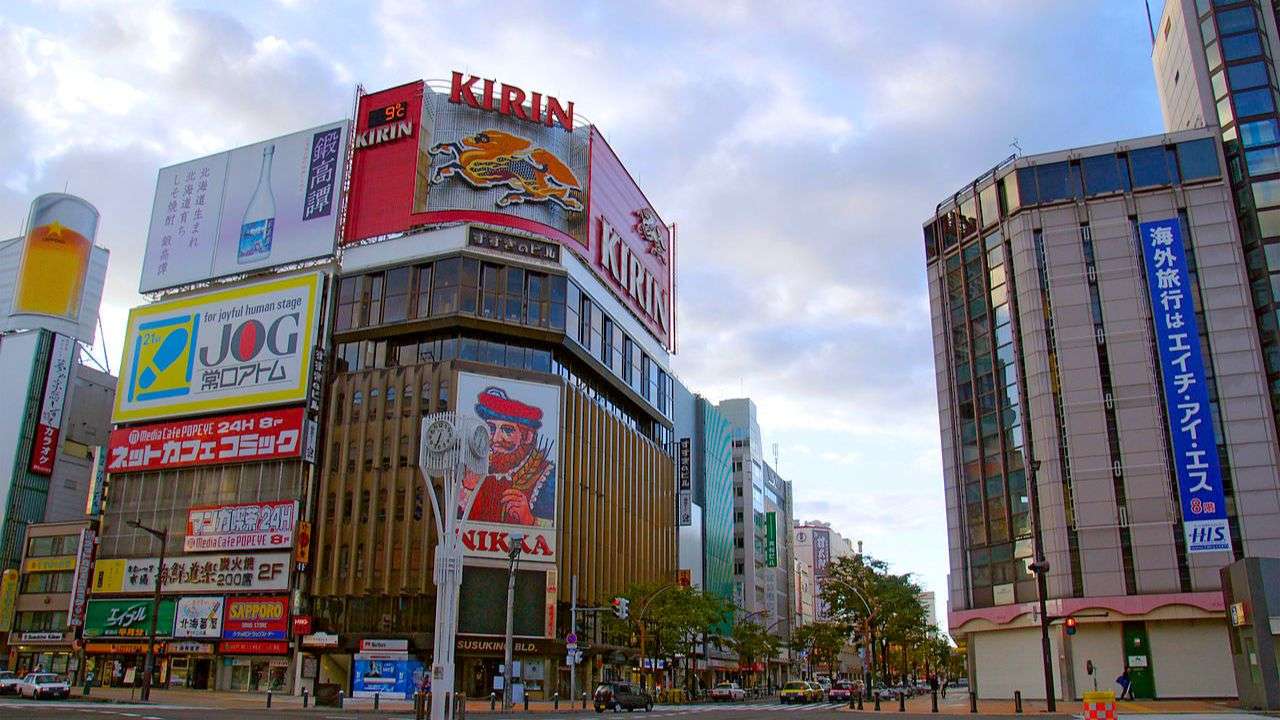
The Hokkaido Prefectural Police defines its borders as between Nishi 2-chome and Nishi 6-chome from east to west and between Minami 3-jo and Minami 7-jo from north to south.
Historical and Recent Changes
The number of shops in the Susukino area exceeded 5,000 by the end of 1989, including 4,190 restaurants. By the end of 2008, this number had decreased to 4,463, including 3,620 restaurants. As of 2020, hotel construction was continuing in central Sapporo, even during the COVID-19 pandemic. The Lafila shopping center in Susukino is being rebuilt, and vacant spaces are being converted into hotels, demonstrating the city’s growth in uniquely designed facilities.
Area: Susukino
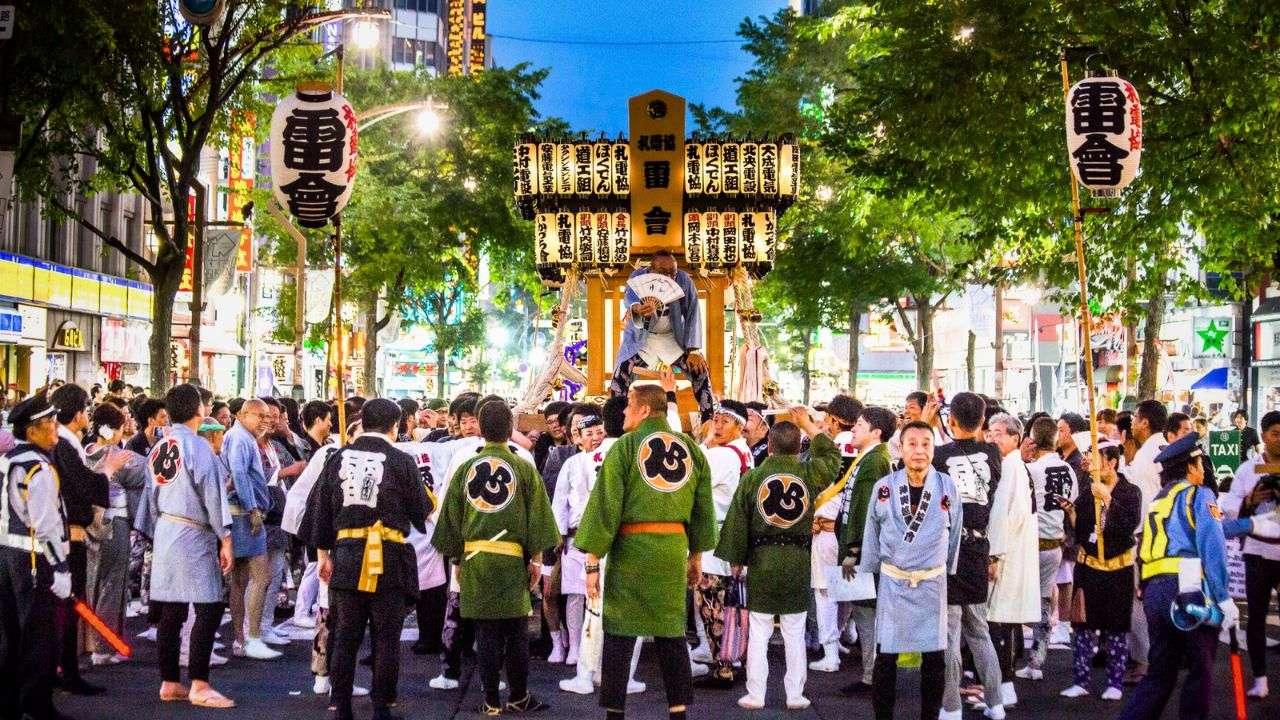
Susukino Crossing is located between Nishi 3-cho and Minami 4- cho, and various neon signs are installed on the buildings along the road, further illuminating the area. One of these signs is the Naka sign in front of the Susukino Building, which features a painting of the symbol of Naka, known as the King of Blenders, and a background of varying colors. Every September, the Hokkaido Marathon is held in Sapporo, during which runners pass through the Susukino Crossing and the Susukino district along Ekimae Dori, leading to the finish line at Nakajima Park. The Susukino Festival is also held every August, where people carrying mikoshi parade down the street, and a large number of visitors come to witness the colorfulness and excitement of the festival.
Susukino is home to popular spots like Ganso Ramen Yokochō and Shin Ramen Yokochō, where ramen restaurants are located side by side. Here, visitors have the opportunity to taste a variety of Sapporo ramen, a specialty of the area and a major tourist attraction.
History: Susukino
The Susukino area dates back to 1871, when Hokkaido Kaitaku-shi designated it as a red-light district from Minami 4 and Minami 5 to Nishi 3-chome and Nishi 4-chome. At that time, the area was called “Susukino Yūkaku” (Susukino Red-Light District) and other brothels were merged into it. A major reason behind this was to keep workers busy in Sapporo, when Hokkaido was just beginning to develop. In 1872, a wall measuring 900 meters was built around Susukino Yūkaku, and a gate was also installed between Nishi 3-chome and Nishi 4-chome. In the same year, an act was passed allowing prostitutes to be freed, but this had little effect on the district. In 1880, the Susukino Kōban (Susukino Police Box) was placed in the area.
Schools and other Development Projects
In 1901, plans were made to relocate the area to accommodate schools and women’s vocational institutions near the Kamokamo River. However, the relocation was not completed until the summer of 1920. In 1918, the Hokkaido 50th Anniversary Exhibition was held in Nakajima Park, and the Susukino Station of the Sapporo Streetcar was also opened. In 1922, the red light district was moved to the Kikusui district of Shiroshi-ku.
World War II and Subsequent Changes
Susukino’s atmosphere remained calm during the war, but cabarets and dance halls were built immediately after the war. American occupation troops also came to the area. Susukino was originally a blue line district where illegal prostitution took place. The Prostitution Prevention Act was enacted in 1958, but prostitution in Susukino did not completely end. In 1964, the government ordered the removal of street stalls, which led to the end of this business.
Development in the 1970s and 1980s
Susukino was selected to host the 1972 Winter Olympics. During this period, Susukino saw the expansion of roads, the construction of the Sapporo Municipal Subway, and the completion of a shopping arcade. In 1974, the Matsuzakaya Sapporo branch opened. In 1983, the Susukino Snow Festival was held, which became part of the Sapporo Snow Festival. In 1986, a natural hot spring was discovered in Susukino, called “Susukino Hot Springs”. In 1988, Hōsui Susukino Station was opened, a subway station on the Tōhō Line.
Taisho Period
The Taisho Period (1912-1926) was a period of significant development and transformation in Susukino. In 1917, the owner of an apple orchard donated land to Sapporo Ward and designated the area for a brothel. At that time, it was decided to move the brothel to Shiroshi-cho, Sapporo Ward (now Kikusui, Shiroshi-ku, Sapporo City). Sapporo Ward allocated approximately 70,000 m² of land for this purpose, of which 43,000 m² was sold to developers. Between 1918 and 1920, the Sapporo brothel moved across the Toyohira River to Shiroshi-cho and began operating on October 1, 1920. Its official name was “Sapporo Brothel”, but locals knew it as “Shiroshi Brothel”.
After the relocation, Susukino seemed deserted for a time, but soon restaurants, cafes, bars, and other eateries began to open here. In 1921 (Taisho 10), two new theaters opened in Susukino: Nanbu Katsutaro’s “Mimanjōkan” and former owner Nishida Ichitaro’s “Nishidaza”.
Fire and the Development of Cinema
In 1923, Nishidaza closed due to a fire, but in 1925 (Taisho 14) it was taken under the umbrella of “Nishikiza Shochiku”, which reopened as “Sapporo Shochikuza” and attracted a large crowd. During this period, the “Mimanjōkan” was engaged in a spectacular cinema war, showing Nakatsu films. Towards the end of the Taisho period, Susukino’s neon district emerged in its current form. This period was an important part of Susukino’s historical development, in which it consolidated its status as a cultural and commercial center.
Important Developments in Susukino
- 1871 (Meiji period): The Hokkaido Development Commission established an officially sanctioned brothel. The commission’s judge, Michitoshi Iwamura, ordered the brothel to open, and in 1872 prostitutes were brought in from Tokyo at government expense. At the same time, Tokyo Tower was also opened.
- 1887 (Meiji 10): The Hokkaido Development Commission enacted the “Rules for the Three Businesses of Rental Houses, Entertainment, and Prostitution”.
- 1918 (Taisho period): The Sapporo Electric Tramway, later known as the Sapporo City Tram, opened at Susukino Police Box Station (now Susukino Station).
- 1920 (Taisho period): The brothel was moved to Shiroshi Village (now Kikusui, Shiroshi-ku, Sapporo City).
- 1965 (Showa 40): The Susukino Festival was held for the first time, later known as the Susukino Festival.
- 1971 (Showa 46): Susukino Station on the Sapporo Municipal Subway Nambuko Line was opened.
- 1978 (Showa 53): The “Susukino Tourism Association” was established.
- 1980 (Showa 55): The Susukino Marathon was held for the first time, ending in 1987.
- 1981 (Showa 56): The Susukino Snow Festival (later the Susukino Ice Festival, and more recently the Susukino Ice World) and Susukino Illumination were held for the first time.
- 1988 (Showa 63): Hosui-Susukino Station opened on the Sapporo Municipal Subway Toho Line.
- 1999 (Hisei 11): The first “Susukino Enichi” event was held.
- 2005 (Hisei 17): Susukino was designated as a model district under the Cabinet Secretariat’s urban regeneration plan, and the Susukino Ordinance was enacted, which was based on the prevention of applications for adult entertainment businesses.
- 2015 (Hisei 27): The Sapporo City Tram was given a loop shape.
- 2020 (Reiwa 2):
– On June 11, the Susukino police box was moved to a temporary location for reconstruction. - – In November, restaurants and other businesses began shortening their operating hours at the request of Hokkaido due to the spread of COVID-19.
- 2021 (Reiwa 3): From August 1 to August 8, the marathon and racewalking events of the 2020 Tokyo Olympics were held. Traffic restrictions were imposed for this.
- 2022 (Reiwa 4): The new Susukino Police Station building was completed and began operation on March 4. It was the first police station in Hokkaido to be equipped with a generator as a backup for power outages, and a digital signboard was also installed.
- 2023 (Reiwa 5): A murder occurred at the Susukino Hotel in July.
Susukino in Popular Culture
The 2012 video game Yakuza 5 features a playable area called Tsukimino, which is based on Susukino. The game features the protagonist, Taiga Sejima, who, after escaping from prison, heads to Susukino to uncover the truth behind the events that led to his expulsion from the yakuza during that time. His parole is denied due to an unknown powerful force, and he attempts to solve the mystery in Susukino.
The popular 1994 anime Marmalade Boy has an episode set in Susukino, depicting the unique life and atmosphere of the area.
Conclusion
Susukino’s historical and cultural background reflects its unique status. Established by the Hokkaido Development Commission in 1871, the area has undergone various stages and changes over time. Starting from here, Susukino has hosted various recreational activities, businesses, and cultural events at various times, including the Susukino Festival, the Susukino Snow Festival, and the Susukino Marathon. Susukino’s importance is also prominent in popular culture, such as its mention in the video game Yakuza 5 and the anime Marmalade Boy. This reflects the area’s diverse history, social influences, and cultural representation, making Susukino an important place in Japan.


