Table of Contents
Blue Jay Bird
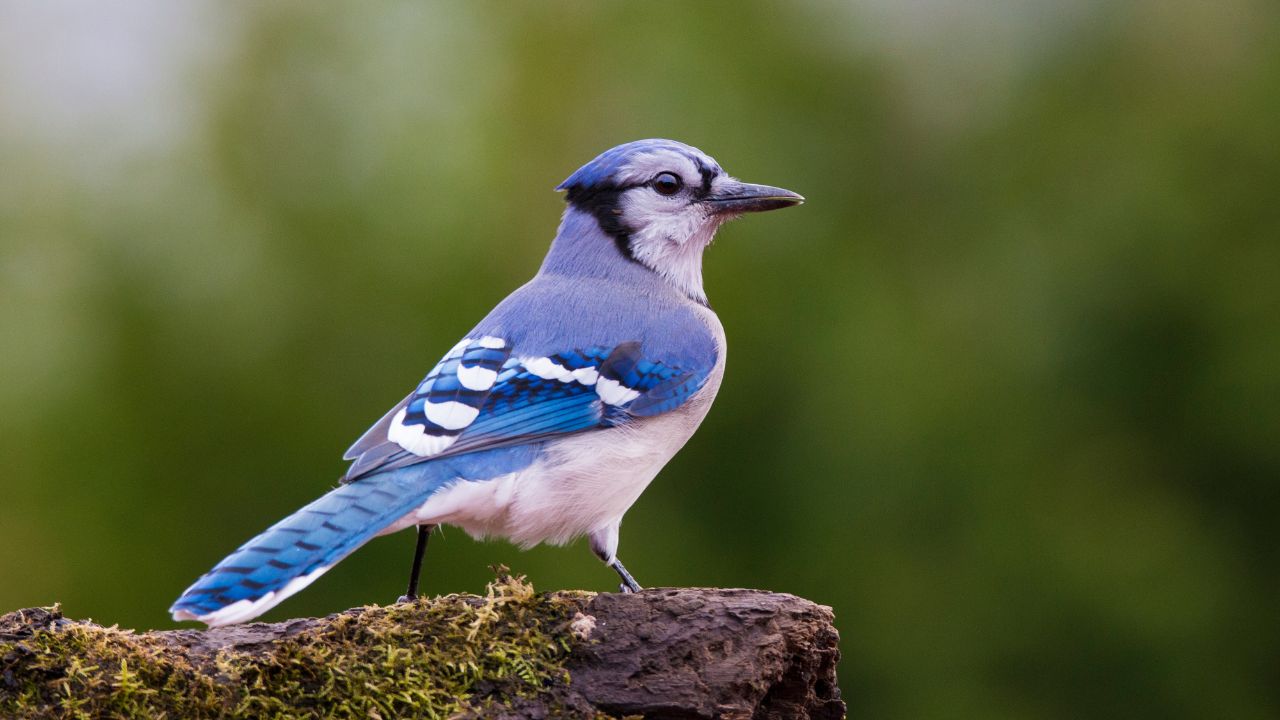
The Blue Jay, scientifically known as Cyanocitta cristata, is a striking bird native to North America, renowned for its vibrant blue feathers, distinctive crest, and loud calls. This intelligent creature, belonging to the Corvidae family, thrives in various habitats east of the Rocky Mountains, spanning from the United States to southern Canada. Its adaptability is evident as it coexists with humans, often seen in urban and suburban areas, though notorious for its aggressive behavior around bird feeders.
Taxonomically, four subspecies of the Blue Jay are recognized: the northern blue jay, inhabiting regions from southern Canada to the southeastern U.S.; the interior blue jay found in the southern Great Plains; the coastal blue jay, prevalent in the eastern U.S.; and the Florida blue jay, residing in southern Florida.
This avian wonder is not just a sight to behold but also an essential part of its ecosystem. Feeding mainly on seeds, nuts, fruits, arthropods, and occasionally small vertebrates, it plays a crucial role in seed dispersal and insect control. Its nesting habits are equally fascinating, with both male and female jays collaborating to build cup-shaped nests in tree branches. Their clutch usually consists of two to seven eggs, which hatch into altricial young cared for by the female.
The name “jay” originates from its chatty and sociable nature, shared among other birds in the Corvidae family. Jays, often referred to as jaybirds, contribute to the rich tapestry of North American birdlife, captivating observers with their beauty and behavior.
Scientific Classification

| Domain | Eukaryota |
| Kingdom | Animalia |
| Class | Aves |
| Order | Passeriformes |
| Phylum | Chordata |
| Family | Corvidae |
| Genus | Cyanocitta |
| Species | C. cristata |
Taxonomy
The blue jay was first documented by English naturalist Mark Catesby in 1731 in his book “Natural History of Carolina, Florida, and the Bahamas,” where he called it Pica glandaria cærulea cristata. Later, in 1758, Carl Linnaeus described it as Corvus cristatus in his work “Systema Naturae.” In 1838, French ornithologist Charles Lucien Bonaparte referred to it as Cyanocorax cristatus in his publication “A geographical and comparative list of the birds of Europe and North America.” Then, in 1845, Hugh Edwin Strickland named it Cyanocitta cristata. The name Cyanocitta comes from Greek words meaning “blue” and “chattering bird,” referring to its blue plumage and chatty nature. The term “cristata,” meaning “crested” in Latin, highlights the bird’s prominent blue crest.
Description
During the 1830s, John James Audubon sketched the blue jay, a bird measuring 22–30 cm (9–12 in) from its bill to tail and weighing 70–100 g (2.5–3.5 oz), with a wingspan of 34–43 cm (13–17 in). Jays from Connecticut averaged 92.4 g (3.26 oz) in mass, while those from warmer southern Florida averaged 73.7 g (2.60 oz), following Bergmann’s rule. A notable feature is its pronounced crest, a crown of feathers on its head that can be raised or lowered according to its mood. When excited or aggressive, the crest is fully raised, while when frightened, it bristles outwards like a brush. During feeding or resting, the crest is flattened.
The plumage of the blue jay ranges from lavender-blue to mid-blue on its crest, back, wings, and tail, while its face is white and the underside is off-white. A black collar extends from the neck to the sides of the head. Strong black, sky-blue, and white barring is seen on its wing primaries and tail. Its bill, legs, and eyes are all black. While males and females appear almost identical, males are slightly larger. Black plumage on the nape, face, and throat varies extensively between individuals and is thought to aid in individual recognition.
Similar to other blue-hued birds, the blue jay’s coloration isn’t due to pigments but rather results from light interference from the feathers’ internal structure. If a blue feather is crushed, the blue disappears as the structure is destroyed, with the actual pigment being melanin, termed as structural coloration.
Show In Table
| Feature | Description |
|---|---|
| Size | The blue jay measures 22–30 cm (9–12 in) from bill to tail and weighs 70–100 g (2.5–3.5 oz), with a wingspan of 34–43 cm (13–17 in). |
| Mass Variation | Jays from Connecticut average 92.4 g (3.26 oz), while those from warmer southern Florida average 73.7 g (2.60 oz). |
| Crest | A pronounced crest on the head, consisting of feathers that can be raised or lowered according to the bird’s mood. |
| Plumage | Lavender-blue to mid-blue in the crest, back, wings, and tail, with a white face and off-white underside. |
| Collar | The neck is collared with black extending to the sides of the head. |
| Wing & Tail | Wing primaries and tail are strongly barred with black, sky-blue, and white. |
| Sexual Dimorphism | Males and females are almost identical, with males being slightly larger. |
| Recognition Aid | Variation in black plumage on the nape, face, and throat assists in individual recognition. |
| Coloration | Coloration is the result of light interference from feather structure, with melanin as the actual pigment. |
Subspecies
| Subspecies | Scientific Name |
|---|---|
| Northern Blue Jay | Cyanocitta cristata cristata |
| Florida Blue Jay | Cyanocitta cristata semplei |
| Interior Blue Jay | Cyanocitta cristata bromia |
| Coastal Blue Jay | Cyanocitta cristata carolinensis |
| Rocky Mountain Blue Jay | Cyanocitta cristata nevadensis |
| Baird’s Blue Jay | Cyanocitta cristata cyanotephra |
| Newfoundland Blue Jay | Cyanocitta cristata atlantica |
| California Blue Jay | Cyanocitta cristata obscura |
| Texas Blue Jay | Cyanocitta cristata texana |
| Arizona Blue Jay | Cyanocitta cristata frontalis |
| Santa Cruz Blue Jay | Cyanocitta cristata coronata |
| Durango Blue Jay | Cyanocitta cristata couchii |
| Honduras Blue Jay | Cyanocitta cristata hondurensis |
| Belize Blue Jay | Cyanocitta cristata cyanotephra belizensis |
| Nicaraguan Blue Jay | Cyanocitta cristata cyanotephra nicaraguae |
| Costa Rican Blue Jay | Cyanocitta cristata cyanotephra costaricensis |
| Panamanian Blue Jay | Cyanocitta cristata cyanotephra atrata |
| Colombian Blue Jay | Cyanocitta cristata cyanotephra columbiana |
| Ecuadorian Blue Jay | Cyanocitta cristata cyanotephra ecuadorensis |
| Peruvian Blue Jay | Cyanocitta cristata cyanotephra peruviana |
| Venezuelan Blue Jay | Cyanocitta cristata cyanotephra venezuelensis |
| Colombian Andean Blue Jay | Cyanocitta cristata cyanotephra albagula |
| Ecuadorian Andean Blue Jay | Cyanocitta cristata cyanotephra andina |
| Bolivian Blue Jay | Cyanocitta cristata cyanotephra boliviana |
| Brazilian Blue Jay | Cyanocitta cristata cyanotephra fluminensis |
| Argentinian Blue Jay | Cyanocitta cristata cyanotephra argentinensis |
Natural history
Blue jays are recognizable for their stunning blue feathers, prominent crest, and loud calls. They measure between 22 and 30 cm (8.7 to 11.8 inches) in length and weigh 65 to 109 grams (2.3 to 3.8 ounces). Their feathers contain melanin, a brown pigment, but they appear blue due to special reflective cells. Along with their blue backs and heads, they have white breasts and wing markings, a gray throat patch, and a gray-blue crest with black bars on the tail and a collar extending from the rear base of the crest.
These birds are omnivores, dining on acorns, grains, fruits, and more. They crack open acorns with their beaks and also eat insects, small rodents, and even the eggs of other birds. They store food for later, sometimes leading to the growth of new plants. Blue jays mimic other bird calls, even those of predators, to steal food. However, they themselves fall prey to larger animals like dogs, cats, and birds of prey.
In terms of taxonomy, they belong to the Animalia kingdom, Aves class, Passeriformes order, Corvidae family, and Cyanocitta genus. They are categorized as a species of least concern.
These songbirds are monogamous, staying with their mate for life. During courtship, one bird may chase or feed the other. They build their nests between March and July in trees, constructing them from twigs, leaves, and mud, sometimes adorning them with string or cloth. Females typically lay four to five eggs, which hatch in about 17 days. Both parents care for the young, which fledge in 17-21 days but often remain with their parents for up to three months. They can start breeding at age one and typically live about 7 years in the wild, though they can live longer in captivity.
Behavior & Diet
The blue jay, known for its noisy and bold demeanor, is a moderately slow flyer, typically cruising at speeds of 32–40 km/h (20–25 mph). This makes it an easy target for predators like hawks and owls, especially when it ventures into open spaces. Various raptors, including Accipiter hawks, are known to prey upon the blue jay, along with other creatures like tree squirrels, snakes, and even fellow jays.

However, the blue jay isn’t just prey; it’s also a protector. It actively defends its territory, chasing away predators and sounding alarms to alert nearby birds of danger. Sometimes, it mimics the calls of larger birds of prey, perhaps to ward off competitors or to check for threats nearby. Interestingly, it’s not just other birds that face its wrath; humans too can be on the receiving end of its aggression, especially if they approach its nest.
Despite its protective instincts, the blue jay can be a bit of a troublemaker. It’s known to raid the nests of other birds, stealing eggs, chicks, and sometimes the nests themselves. However, studies suggest this behavior might not be as common as once believed. Still, other birds will readily gang up to drive away any blue jays encroaching on their turf.
Beyond its defensive and mischievous tendencies, the blue jay exhibits signs of intelligence and curiosity. Like other corvids, it’s drawn to shiny objects and has even been observed playing with items like bottle caps. In captivity, they’ve shown remarkable problem-solving skills, using makeshift tools to obtain food and attempting to manipulate their surroundings.
Diet
The Blue Jay’s diet is quite diverse, with the Audubon Society suggesting that about 75% of what they eat comes from plants. Their robust black bills come in handy for cracking nuts, often holding them with their feet while doing so. They also enjoy nibbling on corn, grains, and seeds, with peanuts still in their shells being a particular favorite. Whether on the ground or up in the trees, they scavenge for various food sources like acorns, berries, weed seeds, and even small animals. Interestingly, they may also feast on bread, meat, and scraps found in urban parks. While they occasionally raid nests for eggs and nestlings, they mostly coexist peacefully with other birds, except when confronted by larger competitors like eastern gray squirrels and red-headed woodpeckers at feeders in places like Florida. Despite their reputation for being feisty, they sometimes yield to these larger birds, illustrating a complex social dynamic in their feeding habits. Additionally, individual Blue Jays exhibit varying degrees of food caching behavior, adding another layer of diversity to their feeding strategies.
Conservation Status
The blue jay, according to the International Union for Conservation of Nature and Natural Resources (IUCN), is listed as a species of least concern. This is because these birds have a wide geographic distribution and can thrive in various habitats, even those altered by human activities. Surveys indicate that blue jay populations remain steady across their range, with an estimated total population reaching as high as 17 million birds. However, there are concerns about factors such as deforestation, habitat destruction, and pesticide use, which can impact their numbers. Additionally, like their relatives, crows and ravens, blue jays are vulnerable to the West Nile virus transmitted by mosquitoes. They can carry the disease without showing symptoms, which can affect their population.
Habitat and Range
Blue Jays are primarily found in deciduous and mixed forests throughout eastern and central North America, from southern Canada down to Florida and westward to Texas. Their adaptable nature has also led them to thrive in suburban areas, where they can often be spotted in parks, gardens, and residential neighborhoods.
Show That List :
- Canada: Northern Blue Jays are found throughout southern Canada.
- United States: Blue Jays are widespread throughout the United States, including states such as Florida, California, Texas, Arizona, and more.
- Mexico: Blue Jays are found in various regions of Mexico.
- Central America: Blue Jays inhabit countries such as Honduras, Belize, Nicaragua, Costa Rica, Panama.
- South America: Blue Jays are found in countries such as Colombia, Ecuador, Peru, Venezuela, Bolivia, Brazil, and Argentina.
Summary
The Blue Jay (*Cyanocitta cristata*) is a captivating bird renowned for its striking appearance and adaptable nature. Found across much of North America, from Canada to South America, this species showcases a diverse range of subspecies, each with its own unique characteristics and habitats. From the Northern Blue Jay of Canada to the Brazilian Blue Jay of South America, these birds inhabit a variety of environments, including forests, parks, and suburban areas. Known for their intelligence and complex social behaviors, Blue Jays play essential roles in their ecosystems, from seed dispersal to maintaining ecological balance. Despite facing threats such as habitat loss and collisions with man-made structures, conservation efforts aimed at preserving their habitats are crucial for ensuring the continued survival of this iconic species across its vast range.