

Table of Contents
Battle of Dessau European (1626)
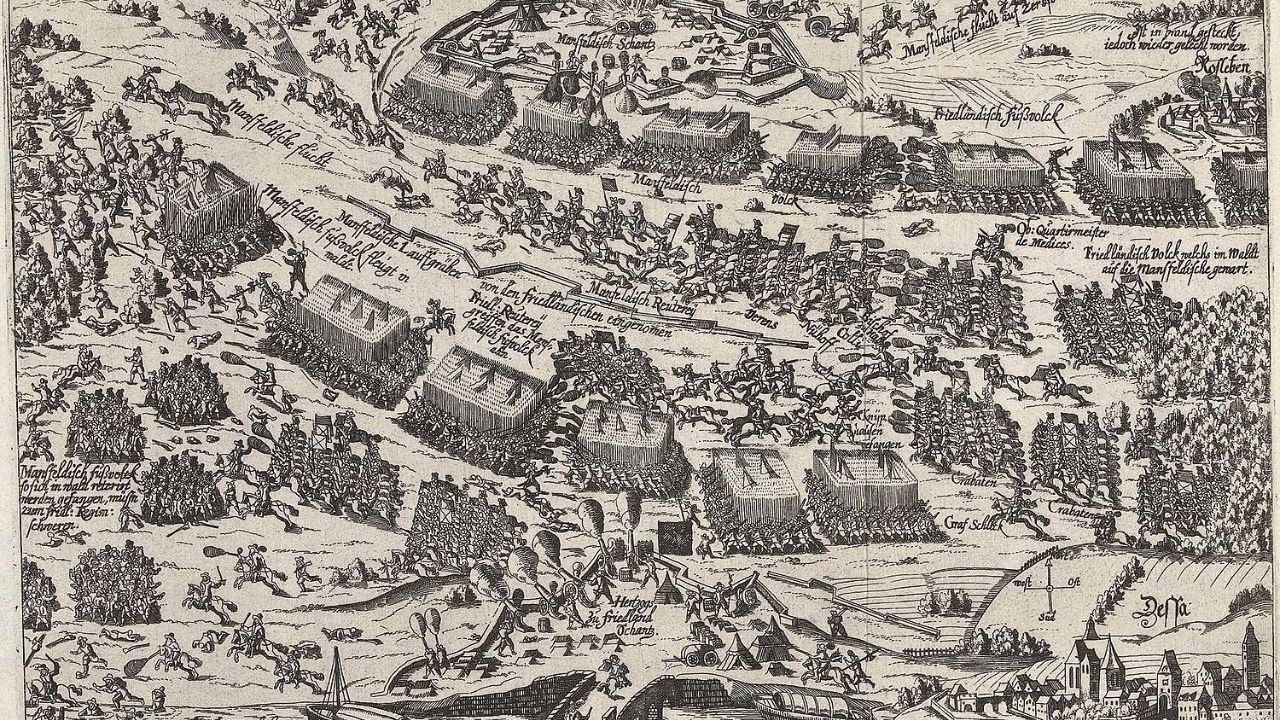
By April 1626, the Thirty Years’ War had devastated the German states and Central Europe for eight years. After a catastrophic defeat at Stadtlohn, the German Protestant cause seemed doomed. However, new hope emerged when Christian IV of Denmark entered the war in 1625. Unfortunately, this optimism was short-lived as, on April 25, 1626, a Protestant army was defeated in the Battle of Dessau by the Catholic forces of Emperor Ferdinand II.
Protestant general Ernst von Mansfeld led his army into Magdeburg to break the imperial line west of the Elbe River. Albrecht von Wallenstein, a wealthy Moravian noble who had converted from Protestantism to Catholicism, commanded the imperial forces there. Dessau, a critical crossing between Magdeburg and Saxony, became the focal point of the conflict.
Wallenstein entrenched four infantry companies on the eastern side, securing a bridgehead. Arriving with superior numbers on April 12, Mansfeld found it difficult to overcome these fortifications. Opting for a siege, he dug trenches and positioned his artillery but made no significant progress. By April 24, substantial imperial reinforcements had arrived, and Wallenstein positioned troops in a wood on the Protestant right flank to outmaneuver them.
Despite being outnumbered, Mansfeld launched a full-scale attack at 6:00 AM on April 25. The battle raged for five hours until Wallenstein’s reinforced troops forced Mansfeld to retreat. Mansfeld ordered the withdrawal of his artillery and baggage while continuing to fight to cover their escape. At noon, fresh imperial cavalry and infantry launched a counterattack from the woods and the bridgehead, forcing the Protestants into a full retreat. This defeat marked the beginning of many setbacks for Christian IV’s strategy, leading to his withdrawal from the war in 1629. The conflict, however, continued for nearly two more decades.
Dessau, largely unfortified, suffered significant damage during the battle and subsequent engagements. Much of the city lay in ruins until the war concluded with the Treaty of Westphalia in 1648.
Dessau, Duchy of Anhalt-Dessau present-day Saxony-Anhalt, Germany
| Battle of Dessau Bridge (1626) | |
| Part of the Thirty Years’ War | |
| Date | 25 April 1626 |
| Location | Dessau, Duchy of Anhalt-Dessau present-day Saxony-Anhalt, Germany |
| Participants |
|
| Result | Catholic victory |
| Strength | |
| Denmark–Norway | 12,000 |
| 20,000 |
| Commanders and leaders | Denmark–Norway
Holy Roman Empire
|
Background and Context
The Thirty Years’ War (1618-1648) was a protracted and devastating conflict primarily fought in the Holy Roman Empire. It involved many of the great European powers and was rooted in religious tensions between Protestant and Catholic states. The Battle of Dessau Bridge, in particular, emerged from the broader context of these religious and political confrontations.
The battle pitted the forces of the Holy Roman Empire, commanded by Albrecht von Wallenstein, against the Protestant troops led by Ernst von Mansfeld. Wallenstein, a brilliant and ambitious military leader, was tasked with halting the advance of Mansfeld, a seasoned mercenary commander known for his support of the Protestant cause.
The Battle Unfolds
The Dessau Bridge, a strategic crossing over the Elbe River, was of paramount importance. Wallenstein, anticipating Mansfeld’s movements, fortified the bridge with a well-prepared defensive position. On April 25, 1626, Mansfeld’s forces launched a determined attack, hoping to break through Wallenstein’s lines and continue their march.
Despite their efforts, Mansfeld’s troops were met with fierce resistance. Wallenstein’s strategic foresight and superior numbers played a decisive role. The Imperial forces, benefiting from their fortified position and disciplined ranks, repelled the Protestant assault. The battle resulted in a significant defeat for Mansfeld, with his army suffering substantial casualties and being forced to retreat.
Aftermath and Significance
The Battle of Dessau Bridge was a crucial victory for the Holy Roman Empire. It not only halted Mansfeld’s advance but also bolstered Wallenstein’s reputation as a formidable military commander. This battle exemplified the brutal and shifting nature of the Thirty Years’ War, where territorial control and military prowess were in constant flux.
In the broader scope of European history, the Battle of Dessau underscores the complex interplay of religion, politics, and military strategy. It highlights the lengths to which rulers and commanders went to assert their dominance and protect their interests during one of Europe’s most destructive conflicts.
Legacy of the Battle of Flores
While not as widely known as other battles of the Thirty Years’ War, the Battle of Dessau Bridge remains a pivotal moment in the conflict. It demonstrates the effectiveness of defensive fortifications and strategic planning in warfare. Moreover, it reflects the broader themes of resilience and adaptation that characterized the era.
In summary, the Battle of Dessau Bridge in 1626 was a defining moment in European history, illustrating the intense military and political struggles of the Thirty Years’ War. Wallenstein’s victory over Mansfeld not only shaped the course of the war but also left a lasting legacy on the strategies and outcomes of future European conflicts.
Statistics
Forces Involved
| Side | Commander | Troops Involved |
| Holy Roman Empire | Albrecht von Wallenstein | Approximately 12,000 soldiers |
| Protestant Forces | Ernst von Mansfeld | Approximately 7,000 soldiers |
Ships and Equipment
| Side | Ships/Equipment | Details |
| Holy Roman Empire | Defensive Fortifications | Fortified positions around Dessau Bridge |
| Protestant Forces | Artillery | Several cannons used in the assault |
Casualties and Losses
| Side | Casualties | Details |
| Holy Roman Empire | Minimal | Precise numbers not well-documented |
| Protestant Forces | Significant | Estimated over 2,000 killed or wounded |


