Table of Contents
St. Anne’s Anglican Church (Church)
St. Anne’s Anglican Church, also referred to as St. Anne’s, Gladstone Avenue, St. Anne’s, Brockton, or the Group of Seven Church, is a significant historic parish church in the Brockton Village neighborhood of Toronto, Ontario. Established in 1862, the church has long been a community cornerstone, providing spiritual guidance and fostering a sense of unity among its parishioners. Over the years, it has become renowned not only for its religious significance but also for its unique architectural and artistic contributions.
The present church building, constructed between 1907 and 1908, stands out as a National Historic Site of Canada. It was designed in the Byzantine Revival style, which is particularly rare for Anglican churches, adding to its architectural significance. The church’s design, characterized by its central dome, cruciform plan, and two domed bell towers, reflects a blend of grandeur and sacred tradition. The building’s construction in concrete and brick, combined with its distinctive style, has made it a landmark in Toronto’s architectural landscape.
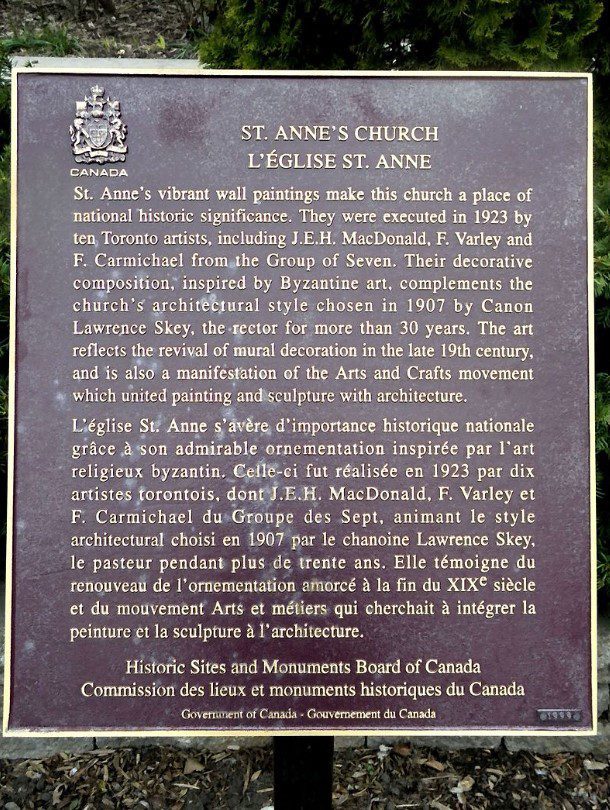
One of the most remarkable aspects of St. Anne’s Anglican Church is its interior decoration. In 1923, the church enlisted members of thup of Seven to create our members Als, making it a unique cultural treasure. Artists like J. E. H. MacDonald, Frederick Varley, and Franklin Carmichael, known for their landscape paintings, brought a rare artistic dimension to the church through their religious-themed murals. These artworks and and sails added in the 1960s turned the church into a fusion of spiritual and artistic heritage.
Tragically, on June 9, 2024, a devastating fire severely damaged St. Anne’s Anglican Church. The blaze destroyed much of the interior and the invaluable Group of Seven murals. Despite this loss, the spirit of the church community remains unbroken. Both the church’s rector, Don Beyers, and Toronto’s Mayor, Olivia Chow, have expressed a strong commitment to rebuilding the church, ensuring that St. Anne’s will continue to be a beacon of faith and heritage for future generations.
St. Anne's Anglican Church
| St. Anne’s Anglican Church | |
| 1996 | |
| Denomination | Anglican Church of Canada |
| Dedication | Saint Anne |
| Heritage | National Historic Site of Canada |
| Designated | 1996 |
| Architect(s) | William Ford Howland |
| Style | Byzantine Revival |
| Years Built | 1907–1908 |
| Province | Ontario |
| Diocese | Toronto |
| Deanery | Parkdale |
| Parish | St. Anne’s, Brockton |
| Rector | The Rev. Don Beyers |
| Honorary priest(s) | The Rev. Dr. Stephen Drakeford |
| Curate(s) | The Rev. Hannah Johnston |
| Website | |
| http://www.saintanne.ca/ | |
Overview
Established in 1862, the current church building is a National Historic Site of Canada and was constructed in 1907–1908 in the Byzantine Revival style, which is unique for an Anglican church. The interior of the church was adorned with murals created by members of the Group of Seven in 1923, and Byzantine mosaics were added in the 1960s. The Group of Seven murals, crafted by J. E. H. MacDonald, Frederick Varley, and Franklin Carmichael, represented a rare instance of religious artwork by this group, who are more commonly known for their landscape paintings.
Recent Events
The church suffered extensive damage from a fire on Sunday, June 9, 2024. The fire destroyed the interior and the precious artworks, including the Group of Seven murals.
Architectural Marvel
St. Anne’s Anglican Church, completed in 1907, is renowned for its distinctive Byzantine Revival style. Designed by the talented architect William Ford Howland, the church’s structure is a visual delight. Its grand dome, intricate brickwork, and stunning stained glass windows capture the eye and the imagination. The church’s interior is equally impressive, with murals painted by members of the Group of Seven, including J.E.H. MacDonald and Frederick Varley. These artworks add a unique artistic dimension, making St. Anne’s a sanctuary for both spiritual reflection and artistic appreciation.
Cultural and Historical Significance
The history of St. Anne’s Anglican Church is deeply intertwined with the development of Brockton Village and Toronto as a whole. Established as a parish in the late 19th century, the church has been a cornerstone of the community, providing a place for worship, education, and social services. Its congregation has grown and evolved over the years, reflecting the diverse and dynamic nature of Toronto’s population.
The church’s commitment to inclusivity and community service is evident in its various programs and initiatives. From food banks and outreach programs to cultural events and concerts, St. Anne’s Anglican Church plays a vital role in addressing the needs and aspirations of its parishioners and the broader community. This spirit of service and community engagement is a defining characteristic of the church, making it a beloved institution in Brockton Village.
History
The parish of St. Anne’s was founded in 1862 to serve the then-hamlet of Brockton, which was annexed by Toronto in 1884. The original church building faced Dufferin Street on the current site of the parish hall and was expanded three times. St. Anne’s is one of seven (formerly twelve) parishes that make up the Parkdale Deanery.
By 1906, the parish had outgrown its initial building. Canon Lawrence Skey, the rector at the time, commissioned a new church. In 1907, a competition for the new church’s design was won by William Ford Howland, an associate at the firm Burke & Horwood. The church, built in the Byzantine Revival style and unique for an Anglican church, features a cruciform plan with a distinctive central dome standing 21 meters (69 feet) tall, two domed bell towers, a half-domed chancel, and arched transepts. It is the only Canadian Anglican church constructed in the Byzantine style. The property is protected by an Ontario Heritage Trust conservation easement and is a designated building under the Ontario Heritage Act. It was declared a National Historic Site by the Government of Canada in 1996.
Group of Seven Contribution
In 1923, Canon Lawrence Skey commissioned artwork for the church’s interior, led by J. E. H. MacDonald, a founding member of the Group of Seven. MacDonald gathered a team of Canadian artists, including fellow Group of Seven members Frederick Varley and Franklin Carmichael, along with Thoreau MacDonald, Neil Mackechnie, Arthur N. Martin, S. Treviranus, H. S. Palmer, and H. S. Stansfield. They created over a dozen murals and large paintings. Sculptors Frances Loring and Florence Wyle contributed medallions and reliefs of the four apostles.
The Fire Incident
On the morning of June 9, 2024, a fire broke out at the church around 8:00 a.m. EDT. The four-alarm fire was contained by 9:30 a.m., but the central dome collapsed, and the building, along with its artifacts, was declared wholly destroyed. Fortunately, no injuries were reported. Both the church’s rector, Don Beyers, and Toronto Mayor Olivia Chow have pledged to rebuild the church.