Table of Contents
Treaty of Brétigny (1360)
On May 8, 1360, the Treaty of Brétigny came into existence, ultimately gaining ratification on October 24, 1360. This historic agreement was forged between King Edward III of England and King John II of France. Hindsight views this treaty as a pivotal moment, signaling the conclusion of the initial phase of the Hundred Years’ War (1337–1453) and the zenith of English influence on the European mainland.
This accord was signed in Brétigny, a village near Chartres, and subsequently confirmed as the Treaty of Calais on October 24, 1360.
King John II of France, who had been captured during the Battle of Poitiers on September 19, 1356, collaborated with King Edward III of England in drafting the Treaty of London. However, it faced strong opposition from the French Estates-General, leading them to advise Dauphin Charles to reject it.
Background
Following his capture as a prisoner of war during the Battle of Poitiers on September 19, 1356, King John II of France collaborated with King Edward III of England in the formulation of the Treaty of London. Regrettably, this treaty faced strong condemnation from the French Estates-General, who counseled Dauphin Charles to reject it.
In response to these developments, Edward, determined to retain many of the advantages outlined in the unsuccessful Treaty of London from the previous year, initiated a siege of Rheims. This siege persisted until January, but as supplies dwindled, Edward opted to withdraw to Burgundy. Subsequently, after an unsuccessful English army siege of Paris, Edward led his forces to Chartres, where discussions regarding the terms of engagement commenced in early April.
Terms
On May 10, 1360, the Treaty of Brétigny was officially ratified at the Hôtel de Sens, with Dauphin Charles and six English knights present. Later, on June 14, 1360, while he remained a prisoner in England, John II ratified the treaty during a banquet attended by Edward III, the Prince of Wales, and other French prisoners who had been captured during the Battle of Poitiers. The finalization of the treaty took place in Calais on October 24, 1360.
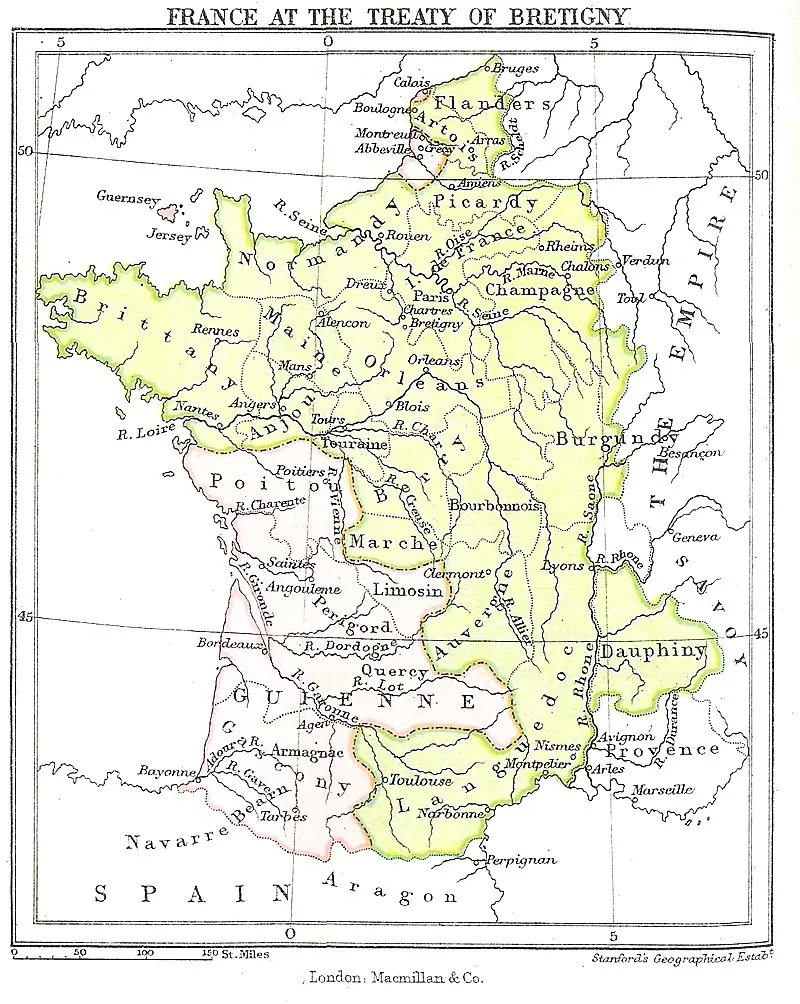
This significant treaty granted Edward III extensive territories, including Guyenne, Gascony, Poitou, Saintonge, Aunis, Agenais, Périgord, Limousin, Quercy, Bigorre, the countship of Gauré, Angoumois, Rouergue, Montreuil-sur-Mer, Ponthieu, Calais, Sangatte, Ham, and the countship of Guînes. These lands were to be held without the need for homage. Furthermore, it stipulated that all islands held by the king of England would no longer be subject to the suzerainty of the king of France. The title “Duke of Aquitaine” was replaced with “Lord of Aquitaine.”
In return, the king of England renounced all claims to the French throne. The terms of the Treaty of Brétigny aimed to unravel the feudal obligations that had fueled conflict and, from the English perspective, consolidate their territories into an expanded version of Aquitaine. Additionally, England restored the rights of the bishop of Coutances to Alderney, which had been stripped from them by the English king in 1228.
John II agreed to pay a substantial ransom of three million écus, with his release contingent upon the payment of one million. This event marked the first issuance of the franc, equivalent to one livre tournois (twenty sous). To guarantee the payment of his ransom, John provided hostages, including two of his sons—Dukes Louis I of Anjou and John of Berry—several princes and nobles, four residents of Paris, and two citizens from each of the nineteen principal towns in France.
Breakdown
While the hostages were detained, John made his way back to France in an attempt to gather the necessary funds for his ransom. In 1362, a pivotal turn of events occurred when John’s son, Louis of Anjou, who was held as a hostage in English-controlled Calais, managed to escape captivity. Consequently, with his substitute hostage gone, John felt morally obligated to return to captivity in England. Tragically, he passed away while still in captivity in 1364, and he was succeeded by his son, Charles V.
In 1369, citing the pretext that Edward III had failed to uphold the terms of the treaty, the King of France once again declared war. By the time of the Black Prince’s death in 1376 and Edward III’s passing in 1377, English forces had been pushed back to their territories in the southwest, primarily centered around Bordeaux.
Inheritance
The treaty did not bring about a lasting peace but rather provided a temporary hiatus of nine years in the Hundred Years’ War. During the subsequent years, French forces found themselves engaged in conflicts against the Anglo-Navarrese, exemplified by Bertrand du Guesclin’s triumph at Cocherel on May 16, 1364, as well as facing off against the Bretons in battle.