Table of Contents
Lycorma meliae
Lycorma meliae, a unique planthopper species exclusive to Taiwan, exhibits striking variations in coloration throughout its various life stages. It was initially documented by Masayo Kato in Taiwan back in 1929 and stands as the sole confirmed member of its genus native to the island. Interestingly, in 1929, a specimen of L. meliae was originally identified as a distinct species, L. olivacea, also attributed to Kato. It wasn’t until 2023 that these two classifications were officially recognized as synonymous. L. meliae undergoes four developmental stages (instars) before reaching adulthood, typically surviving until the onset of winter. It belongs to the genus Lycorma, situated in the planthopper family Fulgoridae, specifically within the subfamily Aphaeninae. These Lycorma species are primarily distributed in various regions of Asia.
Scientific Classification
Domain
Kingdom
Phylum
Class
Order
Suborder
Infraorder
Family
Genus
Species
Eukaryota
Animalia
Arthropoda
Insecta
Hemiptera
Auchenorrhyncha
Fulgoromorpha
Fulgoridae
Lycorma
L. meliae
Classification
Lycorma meliae, belonging to the genus Lycorma and the planthopper family Fulgoridae, falls under the subfamily Aphaeninae. This genus is primarily distributed throughout Asia. Both L. meliae and its synonym, L. olivacea, were first described by Masayo Kato in Taiwan in 1929. Although they were initially considered as two distinct species, a 2023 report published in the Zoological Studies journal established that L. meliae and L. olivacea actually represent different life stages of the same species. In this reclassification, L. olivacea was formally designated as a junior synonym.
Binomial name
Lycorma meliae Kato, 1929
Synonyms
Lycorma olivacea Kato, 1929
Description
In terms of size, male specimens of L. meliae typically have body lengths ranging from 22.2 millimeters (0.87 inches) to 28.5 millimeters (1.12 inches). In contrast, female specimens are generally larger, with body lengths varying between 26.5 millimeters (1.04 inches) and 32.2 millimeters (1.27 inches). The length of the tegmen, or wing cover, in males ranges from 18.9 millimeters (0.74 inches) to 25 millimeters (0.98 inches), while in females, it spans from 23.2 millimeters (0.91 inches) to 27.8 millimeters (1.09 inches).
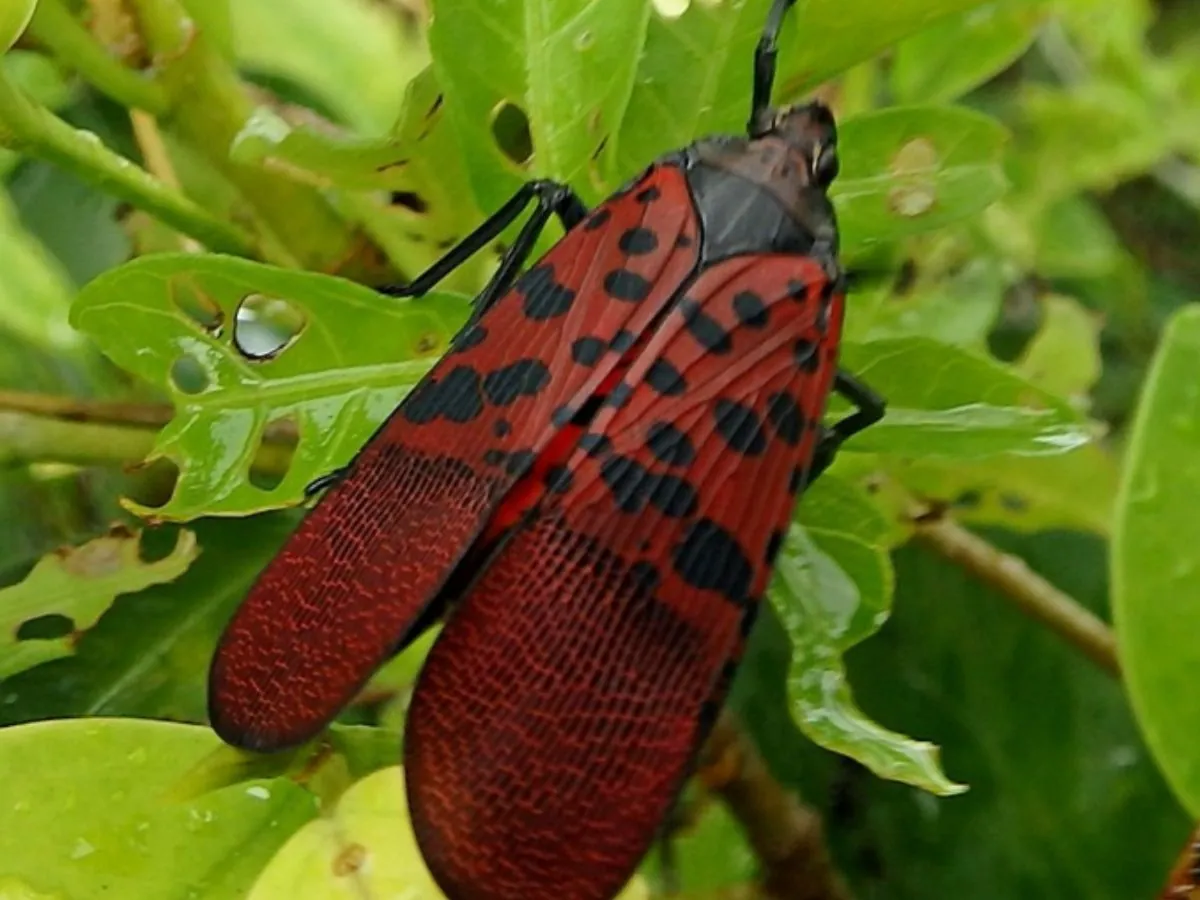
The head of the L. meliae is characterized by its short, broad shape that inclines upward, displaying colors that vary from brown to black. The rear of the head exhibits two dark brown segments, each featuring a ridge running along its back. Longitudinal ridges are also noticeable on the sides of these segments. The clypeus is broad, and the labium, a component of the mouth, is elongated but doesn’t reach the abdomen. The antennae of the species are a marigold orange-yellow hue. Moving down to the thorax, the pronotum can range from brown to black and is adorned with a series of small dark spots. Both the prothorax and mesothorax are black. The basal 3/5ths of the tegmen transitions from a bright red to blue and is covered in varying-sized black and brown spots, sometimes with a white powdery appearance. The remaining portion of the tegmen features a vein pattern. The hindwings of L. meliae exhibit colors ranging from pink to light blue, often with brown spots and a visible vein pattern. The upper third of the hindwings appears brown. The legs of the species are generally dark brown to black. During their development, the wings of L. meliae undergo a series of color changes, beginning with a bright red and transitioning through reddish brown, brown, deep green, ultimately ending at dark blue. The abdomen is black, and the laterosternites, part of the sternum, and the margins of the tergites can sometimes exhibit a marigold orange-yellow coloration.
The male genitalia of L. meliae occupy the 9th, 10th, and 11th abdominal segments. On the 9th segment, the anterior margin is concave, and the margins feature a series of small projections. The 10th segment is moderately convex, with the apical section broader than the basal section, creating a V shape when viewed from the side and a U shape from the top. The 11th segment consists of a sternite that is approximately twice the size of the tergite and is oval-shaped with hooks on the lateral margins. During mating, the lobes can expand to five times their sheathed length, folding backward and downward.
Although L. meliae shares a visual resemblance with Lycorma delicatula and has historically been mistaken for it, they can be distinguished based on differences in their eye structures.
Life Cycle And Ecology
Lycorma meliae follows a hemimetabolous development, which means that with each molt, the next stage (instar) becomes progressively more similar to the adult form. Unlike holometabolous insects, L. meliae does not go through a pupal stage in its life cycle. During the late fall to early winter seasons, L. meliae lays its eggs in clusters that are enveloped in a waxy cuticle. These eggs then undergo development until late spring, at which point L. meliae nymphs emerge. In total, L. meliae experiences four instar stages before reaching adulthood.
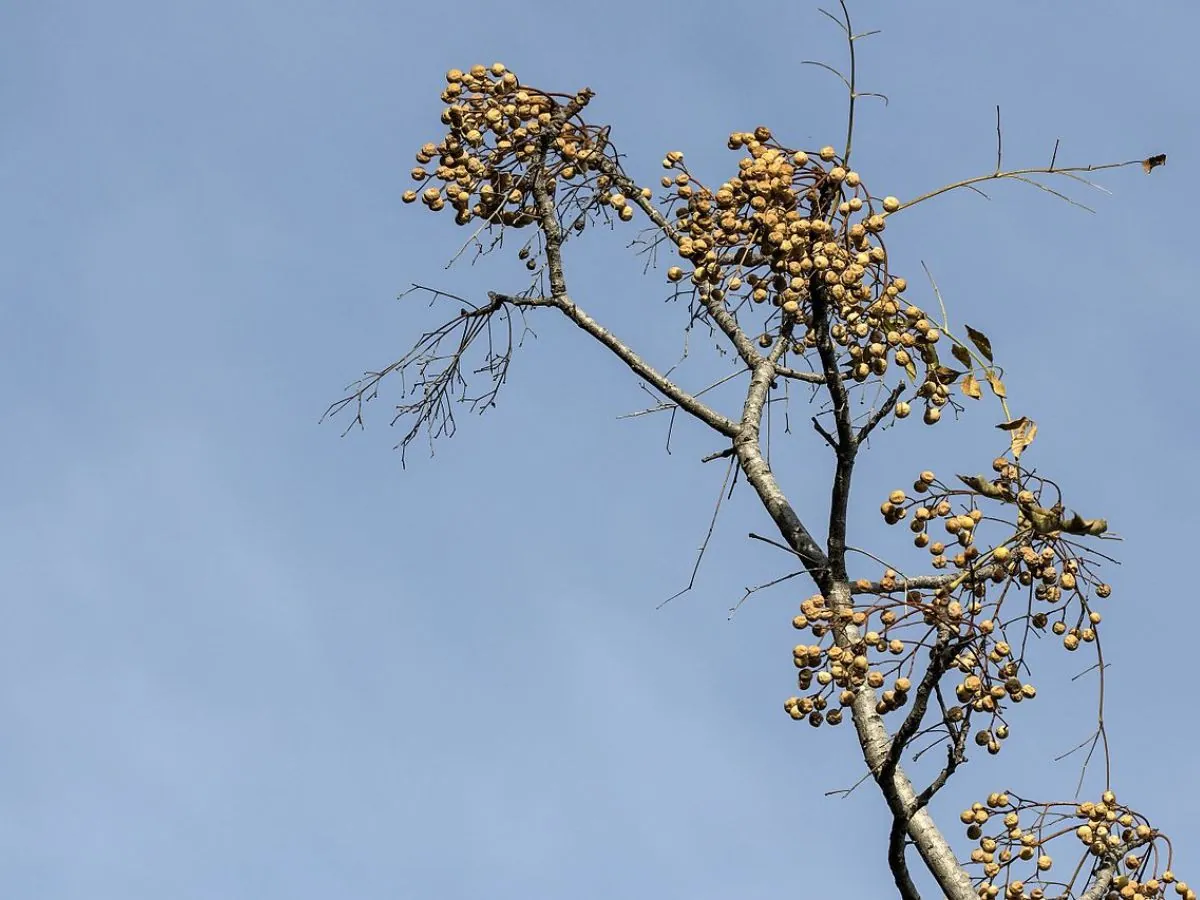
The chinaberry tree, scientifically known as Melia azedarach, serves as a recognized host for L. meliae. Additionally, Lycorma meliae, along with other members of the Lycorma genus, can be parasitized by the eupelmid wasp Anastatus orientalis and the dryinid wasp Dryinus sinicus.
Distribution and evolution
Lycorma meliae is exclusively found on the island of Taiwan. The following cladogram depicts the phylogenetic placement of L. meliae within a chosen group of the Aphaenini tribe. This classification is established by comparing mitochondrial DNA.