

Table of Contents
Battle of Tanga (WWI 1914)
The Battle of Tanga, often called the “Battle of the Bees,” was a notable yet lesser-known clash during World War I. It occurred from November 2 to 5, 1914, in Tanga, German East Africa (now Tanzania). This conflict between British and German colonial forces is remembered for strategic mistakes, unexpected outcomes, and nature’s surprising role.
The battle was the first major conflict in German East Africa during World War I. An amphibious British landing at Tanga ended disastrously, failing to secure the harbor and thwarting hopes for a quick occupation of the German colony.
Initially, British commanders in London planned for an expeditionary force to travel through the Suez Canal and land at Tanga to deny Germany an important port. However, when Germany’s Ottoman allies intensified their campaign in the Middle East, British troops were redirected to Egypt, leaving colonial troops to attack German East Africa. The mission expanded from capturing the port to conquering all of Germany’s East African territories, making the plan overly ambitious.
Major General Arthur Aitken led the operation with Indian Expeditionary Force B, consisting of about 8,000 soldiers, including an infantry brigade, two artillery batteries, and a machine-gun company from the Indian Army. Unfortunately, many of these men were poorly trained. Intelligence about local German forces, which included only about 1,000 African soldiers and their German officers, was scant. Aitken ignored advice from those with local knowledge, and surprise was lost when a local truce led to a British naval officer inadvertently alerting the Germans about the attack. This allowed the German commander, Lieutenant Colonel Paul von Lettow-Vorbeck, to strengthen his small Schutztruppe force at Tanga.
Tanga, German East Africa
| Battle of Tanga | |
| World War I 1914 | |
| Date | 3–5 November 1914 |
| Location | Tanga, German East Africa |
| Result | German Victory |
| Casualties and Losses | |
| Germans killed | 16 |
| British Empire killed | 360 |
| Askaris killed | 55 |
| Wounded British Empire | 487 |
| Germans & Askaris wounded | 76 |
| Missing British Empire | 148 |
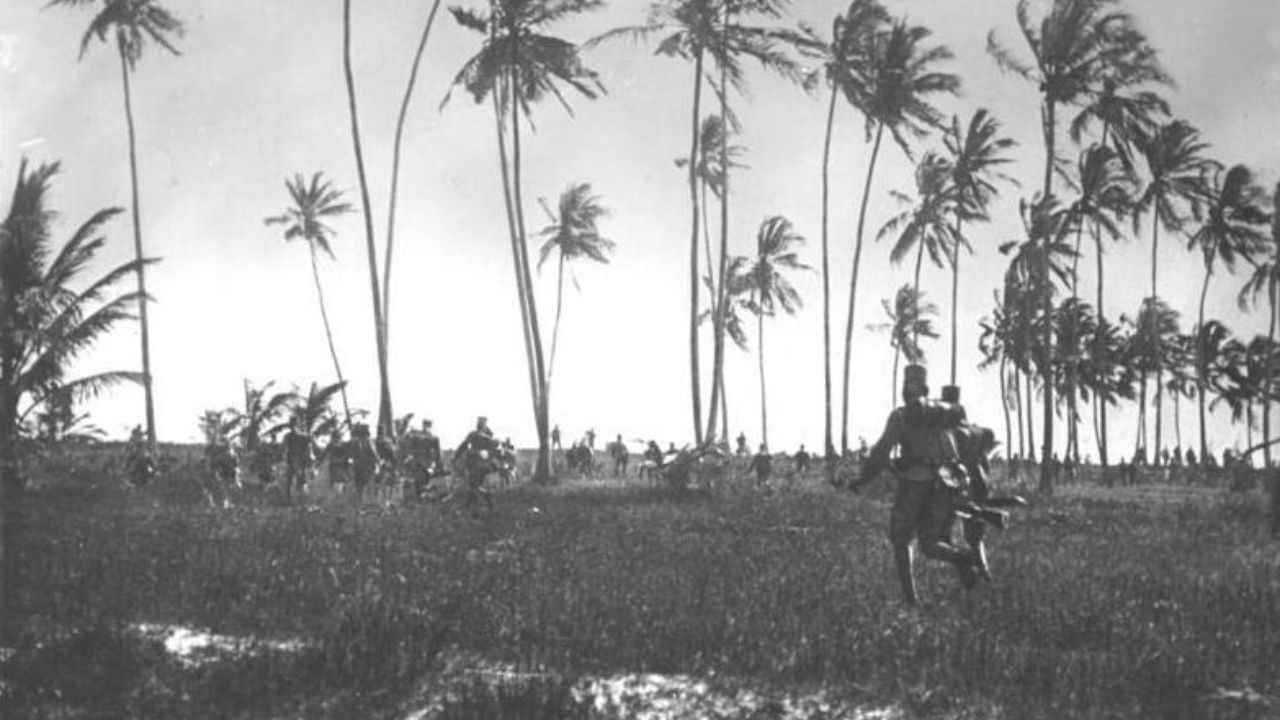
Aitken’s landing on November 2 was immediately met with German machine gun fire. On November 4, he launched a large-scale assault. Indian troops faced intense rifle and machine gun fire, suffering heavy casualties. The battle’s chaos was exacerbated by agitated bees, which caused both sides to temporarily cease fire as they fled from the stinging insects. This bizarre incident earned the battle its “Battle of the Bees” nickname. Lettow-Vorbeck then counterattacked, causing panic among Indian units and leading to the collapse of their assault. Artillery and naval gunfire support were never called upon, and with his force in disarray, Aitken ordered a retreat the next day. The withdrawal was chaotic, with troops abandoning equipment as they fled to the boats. The remaining troops regrouped in British East Africa, awaiting a German counterattack.
Following the battle, most Indian units, except for two Kashmiri battalions, were deemed unreliable. Aitken was relieved of his command, while Lettow-Vorbeck continued to lead one of the most successful guerrilla campaigns in history. Though a minor battle in the grand scope of World War I, the Battle of Tanga exposed significant flaws in British planning and operations that would resurface at Gallipoli the following year.
The Battle Unfolds
The battle began in earnest on November 3, with the British launching a direct assault on Tanga. However, the German defenders, well-prepared and familiar with the terrain, repelled the initial attacks. The British advance was further hampered by thick vegetation and unfamiliar tropical conditions.
The German Counterattack
Capitalizing on the British confusion, von Lettow-Vorbeck launched a counterattack. His well-coordinated and disciplined forces exploited the weaknesses in the British lines, pushing them back and inflicting significant casualties. The British were forced into a disorganized retreat, suffering heavy losses in both men and equipment.
Aftermath and Significance
The Battle of Tanga was a humiliating defeat for the British. They lost nearly 800 men, while German casualties were minimal. The failure at Tanga had far-reaching consequences, boosting German morale and solidifying von Lettow-Vorbeck’s reputation as a brilliant tactician. The British were forced to reconsider their strategy in East Africa, leading to a prolonged and grueling campaign.
Statistics
Forces Involved
| Side | Commander | Troops Deployed | Units/Regiments |
| British | Major General Arthur Aitken | Approximately 8,000 | Indian Expeditionary Force B |
| German | Lieutenant Colonel Paul von Lettow-Vorbeck | Approximately 1,100 | Schutztruppe and Askari soldiers |
Casualties and Losses
| Side | Killed | Wounded | Captured/Missing | Total Casualties |
| British | ~360 | ~487 | ~150 | ~997 |
| German | 16 | 55 | 0 | 71 |
Equipment and Supplies
| Category | British | German |
| Rifles and Small Arms | ~8,000 | ~1,100 |
| Machine Guns | 16 | 12 |
| Artillery Pieces | 8 | 4 |
| Supply Ships | 10 | 0 |
Strategic and Tactical Overview
| Aspect | British | German |
| Objective | Capture Tanga and cut off German supply lines | Defend Tanga and maintain control of the port |
| Key Strengths | Numerical superiority | Superior local knowledge and preparedness |
| Key Weaknesses | Poor coordination, logistical issues, unfamiliar terrain | Outnumbered, limited resources |
| Unique Elements | Attacked by swarms of bees | Effective use of terrain and defensive tactics |
Timeline of the Battle
| Date | Event |
| November 2, 1914 | British forces begin landing near Tanga |
| November 3, 1914 | Initial British assault repelled by German defenders |
| November 4, 1914 | Intense fighting; bees cause chaos among troops |
| November 5, 1914 | German counterattack forces British retreat |


